


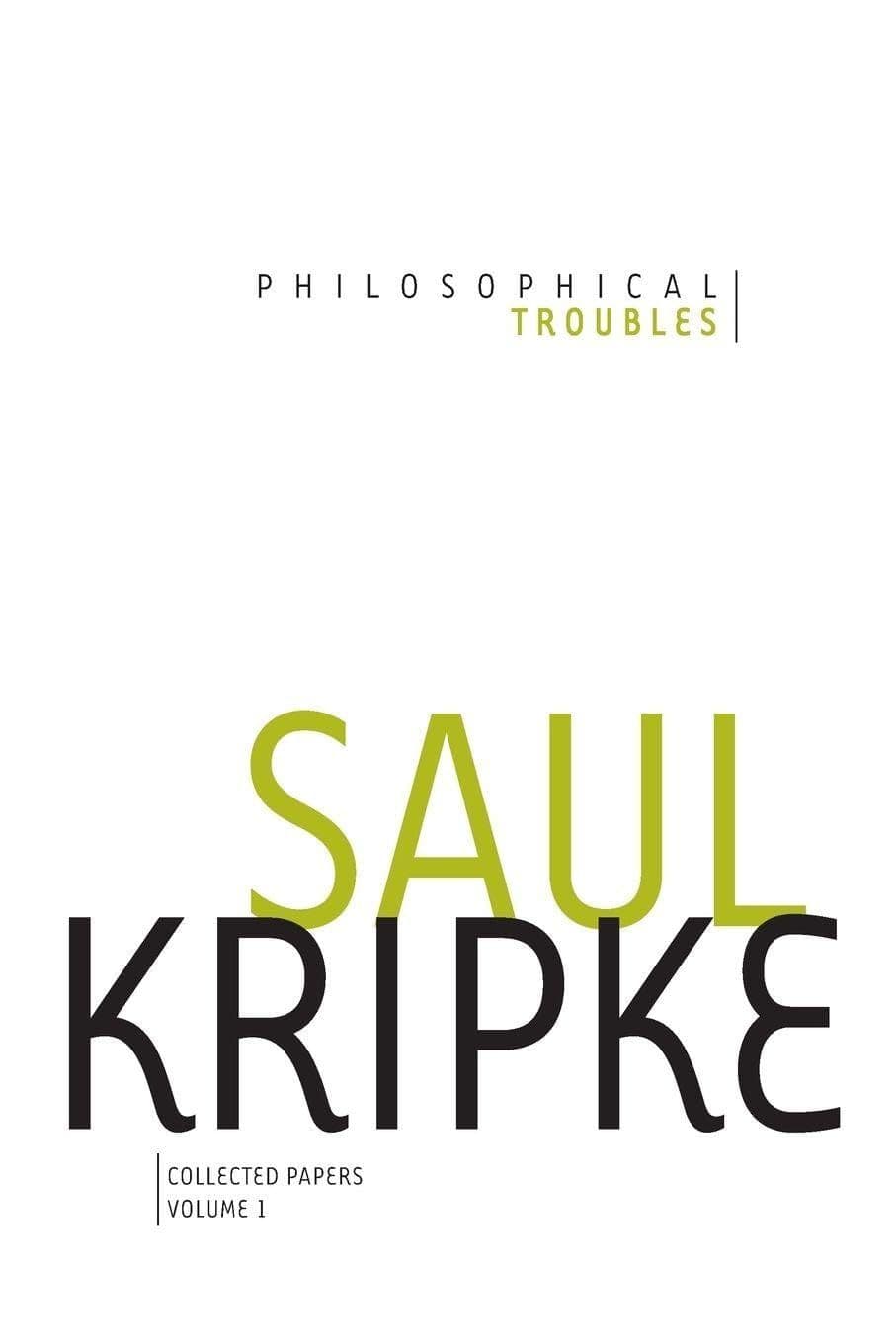
Philosophical Troubles: Collected Papers, Volume 1

This first volume of Kripke's collected papers gathers classic essays—'Identity and Necessity,' 'A Puzzle About Belief,' 'Speaker's Reference and Semantic Reference'—alongside previously unpublished work. Its unifying thread is Kripke's method of isolating a stubborn philosophical puzzle and following it wherever it leads, often overturning received distinctions without constructing a grand theory. The collection ranges across modality, belief ascription, truth, and fictional reference, displaying the argumentative tenacity that reshaped analytic philosophy without a systematic doctrine.
Key Insights
✦What holds this collection together, given its range across epistemology, language, and metaphysics?
The unifying element is methodological rather than doctrinal. Kripke does not advance a single system across these essays; instead, each paper isolates a specific puzzle—identity across possible worlds, belief ascription under substitutivity failure, the semantic paradoxes—and follows its implications wherever they lead. In his introduction, Kripke admits he followed 'several different and perhaps even conflicting criteria' in selecting the papers, deliberately excluding his technical modal logic work in favor of philosophically oriented pieces . What emerges from the collection is a style of philosophy that proceeds by counterexample and distinction rather than by constructing a comprehensive theory, a point reviewers have noted as distinctively Kripkean .
✦Which essays in this volume were previously unpublished, and what do they add to Kripke's corpus?
Six of the thirteen essays appear here for the first time. These include older works such as 'On Two Paradoxes of Knowledge,' 'Vacuous Names and Fictional Entities,' and 'Nozick on Knowledge,' as well as more recent pieces like 'The First Person' and 'Unrestricted Exportation and Some Morals for the Philosophy of Language' . 'A Puzzle about Time and Thought' was written expressly for this volume, though Kripke notes he first conceived the paradox decades earlier . The unpublished material is significant because it fills gaps in the public record of Kripke's views—particularly on fictional names and de re belief—that had circulated informally for years before appearing in print.
✦How does 'A Puzzle About Belief' relate to Kripke's earlier work on naming and necessity?
'A Puzzle About Belief' applies the framework of rigid designation to belief ascription and produces a result that unsettles both descriptivist and Millian accounts of names. Kripke constructs cases—most famously the Pierre puzzle, where a monolingual Frenchman who learns English forms contradictory beliefs about London without any logical inconsistency—to show that our ordinary practices of belief attribution generate paradoxes that no theory of reference has cleanly resolved . The essay extends the critique of descriptivism from Naming and Necessity into the doxastic sphere, but it does so without offering a positive solution. Kripke presents the puzzle as a genuine trouble for philosophy, not as a problem awaiting his own theory.
✦What is the significance of 'Unrestricted Exportation and Some Morals for the Philosophy of Language'?
This previously unpublished essay mounts a sustained attack on the view that de re belief can be reduced to de dicto belief via an exportation principle. Kripke argues that any such bridge principle—formulated as the thesis that S believes x is G if and only if, for some description F uniquely satisfied by x, S believes the F is G—produces absurd results, including attributing to Hoover beliefs he plainly did not hold . The essay's moral is that de re belief, like de re necessity, must be allowed to stand on its own without reduction to a more fundamental form. This extends the anti-reductionist stance of Naming and Necessity into the philosophy of mind and language.
✦How did reviewers assess the collection, and what criticisms were raised?
Reviewers generally praised the volume as a major event in analytic philosophy and noted the characteristic brilliance of Kripke's argumentative style—'an apparent effortless ease of exposition with a ferocious tenacity' . Graeme Forbes, reviewing the book, engaged at length with 'Nozick on Knowledge,' noting that Kripke's counterexamples to Nozick's truth-tracking account of knowledge turn on cases involving zebras and painted donkeys, and that Kripke shows Nozick's conditions fail for disjunctive beliefs and sceptical hypotheses . The main criticism was structural rather than substantive: the collection lacks a single organizing thesis, and the inclusion of previously unpublished material of varying dates makes it a supplement to Kripke's corpus rather than a standalone statement.
✦What common misreading of this collection should readers avoid?
A common misreading treats Philosophical Troubles as a sequel to Naming and Necessity or as a systematic development of its themes. The collection is neither. It is a gathering of essays written across four decades for different occasions and audiences, and Kripke explicitly disclaims a single selection criterion . The essays on truth ('Outline of a Theory of Truth'), on knowledge (the Nozick critique and the paradoxes of knowledge), and on Frege and Russell are not applications of the rigid designation framework but independent investigations. Readers seeking a unified Kripkean doctrine will be disappointed; readers interested in how a singular philosophical mind approaches disparate problems will find the volume indispensable.
Wealthy Psyche is an intellectual archive. We do not host, distribute, or sell book copies — physical or digital. We provide structured knowledge to help you think better, faster.