


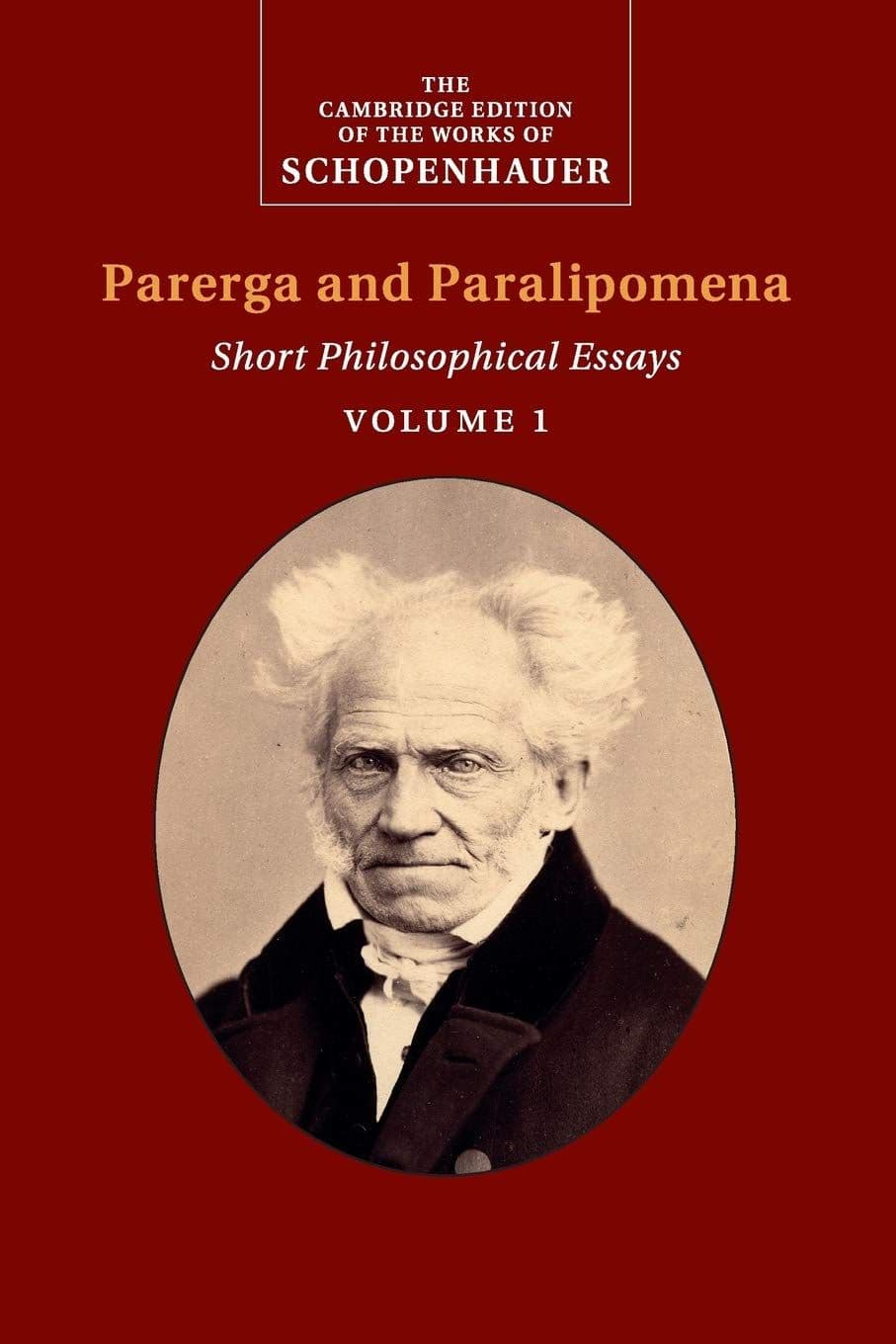
Parerga and Paralipomena: Short Philosophical Essays
Schopenhauer's final major work is not a systematic treatise but a curated collection of essays and aphorisms that translates his core metaphysics into a portable art of living. Its central contribution is the essay 'On the Suffering of the World' and the 'Aphorisms on the Wisdom of Life,' which reframe the Will's metaphysical restlessness as a practical problem of minimizing pain through intellectual detachment and aesthetic contemplation. The volume also showcases Schopenhauer's polemical prose on writing, religion, and women—material that secured his late fame while remaining philosophically subordinate to The World as Will and Representation.
Key Insights
✦What does Parerga and Paralipomena add to Schopenhauer's philosophical system?
It does not introduce a new metaphysical principle. Instead, it applies the doctrine of the Will—the blind, insatiable striving identified in The World as Will and Representation—to concrete domains: conduct, aesthetics, writing, religion, and the problem of suffering. The essay 'On the Suffering of the World' treats pain not as an anomaly but as the positive baseline of existence, from which pleasure is merely a temporary negation. The 'Aphorisms on the Wisdom of Life' then ask how an individual, knowing this, can arrange existence to minimize positive misery rather than pursue illusory satisfaction. The collection's unity is stylistic and applicative, not architectonic.
✦How did a collection of essays secure Schopenhauer's fame when his systematic masterpiece had not?
The World as Will and Representation, first published in 1818, had sold poorly for decades. Parerga and Paralipomena, published in 1851 by A. W. Hayn of Berlin after Schopenhauer's usual publisher declined it, found a wider readership precisely because it was fragmentary and accessible . Its essays on fame, women, noise, and style were quotable and polemical in a way the dense main work was not. Schopenhauer remarked that the book's success was 'the dawn of my fame,' and it transformed him in his final decade from an obscure malcontent into a recognized public philosopher in Germany.
✦What specific text within the collection is most often extracted and read independently?
'Aphorisms on the Wisdom of Life' (Aphorismen zur Lebensweisheit), from Volume One, is the most frequently excerpted portion, often published alone under titles like The Wisdom of Life. It is not a metaphysical treatise but a eudaimonological one: Schopenhauer explicitly says he is treating life from the standpoint of ordinary happiness, not the highest metaphysical insight, and that this standpoint is ultimately a compromise. The essay's structure—divided into what one is, what one has, and what one represents—offers a tripartite analysis of the sources of human satisfaction and their relative unreliability.
✦How does the essay 'On Women' relate to the rest of the collection and to Schopenhauer's reception?
'On Women' (Über die Weiber) is a short, venomous piece in Volume Two whose claims about women's intellectual and moral capacities are essentialist and openly contemptuous. It has damaged Schopenhauer's reputation in subsequent scholarship and is often cited as evidence of personal prejudice rather than philosophical argument. Within the collection it has no structural role; it sits alongside equally opinionated essays on noise, dueling, and universities. Contemporary readers typically treat it as a historical document of nineteenth-century misogyny and as a test case for whether Schopenhauer's metaphysics of Will can be separated from his empirical generalizations, which many scholars argue it cannot.
✦What are the textual and editorial complications of reading Parerga and Paralipomena in English?
Only one edition appeared during Schopenhauer's lifetime, in 1851, and subsequent German editions incorporated material from his manuscripts. The first complete English translation was by E. F. J. Payne, published by Clarendon Press in 1974, and it remained standard for decades. Cambridge University Press has since issued a new translation edited by Christopher Janaway and Adrian Del Caro, with scholarly notes on variants between editions . Readers using older or abridged editions may not realize that the arrangement and even the contents of the two volumes have been subject to editorial mediation, particularly regarding the Paralipomena's shorter fragments.
✦Did Nietzsche engage with Parerga and Paralipomena, and if so, how?
Nietzsche's relationship to Schopenhauer was intense but selective, and his engagement centered more on The World as Will and Representation and the essays on genius and the artist than on the collection as a whole. His third Untimely Meditation, 'Schopenhauer as Educator' (1874), treats Schopenhauer as a model of philosophical sincerity and cultural criticism rather than as a metaphysician to be followed. Later, in works like Human, All Too Human, Nietzsche explicitly breaks with Schopenhauer's metaphysical Will and his ascetic ideal. Parerga's practical essays on the solitary intellectual life nonetheless left a stylistic and temperamental mark on Nietzsche's own aphoristic mode.
✦What is the most common misreading of the 'Wisdom of Life' essay?
The common misreading treats the essay as a positive doctrine of how to achieve happiness, a kind of philosophical self-help. Schopenhauer's framework is the opposite: he argues that happiness is negative, that suffering is positive and constant, and that the best one can do is reduce pain through intellectual cultivation and the avoidance of entanglement. The 'wisdom' on offer is defensive and minimalist, not aspirational. Readers who extract maxims about solitude or intellectual life without the underlying pessimism mistake a strategy of damage limitation for a theory of flourishing.
Wealthy Psyche is an intellectual archive. We do not host, distribute, or sell book copies — physical or digital. We provide structured knowledge to help you think better, faster.