


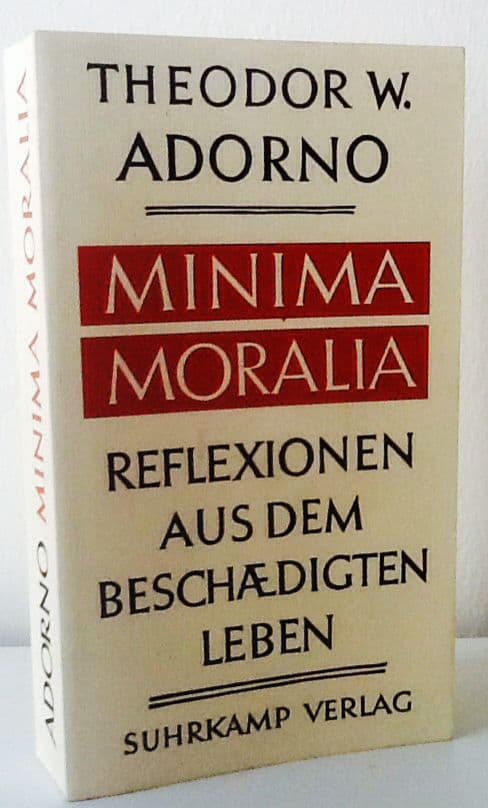
Minima Moralia: Reflections from Damaged Life (Minima Moralia: Reflexionen aus dem beschädigten Leben)
Written in exile between 1944 and 1947 and published in 1951, Adorno's collection of 153 aphorisms and short prose pieces practices a 'melancholy science' that examines the decay of private life under late capitalism. Its distinctive method is to treat the most ordinary objects and gestures—a door handle, a greeting, the impossibility of giving gifts—as symptoms of a damaged social totality. The work's central claim is that there can be no right life within the wrong one, and that the most intimate experiences are shaped by the same reification that governs the commodity form.
Key Insights
✦What is the central claim of Minima Moralia, and what does it reject?
The central claim is crystallized in Adorno's famous formulation that 'there is no right life within the wrong one': under conditions of late capitalism, individual existence is so thoroughly shaped by reification, exchange value, and domination that the project of living a good life cannot be pursued in isolation from the transformation of the social totality. The book rejects the possibility of private ethical cultivation that leaves the larger world untouched, as well as the Hegelian consolation that history is rational. It is written as a series of 153 aphorisms, a form Adorno chose because the broken, discontinuous essay can register the fragmentation of modern experience that systematic philosophy obscures.
✦What is the significance of the title Minima Moralia, and how does it relate to Aristotle's Magna Moralia?
The title inverts Aristotle's Magna Moralia ('Great Ethics'), offering instead 'Little Ethics' or 'Minimal Moralities.' The inversion is deliberate: in a damaged world, the great ethical systems of the past are no longer credible, and what remains are small, fragmentary reflections on the most ordinary aspects of life. Adorno writes that the melancholy science he practices is 'a teaching of the good life' but one that can no longer presume to know what the good life is. The title thus signals the book's diminished ambitions and its refusal of the classical claim to systematic completeness. It is ethics after the collapse of the conditions that made classical ethics possible.
✦What is the composition history of the book, and how does its form reflect its historical moment?
Adorno wrote the aphorisms between 1944 and 1947, during his exile in Los Angeles, and the book was published in 1951. The original plan was to dedicate the volume to Max Horkheimer on his fiftieth birthday, though the book was withdrawn and then published, according to the translator's note, without the dedication . The aphoristic form is not merely stylistic: Adorno described the book as a collection of 'reflections from damaged life,' and the fragmentary, discontinuous structure mirrors the brokenness of the world it describes. The exile context is crucial—the book's observations of American daily life are those of a European intellectual estranged from both his homeland and his new environment, registering alienation from both.
✦How did E. F. N. Jephcott's English translation shape the book's reception?
E. F. N. Jephcott's translation was first published by New Left Books in 1974 and has been reissued by Verso, becoming the standard English version . The book's fifty aphorisms and the text were translated by Jephcott, while the dedication was translated by Dennis Redmond. Jephcott, a distinguished translator of Adorno, also rendered the afterword and other materials, and his version has been praised for its fidelity to Adorno's prose . The English title preserves the Latin original, and the translation has made the book one of Adorno's most widely read works in the Anglophone world, thanks in part to its aphoristic form, which is more accessible than his systematic treatises .
✦How does the book relate to Adorno's critique of identity thinking and his later Negative Dialectics?
The essayistic method of Minima Moralia anticipates the negative dialectics of Adorno's later work. Each aphorism works by attending to the particular, the non-identical, in a way that resists subsumption under general concepts. The book's attention to the small, the overlooked, the damaged is a practical exercise in what Negative Dialectics would later theorize. The rejection of the system—the refusal to present a unified philosophical edifice—is also a refusal of identity thinking at the level of form. Adorno's later work would provide the theoretical justification for a practice that Minima Moralia already embodies.
✦What common misreading of Minima Moralia should readers avoid?
A common misreading treats the book as a collection of pessimistic aphorisms about personal life, a kind of world-weary wisdom literature. This misses the theoretical rigor and the critical intent behind each fragment. Adorno's observations are not mere laments but precise analyses of how social structures penetrate the most intimate recesses of experience. Another misreading assumes the book offers a positive ethical program, a set of rules for right living. It does not. The 'minima moralia' are not commandments but investigations of the impossibility of ethics under present conditions. The book's title warns against expecting a new ethics; it is a reflection on why ethics cannot yet be realized.
Wealthy Psyche is an intellectual archive. We do not host, distribute, or sell book copies — physical or digital. We provide structured knowledge to help you think better, faster.