


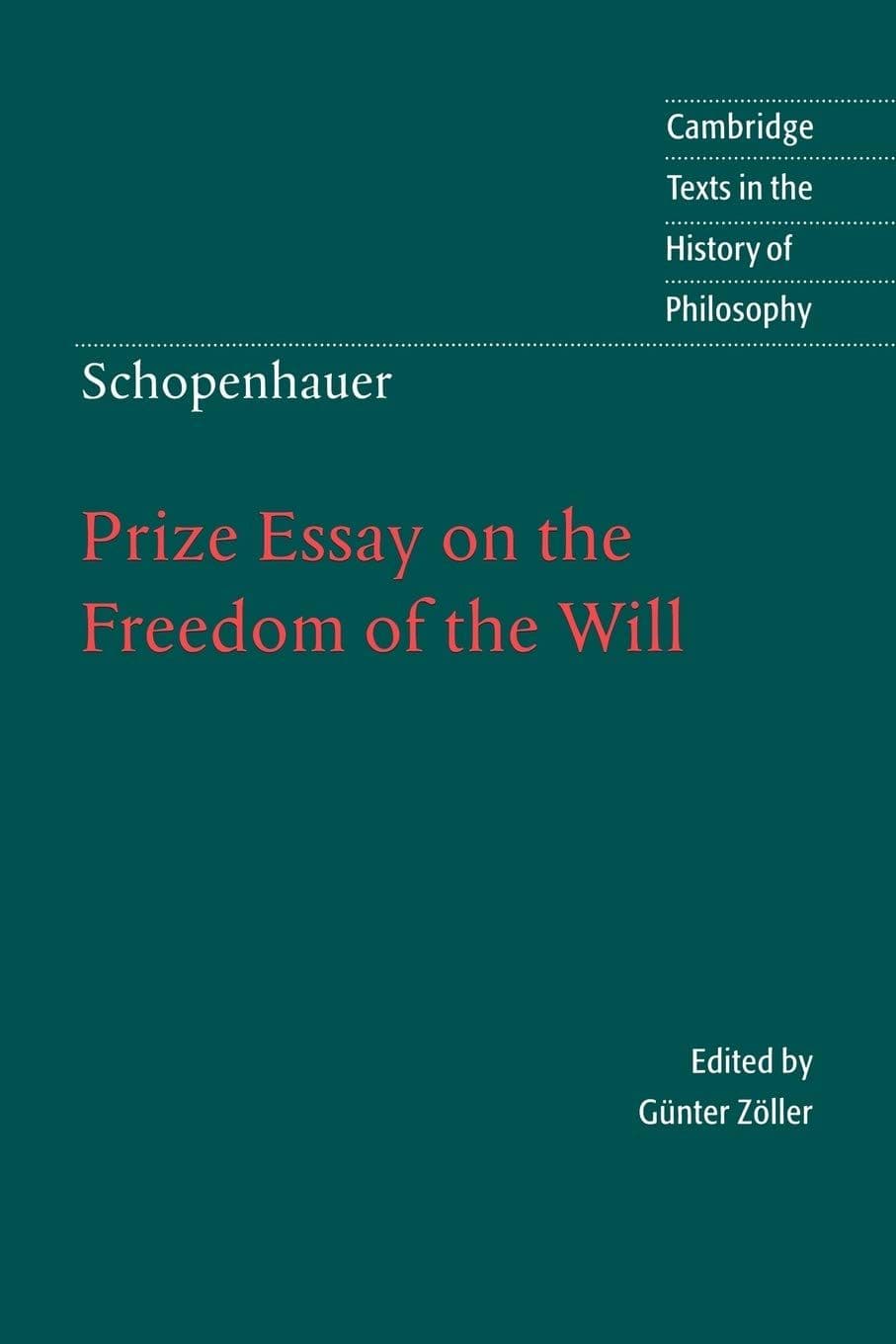
Essay on the Freedom of the Will
Schopenhauer's prize-winning essay argues that the question of free will must be answered negatively: human actions are thoroughly determined by motive and character, and the feeling of 'I could have done otherwise' is an illusion of self-consciousness. What appears as freedom is only the absence of external constraint. Yet Schopenhauer preserves a residual freedom at the intelligible level—the timeless character of the individual as will—which grounds moral responsibility without requiring libertarian choice. The essay's method is analytic, moving from self-consciousness to the empirical world to establish that necessity, not freedom, governs the phenomenal will.
Key Insights
✦What was the Royal Norwegian Society's question, and how did Schopenhauer answer it?
The Society asked whether human free will could be demonstrated from self-consciousness. Schopenhauer's answer was effectively negative: self-consciousness reveals only a feeling of freedom, which he identifies as the absence of external coercion, not a genuine capacity to will otherwise. When the will confronts motives, it acts with necessity. The essay therefore splits the question into two domains: the empirical will, which is determined, and the intelligible will, which is free but inaccessible to self-consciousness. The Society awarded the essay the prize, and it marked the beginning of Schopenhauer's public recognition after decades of neglect .
✦How does Schopenhauer's position differ from Kant's on the intelligible character?
Kant locates freedom in a noumenal rational agency that can legislate moral law independently of inclination. Schopenhauer retains the empirical/intelligible distinction but empties the intelligible character of rationality and causality. For him, the intelligible character is a timeless act of will that constitutes what an individual essentially is, and empirical actions merely unfold what was already decided at that atemporal level. Christopher Janaway has argued that this move makes the intelligible character potentially redundant to Schopenhauer's explanatory project, and that a more consistent position would have been to deny freedom to the individual altogether . Sandra Shapshay, by contrast, reads Schopenhauer as developing a mature compatibilism heavily indebted to Kant despite his protests .
✦What does Schopenhauer mean by 'liberum arbitrium indifferentiae,' and why does he reject it?
The term designates an absolutely indifferent faculty of choice—the capacity to will either A or B with no determining ground whatsoever. Schopenhauer treats this as the only genuine concept of free will and argues that it is incoherent. If the will were truly indifferent, no motive could incline it one way rather than another, and action would be impossible. He observes that even the feeling of 'I can do what I want' presupposes a definite want already in place. What remains after this rejection is a compatibilist picture: actions follow necessarily from character and motive, but the agent is not externally coerced. The essay's analytic rigor on this point is what earned it the prize .
✦How does this essay relate to Schopenhauer's larger system in The World as Will and Representation?
Schopenhauer himself described the prize essays on freedom and morality as supplements to the fourth book of his main work, treating analytically and a posteriori what the earlier book had derived synthetically and a priori. The essay on freedom does not introduce a new metaphysical principle but demonstrates that the empirical determinism implied by the Will's objectification is compatible with a form of intelligible freedom. In this sense it is an application of the system's architecture to a specific problem, and it presupposes the distinction between will as thing-in-itself and will as appearing under the forms of space, time, and causality.
✦Is the essay a work of hard determinism, or does it leave room for freedom?
It is neither straightforwardly one nor the other, which is why it remains contested. The empirical self is exhaustively determined, and Schopenhauer explicitly denies that any particular action could have been otherwise given the character and motive in play. Yet he insists that responsibility is not an illusion: the intelligible character is the agent's own timeless act, and the empirical agent 'is' that character without having chosen it in time. Critics such as Janaway have questioned whether this residual intelligible freedom does any real work or merely relabels necessity. Shapshay argues that Schopenhauer's mature view is a genuine compatibilism that permits self-shaping, even transformation, of character through rational reflection .
✦What is the textual and publication history of the essay in English?
The essay was written in 1839 for the Norwegian competition and first published in German in 1841 as part of Die beiden Grundprobleme der Ethik, alongside the essay on morality . The first standalone English translation of note was E. F. J. Payne's, published by Clarendon Press and later reissued by Cambridge University Press in 1999 with an introduction by Günter Zöller . Christopher Janaway's 2009 Cambridge translation reunited the two prize essays in a single volume for the first time in English, with revised terminology and extensive editorial apparatus . Readers should be aware that earlier English editions often presented the essay in isolation from its companion, obscuring the systematic relationship Schopenhauer intended between the two problems.
✦Why did the Danish Academy reject Schopenhauer's companion essay, and does that bear on the freedom essay?
Schopenhauer submitted the freedom essay to the Norwegian Society and the morality essay to the Danish Academy. The Danish Academy not only declined to award the prize but published a critique accusing him of misunderstanding the question; Schopenhauer reproduced and rebutted that critique in the published edition . The episode is relevant to the freedom essay because it illustrates his combative relationship with academic institutions and his insistence on the independence of his two problems. The Danish rejection did not concern the freedom essay directly, but it colored the reception of both essays when they appeared together in 1841, and Schopenhauer's polemical response is part of the published text's framing.
Wealthy Psyche is an intellectual archive. We do not host, distribute, or sell book copies — physical or digital. We provide structured knowledge to help you think better, faster.