


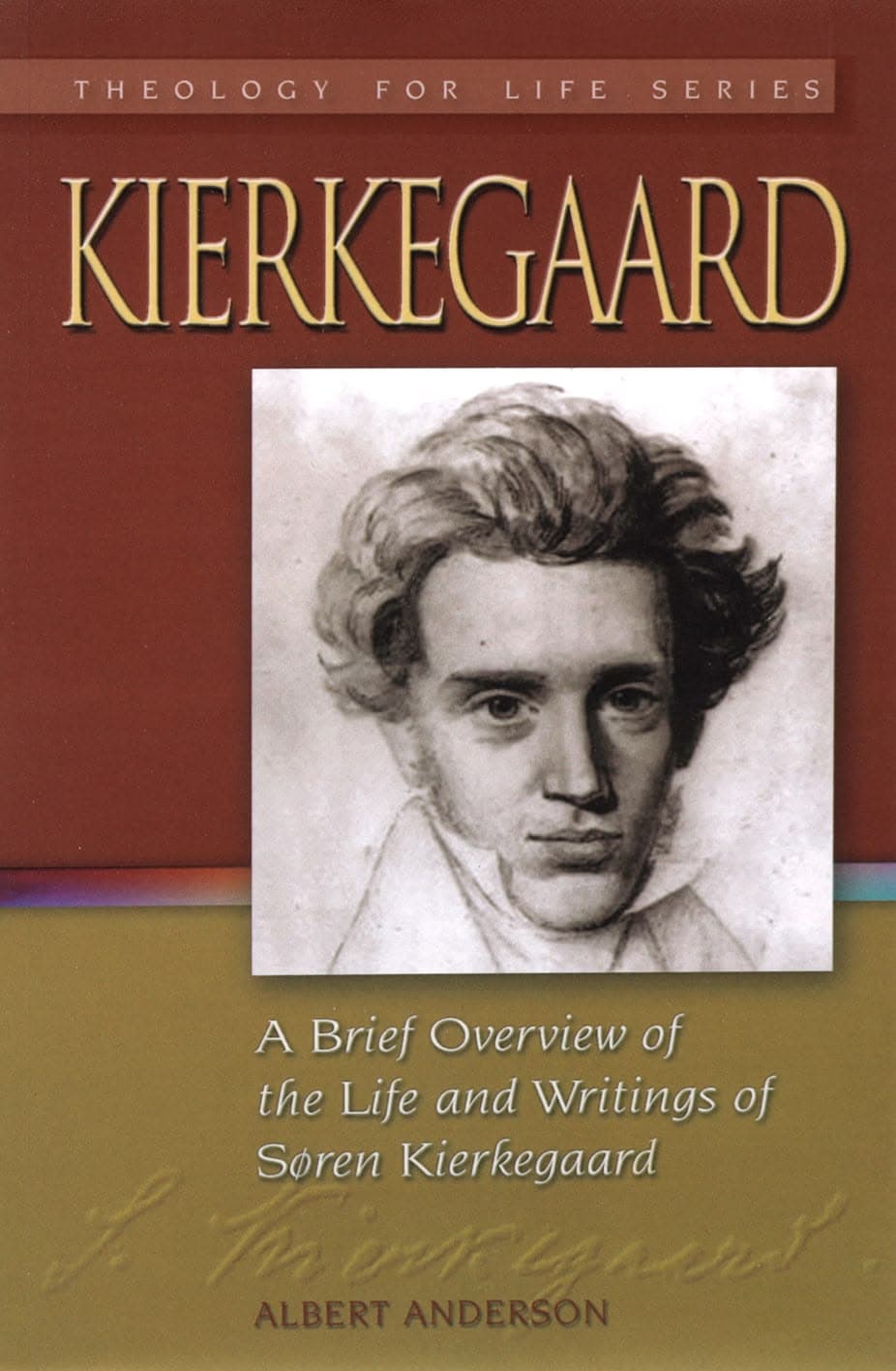
Kierkegaard: Construction of the Aesthetic (Kierkegaard: Konstruktion des Ästhetischen)

Adorno's Habilitationsschrift, published in 1933 and withdrawn from academic circulation after the Nazi seizure of power, reads Kierkegaard's aesthetic writings through the lens of his own philosophical project. Its distinctive thesis is that Kierkegaard's turn inward—the claim that truth is subjectivity—is not a solution to alienation but a symptom of it: the bourgeois individual's withdrawal from a reified world into an interiority that remains abstract because it cannot transform the conditions it flees. Adorno's method is immanent critique, entering Kierkegaard's texts to show how their own logic undermines their pretensions to inwardness.
Key Insights
✦What is the central argument of Adorno's Kierkegaard book, and what does it reject?
The central argument is that Kierkegaard's celebration of inwardness—the claim that truth is subjectivity—is not a genuine escape from alienation but a symptom of it. Adorno argues that the bourgeois individual's retreat into interiority leaves the external world untouched and the self abstract. The book rejects the existentialist reading of Kierkegaard as a heroic champion of authentic choice against the crowd. Instead, Adorno shows through immanent critique that Kierkegaard's texts undermine their own pretensions: the inwardness they celebrate is empty, the choice they demand is arbitrary, and the God they invoke is a projection of the isolated subject .
✦What is the significance of the book's subtitle, 'Construction of the Aesthetic'?
The subtitle signals that Adorno is not offering a comprehensive study of Kierkegaard's thought but a construction—a deliberate, selective reconstruction focused on the aesthetic writings. 'Construction' is a technical term in Adorno's vocabulary: it means arranging the material according to the demands of the argument rather than reproducing the author's own organization or intentions. The book concentrates on Either/Or, Fear and Trembling, and Stages on Life's Way, treating them as the privileged site where Kierkegaard's philosophy of inwardness is most fully articulated. This method anticipates Adorno's later practice of immanent critique, in which the critic enters a text's internal logic to expose its contradictions.
✦What was the book's fate in Nazi Germany, and how did that shape its reception?
Adorno published the book in 1933, the year the Nazis came to power, and his right to teach was soon revoked. The book was withdrawn from circulation and effectively disappeared for decades, a fate that contributed to its relative neglect compared to Adorno's later work. A review in the Journal of Religion noted that the book had been 'withdrawn from circulation after the Nazis came to power' and that its subject matter—Kierkegaard's inwardness—became suspect in an era that demanded political engagement . The English translation did not appear until 1989, long after Adorno's other major works, which means that its reception in the Anglophone world has been shaped by readers already familiar with his mature critical theory.
✦How does the book relate to Adorno's later critique of identity thinking in Negative Dialectics?
The Kierkegaard book contains in embryo the critique of identity thinking that Adorno would elaborate in Negative Dialectics. In Kierkegaard, Adorno finds a thinker who seeks truth in the isolated subject's relation to God—an identity that excludes the external world and the social conditions of existence. Adorno argues that this inwardness is a form of identity thinking, a reduction of the particular to the universal of the self, and that it therefore shares in the violence he would later attribute to conceptual subsumption. The book's method—showing how a philosophy's own logic betrays its intentions—is a precursor to the negative dialectical practice of Adorno's maturity.
✦How did Robert Hullot-Kentor's translation shape the book's Anglophone reception?
Robert Hullot-Kentor's translation was published by the University of Minnesota Press in 1989, fifty-six years after the German original . Hullot-Kentor was a distinguished translator of Adorno, having also translated Aesthetic Theory, and his version of the Kierkegaard book was praised for its fidelity to Adorno's dense prose and for its substantial introduction, which situates the work in Adorno's development. The translation made available a text that had been known to Anglophone readers only through secondary discussion, and it has been used in subsequent scholarship to reassess Adorno's early thought . Readers should be aware that the translation, while accurate, does not eliminate the difficulty of Adorno's early style.
✦What common misreading of the book should readers avoid?
A common misreading treats the book as an attack on Kierkegaard, a straightforward debunking of existentialist inwardness. Adorno's relation to Kierkegaard is more complex: he takes him seriously as a thinker who articulated a genuine problem—the alienation of modern life—even if he believes the solution is inadequate. Another misreading assumes the book is merely an early, immature work superseded by Adorno's later philosophy. It is a sophisticated example of immanent critique that anticipates the method of his mature work, and its analysis of the relationship between inwardness and social conditions remains a significant contribution to the reception of Kierkegaard.
Wealthy Psyche is an intellectual archive. We do not host, distribute, or sell book copies — physical or digital. We provide structured knowledge to help you think better, faster.