


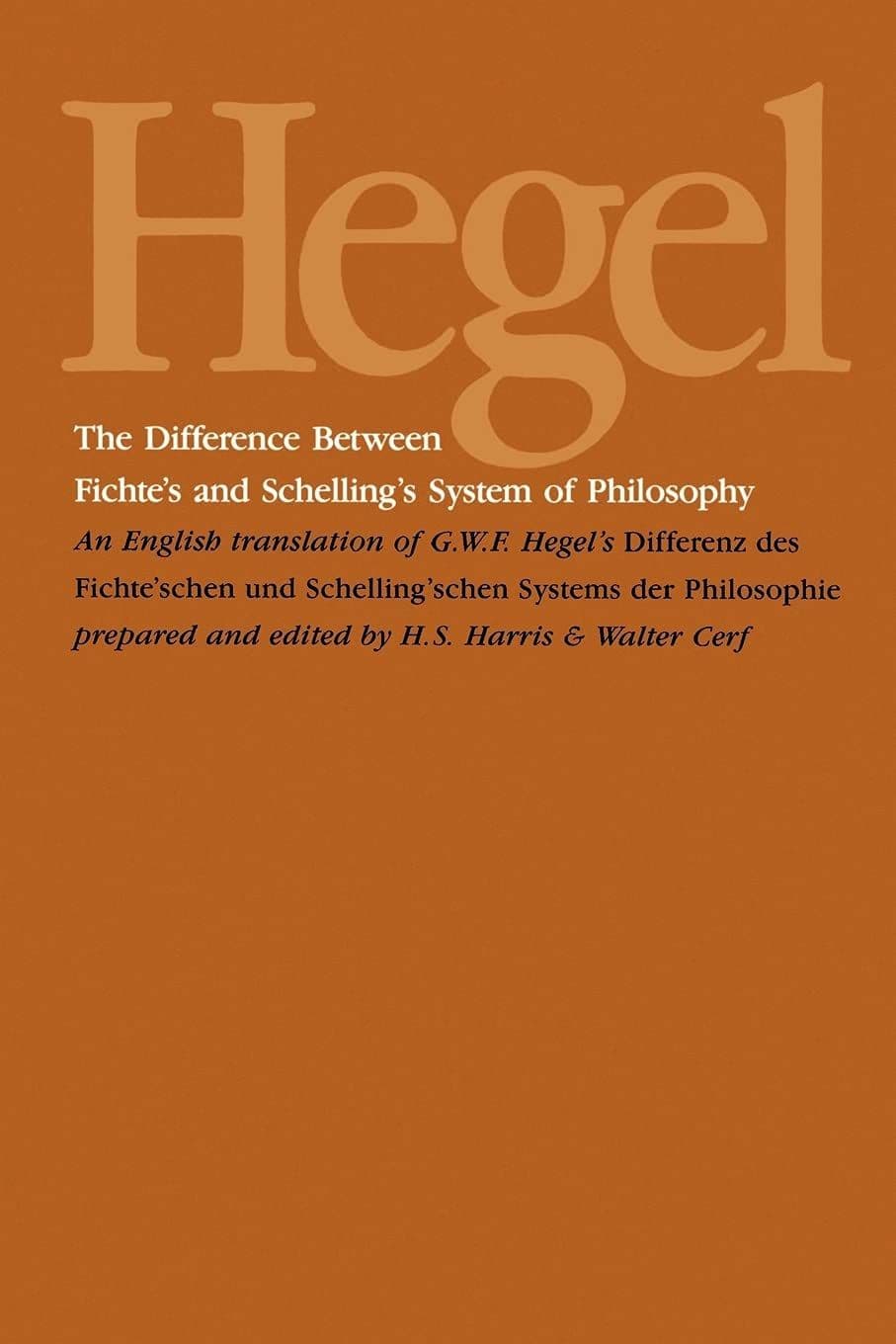
The Difference Between Fichte's and Schelling's System of Philosophy (Differenz des Fichteschen und Schellingschen Systems der Philosophie)

Hegel's first published book, written in Jena in 1801, argues that Schelling's objective idealism corrects Fichte's subjective idealism by positing an absolute identity of subject and object that neither term can exhaust. The work's distinctive mechanism is its critique of 'reflection'—the understanding that remains trapped in rigid oppositions—and its call for 'speculation' as the higher cognition that grasps unity in difference. Hegel uses this distinction to position Schelling's system as the consummation of Kantian philosophy and his own emerging project as its continuation.
Key Insights
✦What is the central argument of Hegel's Difference essay, and what does it reject?
The central argument is that Schelling's philosophy of absolute identity constitutes a genuine advance over Fichte's subjective idealism. Hegel contends that Fichte's system remains trapped in the standpoint of reflection, where the ego is opposed to a non-ego and the absolute is conceived only as a subjective postulate. Schelling's insight—that subject and object are identical in the absolute—overcomes this opposition, though Hegel insists the identity must be grasped as an identity of identity and non-identity, not as a featureless indifference. The essay rejects the reflective understanding's tendency to fix oppositions as ultimate, calling instead for speculative cognition that grasps unity in difference.
✦Why is the essay's title misleading, and what did Hegel actually intend?
The English title 'The Difference Between Fichte's and Schelling's System' suggests Hegel is announcing a breach or rupture between the two thinkers. Susan-Judith Hoffmann has argued that this translation has misled Anglophone readers: Hegel's German term Differenz does not mean a simple 'difference' or opposition but rather 'system-differentiation,' the process by which new philosophical forms emerge organically from older ones . Hegel's intention was not to sever Schelling from Fichte but to show how Schelling's system represents a necessary advance from Fichte's within the teleological development of philosophy. The essay is thus less a polemic against Fichte than a philosophical genealogy of post-Kantian idealism .
✦How did the essay's publication context shape its reception and Hegel's career?
Hegel published the Differenzschrift in 1801, the same year he arrived at the University of Jena as a Privatdozent and submitted his inaugural dissertation. The work appeared through the Akademische Buchhandlung in Jena and coincided with the founding of the Kritische Journal der Philosophie, which Hegel and Schelling edited together . The essay established Hegel as a significant philosophical voice and marked him publicly as a follower of Schelling. This association would later become a liability: when Hegel's own system diverged from Schelling's, the earlier identification became a source of friction between the two former allies. The essay thus occupies a peculiar position as both Hegel's debut and a document of a philosophical alliance that would not last.
✦What is the significance of the essay's critique of 'reflection' for Hegel's later philosophy?
The critique of reflection is the essay's most enduring contribution to Hegel's development. Hegel argues that reflective understanding—the mode of thought that fixes oppositions between subject and object, finite and infinite, reason and sensibility—is incapable of grasping the absolute because it treats these oppositions as ultimate rather than as moments within a higher unity. This critique, first formulated in the Differenzschrift, becomes a structural principle of Hegel's mature system: the Phenomenology of Spirit traces consciousness's progressive overcoming of reflective standpoints, and the Science of Logic develops the categories through which thought moves beyond the understanding's rigid distinctions. The essay thus contains in embryo the dialectical method that Hegel would elaborate over the following decades .
✦How faithful is the Harris and Cerf English translation to Hegel's original, and what editorial choices did it make?
H. S. Harris and Walter Cerf's translation, published by SUNY Press in 1977, was the first complete English edition of the Differenzschrift and remains the standard access point for Anglophone readers . The translation includes a substantial introduction by the translators that situates the essay in the context of post-Kantian philosophy. However, the decision to render Differenz as 'difference' in the title has been criticized for obscuring Hegel's technical meaning, as Hoffmann argues . Harris and Cerf's version is generally reliable for philosophical content, though readers should consult the German text for the essay's dense terminological distinctions. The SUNY edition has been reprinted multiple times, including a 1988 paperback, and remains in print .
✦What common misreading of the essay should readers avoid?
A persistent misreading treats the Differenzschrift as a mere apprentice work, valuable only as a preview of Hegel's mature system, or as a straightforward polemic against Fichte written from a position of Schellingian orthodoxy. Both readings underestimate the essay's independence. Hegel is not simply reproducing Schelling's views; he is already developing his own distinctive conception of speculation and his own critique of reflection, which will diverge from Schelling's in important respects. The essay is also not primarily an attack on Fichte. Hegel acknowledges Fichte's advance over Kant and treats his system as a necessary moment in philosophy's development. The misreading that sees the essay as a partisan tract misses the teleological framework that Hegel is already constructing .
Wealthy Psyche is an intellectual archive. We do not host, distribute, or sell book copies — physical or digital. We provide structured knowledge to help you think better, faster.