


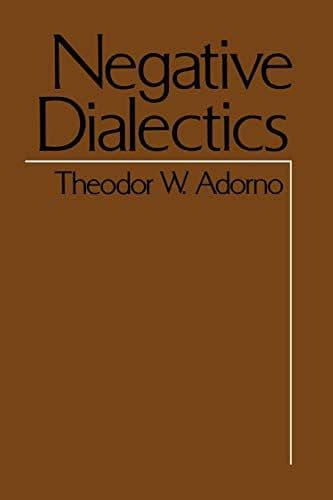
Negative Dialectics (Negative Dialektik)
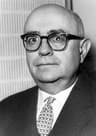
Adorno's Negative Dialectics argues that identity thinking—the conceptual subsumption of particulars under universals—is the philosophical core of domination, and that philosophy must instead remain loyal to the non-identical. Its distinctive method is to move between concept and instance without seeking a positive synthesis, refusing the Hegelian 'negation of the negation' that would reconcile thought with its object. The work's central claim is that Auschwitz confirmed the 'philosophemes of pure identity as death,' and that genuine thought must resist the temptation of affirmative reconciliation after catastrophe.
Key Insights
✦What is the central claim of Negative Dialectics, and what does it reject?
The central claim is that 'identity thinking'—the conceptual subsumption of particular things under general concepts, treating them as instances of a universal—is a form of domination that suppresses the non-identical, the excess in each thing that exceeds its concept. Adorno rejects Hegel's affirmative dialectic, particularly the 'negation of the negation' that promises a positive reconciliation of thought and reality. The book opens by declaring its aim to free dialectics from affirmative traits without reducing its determinacy . For Adorno, after Auschwitz, any philosophy that claims to grasp reality as a harmonious whole is complicit in the violence it overlooks.
✦What does 'the non-identical' mean, and why is it central to Adorno's project?
The non-identical is whatever in a particular object resists being fully captured by the concept applied to it—the concrete, sensuous, historically specific surplus that identity thinking suppresses. Adorno argues that no two trees are identical, yet the concept 'tree' treats them as interchangeable instances . Negative dialectics is 'the consistent consciousness of nonidentity,' a mode of thinking that continually points out the ways concepts fail to do justice to their objects . This is not a call for irrationalism or intuition, but for a disciplined attention to what thought excludes in the very act of identifying.
✦How does Negative Dialectics relate to Adorno's earlier Dialectic of Enlightenment?
Negative Dialectics is often read as Adorno's attempt to work through the philosophical impasse diagnosed in Dialectic of Enlightenment. The earlier book, co-written with Horkheimer, argued that instrumental reason reverses into myth and domination; Negative Dialectics develops a method—negative dialectics—that refuses the affirmative reconciliation that would make thought complicit in that domination. The Stanford Encyclopedia of Philosophy notes an alternative narrative in which Dialectic of Enlightenment was consistent with themes Adorno had articulated since the 1930s, themes that came to fruition in Negative Dialectics . The later work provides the methodological elaboration of the earlier diagnosis.
✦What is the significance of Adorno's claim that 'Auschwitz confirmed the philosophemes of pure identity as death'?
This claim, from the book's final section on 'Meditations on Metaphysics,' is Adorno's most radical indictment of identity thinking. Genocide, he writes, is 'the absolute integration'—the reduction of human beings to instances of a category, stripped of their particularity and non-identity . Auschwitz demonstrates that the philosophical impulse to subsume the particular under the universal, when taken to its extreme, culminates in the extermination of those who cannot be assimilated. The claim has been criticized for its apparent discontinuity with Adorno's earlier dialectical rigor, but it functions as the historical ground of his insistence that philosophy after Auschwitz cannot return to affirmative metaphysics.
✦How did E. B. Ashton's translation shape Anglophone reception, and what are its limitations?
E. B. Ashton's translation was first published in 1973 by Seabury Press in the US and Routledge and Kegan Paul in the UK . It remained the only English translation for decades and is still widely cited, though it has been criticized for occasional opacity and for flattening Adorno's deliberately convoluted German prose. Adorno rejected standard clarity as a form of repression, and his style is integral to his argument . Ashton's version, while serviceable, does not always convey the philosophical weight of terms like Nichtidentität and bestimmte Negation. Readers should be aware that the translation mediates a text whose form is inseparable from its content.
✦What common misreading of Negative Dialectics should readers avoid?
A persistent misreading treats negative dialectics as a form of nihilism or as a rejection of reason altogether. This misunderstands Adorno's project. He is not against reason but against reason reduced to identity thinking; he is not against concepts but against the claim that concepts exhaust their objects. Another misreading assumes the book offers no positive content. While it refuses systematic reconciliation, it does articulate a discipline of thinking—attention to non-identity—that has critical force. The Routledge Encyclopedia of Philosophy notes that Adorno's refusal of detachable conclusions is deliberate: negative dialectics has 'no natural stopping point' and will not result in a new, more adequate concept .
Wealthy Psyche is an intellectual archive. We do not host, distribute, or sell book copies — physical or digital. We provide structured knowledge to help you think better, faster.