


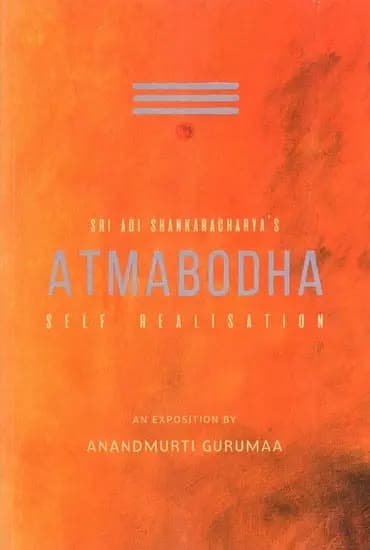
Atmabodha
Traditionally ascribed to Adi Shankara but increasingly treated by modern scholarship as a later work, the Atmabodha is a concise manual of Advaita Vedanta in sixty-eight verses. Its central mechanism is the direct equation of self-knowledge with liberation: ignorance (avidya) superimposes the non-self onto the self, and only the recognition that Atman is Brahman removes this superimposition. The text presents a progressive pedagogy—qualifications of the seeker, the nature of superimposition, the analysis of the sheaths, and the state of the liberated being—designed to move the student from intellectual understanding to direct realization.
Book Archives
Detailed research articles, summaries and analyses from this book.
 Archive
The Mechanics of Liberation: Understanding Jivanmukti
 Archive
Consciousness and the Quantum Vacuum: A Vedantic Perspective
 Archive
Refuting The External World: Gaudapada’s Karika Analyzed
 Archive
Vichara-Sagara: A Deep Dive into Non-Dual Enquiry
 Archive
The Silence of the Sages: Understanding Dattatreya's Avadhuta Gita
 Archive
The Role of Negation (Neti Neti) in Absolute Realization
 Archive
The Secret Logic Behind Advaita's Theory of Maya
 Archive
Why Shankaracharya Rejected Buddhist Emptiness
 Archive
Brahma Sutra Bhashya: Decoding the Bhashyakara's Method
 Archive
The Hidden Meaning of Turiya in the Mandukya Upanishad
Key Insights
✦What is the central teaching of the Atmabodha, and what does it reject?
The Atmabodha's central teaching is that self-knowledge (atma-bodha) alone destroys the ignorance (avidya) that causes the self to be mistaken for the body, mind, and world. The text rejects the view that ritual action or mere intellectual study can produce liberation. Its opening verses establish the qualifications of a seeker—discrimination, renunciation, and a desire for liberation—and then proceed through an analysis of superimposition (adhyasa), the five sheaths, and the three states of consciousness. The text culminates in the direct recognition that Atman is Brahman, described as existence-consciousness-bliss (sat-chit-ananda). The pedagogy is progressive: each verse removes a layer of false identification until only the witnessing consciousness remains, which the text insists was always already present.
✦Why do modern scholars reject the traditional attribution to Adi Shankara?
Ivan Andrijanić's 2024 study applies two criteria to the question of authorship. First, Paul Hacker's colophon criterion: the manuscripts of the Atmabodha do not consistently attribute the work to Shankara in a way that meets the standard for authentic works. Second, terminological analysis: the text uses terms such as anādi (beginningless) and anirvacanīya (inexpressible) as attributes of avidya in verse 14, terms that Hacker identified as markers of later Advaita Vedanta and that never appear in Shankara's authentic works [citation:4]. The text also treats avidya as a metaphysical principle rather than a psychological affliction, which is characteristic of post-Shankara Advaita. Andrijanić's stylometric analysis using the General Imposters framework likewise failed to identify the Atmabodha as Shankara's work [citation:12].
✦What is the textual history of the Atmabodha, and when was it first printed?
The Atmabodha was first printed in Sanskrit in Madras in 1840, edited by Puranam Venkata Narayana Krishna Sastri [citation:8]. Before that, an English translation by J. Taylor was completed in 1812 using manuscripts. The text was included in the first printed collection of Shankara's works, Sri-Sankaracharya's Miscellaneous Works (Mysore, 1898–1899), at the beginning of the fourth volume. Since 1840, the Sanskrit text has been published in approximately fifty editions, and there are twenty translations into English, German, French, and Polish [citation:8]. This publication history is significant because it shows the text's popularity long predates modern authorship debates; it was circulating and being translated as Shankara's work well before scholars began to question the attribution.
✦How does the Atmabodha differ from the Vivekachudamani in style and content?
Both texts are Advaita pedagogical manuals traditionally ascribed to Shankara, but they differ in scope and emphasis. The Vivekachudamani is much longer (580 verses) and develops its argument through an extended dialogue between a disciple and a guru, with detailed analyses of the five sheaths, the three states, and the characteristics of the liberated being. The Atmabodha is shorter (68 verses) and more aphoristic, moving quickly through its topics without the sustained dialogical framing. The Atmabodha's treatment of avidya as a metaphysical principle with attributes like anādi and anirvacanīya is more characteristic of later Advaita than the Vivekachudamani's approach [citation:4]. This difference in doctrinal terminology is one reason scholars treat both texts as post-Shankara works, despite their traditional attribution.
✦What English translations of the Atmabodha are most widely used?
Swami Nikhilananda's translation, published by the Ramakrishna-Vivekananda Center in 1946, remains the most widely cited English edition. It includes an extensive introduction based on the Vedantasara and the Drig-drisya Viveka, along with notes and comments [citation:3]. Swami Chinmayananda's translation and commentary is also widely used, particularly in the Chinmaya Mission's teaching tradition. Other notable translations include those by T.M.P. Mahadevan and Parthasarathy [citation:5]. The 1946 Nikhilananda edition was reprinted multiple times (1947, 1970) and remains the standard scholarly reference in English. These translations matter because the text's popularity in the West has been mediated primarily through the Ramakrishna Mission and Chinmaya Mission publication traditions, both of which accept the traditional attribution to Shankara.
✦What is a common misconception about the Atmabodha's relationship to Shankara's authentic philosophy?
A common misconception is that because the Atmabodha is traditionally attributed to Adi Shankara and is widely used in Advaita teaching, it must accurately represent his philosophical position. Modern scholarship has shown that the text's treatment of avidya as a metaphysical entity with positive attributes (anādi, anirvacanīya) diverges from Shankara's authentic works, where avidya is primarily a psychological affliction rather than a cosmic principle [citation:4]. This means that readers who treat the Atmabodha as a reliable guide to Shankara's own thought may be absorbing later Advaita developments without realizing it. The text remains valuable as a pedagogical manual, but conflating it with Shankara's authentic philosophy obscures important doctrinal shifts that occurred in the centuries after his death.
Wealthy Psyche is an intellectual archive. We do not host, distribute, or sell book copies — physical or digital. We provide structured knowledge to help you think better, faster.