


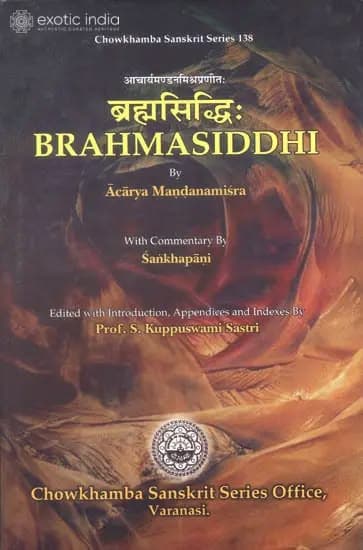
Brahmasiddhi

Mandana Mishra's Brahmasiddhi is a foundational Advaita treatise that develops a distinctive theory of error (avidya) to explain how the unitary Brahman appears as a world of multiplicity. Its central mechanism is the analysis of erroneous cognition: Mandana argues that all experience, whether everyday misperception or the transcendental error of seeing diversity in unity, involves a misapprehension that is neither purely subjective nor fully real. He defends a version of the Bhatta theory of error (viparitakhyati) and integrates it into Advaita, while also asserting that scriptural knowledge alone is insufficient for liberation—direct realization through meditation is required.
Book Archives
Detailed research articles, summaries and analyses from this book.
 Archive
The Mechanics of Liberation: Understanding Jivanmukti
 Archive
Consciousness and the Quantum Vacuum: A Vedantic Perspective
 Archive
Refuting The External World: Gaudapada’s Karika Analyzed
 Archive
Vichara-Sagara: A Deep Dive into Non-Dual Enquiry
 Archive
The Silence of the Sages: Understanding Dattatreya's Avadhuta Gita
 Archive
The Role of Negation (Neti Neti) in Absolute Realization
 Archive
The Secret Logic Behind Advaita's Theory of Maya
 Archive
Why Shankaracharya Rejected Buddhist Emptiness
 Archive
Brahma Sutra Bhashya: Decoding the Bhashyakara's Method
 Archive
The Hidden Meaning of Turiya in the Mandukya Upanishad
Key Insights
✦What is the central argument of the Brahmasiddhi, and what does it reject?
The Brahmasiddhi's central argument is that the appearance of a differentiated world is due to a beginningless error (avidya) that is located in the individual self (jiva), not in Brahman. Mandana analyzes the nature of this error with great sophistication, arguing that it is a form of misapprehension (anyathakhyati) that is neither entirely real nor entirely unreal. The text rejects the view that scriptural knowledge alone, such as hearing the mahavakyas, is sufficient for liberation. Mandana insists that direct realization (aparoksha-anubhuti), cultivated through meditation, is required. This position places him at odds with Shankara's more knowledge-centric soteriology and aligns him more closely with the later Bhamati school.
✦How does Mandana's theory of error differ from Shankara's and Sureshvara's?
Mandana defends a version of the Bhatta Mimamsa theory of error (viparitakhyati or anyathakhyati), which holds that in erroneous cognition, one real object is misapprehended as another real object (e.g., a rope is misapprehended as a snake). He argues that this theory, with slight modification, is acceptable for Advaita [citation:6]. Shankara and Sureshvara, by contrast, are associated with the anirvacaniya-khyati theory, which holds that the object of error is indescribable (anirvacaniya) and neither real nor unreal. Mandana's adoption of the Bhatta theory was followed by Vachaspati Mishra in his Tattvasamiksha commentary on the Brahmasiddhi, though Vachaspati later tried to establish anirvacaniya-khyati in his Bhamati [citation:6].
✦Why do scholars distinguish Mandana Mishra from Sureshvara, and what does this reveal about Advaita's history?
Scholars such as S. Kuppuswami Sastri have demonstrated through careful textual and doctrinal analysis that Mandana Mishra and Sureshvara (traditionally identified as the same person after Mandana's supposed defeat by Shankara) were distinct individuals with divergent views [citation:5][citation:6]. Mandana's Brahmasiddhi criticizes some of Shankara's positions and maintains the Sphotavada of Bhartrihari, which Shankara explicitly rejects. Sureshvara's Vartikas, by contrast, closely follow Shankara and repudiate Mandana's views on key points [citation:5]. This distinction is significant because it shows that Advaita Vedanta was not a monolith even in its early period, and that the later Bhamati and Vivarana schools can be traced to these foundational disagreements.
✦What is the textual history of the Brahmasiddhi, and what editions and commentaries exist?
The Brahmasiddhi was first critically edited by S. Kuppuswami Sastri and published in 1937 in the Madras Government Oriental Manuscripts Series, with the commentary of Shankhapani [citation:7]. A second edition was published in 1984 by Sri Satguru Publications [citation:2]. Vachaspati Mishra is said to have written a commentary called Brahma Tatvasamiksha, but it has not been available in modern times [citation:14]. The text is in Sanskrit, and the 1937 edition includes a substantial English introduction that remains a key source for understanding Mandana's distinctive position and his relationship to Shankara and Sureshvara. No complete English translation of the Brahmasiddhi is known to be widely available.
✦How does the Brahmasiddhi relate to the later Bhamati and Vivarana schools of Advaita?
The Brahmasiddhi is a key precursor to the Bhamati school. Mandana's position that avidya is located in the individual jiva, and that scriptural knowledge alone is insufficient for liberation, was adopted and developed by Vachaspati Mishra in his Bhamati commentary on Shankara's Brahma Sutra Bhashya [citation:10][citation:13]. The opposing Vivarana school, founded by Prakasatman, holds that avidya is located in Brahman and that the mahavakyas directly produce liberating knowledge. The Bhamati-Vivarana divide, one of the most important doctrinal divisions in later Advaita, thus has its roots in the positions Mandana staked out in the Brahmasiddhi, making the text essential for understanding the school's internal development.
Wealthy Psyche is an intellectual archive. We do not host, distribute, or sell book copies — physical or digital. We provide structured knowledge to help you think better, faster.