


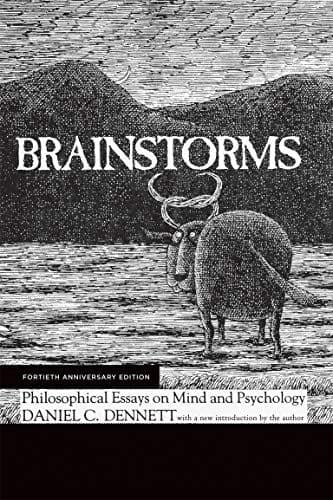
Brainstorms: Philosophical Essays on Mind and Psychology

Brainstorms collects seventeen essays in which Dennett develops the 'intentional stance' as a methodology for predicting and explaining the behavior of complex systems without requiring them to possess genuine consciousness. The book's central mechanism is strategic: treat a system as if it had beliefs and desires, and if this predictive strategy works, you have identified an intentional system—no further metaphysical credentials needed. Its distinctive claim is that intentional explanations are a legitimate level of description for cognitive science, and that the apparent mystery of mind dissolves once homunculi are discharged through hierarchical decomposition rather than feared as circular.
Key Insights
✦What is the central argument of Brainstorms, and what does it reject?
The book's central argument is that the 'intentional stance' is a legitimate and indispensable methodology for cognitive science. To adopt the intentional stance toward a system is to predict its behavior by attributing beliefs and desires to it, treating it as a rational agent. If the predictions succeed, the system is an intentional system—no further metaphysical questions about whether it 'really' has beliefs need to be answered before the science can proceed . What Brainstorms rejects is the behaviorist prohibition on mentalistic language (represented by Skinner, whom Dennett targets in 'Skinner Skinned') and the Cartesian assumption that intentionality requires a conscious inner theater. The book's method is to legitimize mentalistic predicates for scientific use while deflating their metaphysical pretensions.
✦What is the 'homunculus problem,' and how does Dennett propose to solve it?
The homunculus problem is the threat of infinite regress: if you explain intelligence by positing a little man (homunculus) inside the head who reads signals and makes decisions, you must then explain the intelligence of that little man, and so on. Dennett's solution, developed in 'Artificial Intelligence as Philosophy and Psychology,' is hierarchical decomposition. The theorist begins with a relatively intelligent homunculus and replaces it with a network of stupider homunculi, each of which performs a simpler task. This process continues until the homunculi are so stupid that they can be replaced by machines . Dennett acknowledges that this 'takes out a loan of intelligence' at each stage, but argues that the loan can be repaid by eventually discharging all homunculi into mechanistic processes. The AI programmer's confidence that the program will run is the guarantee that the loan will be honored .
✦What is the significance of 'Where Am I?'—the essay that closes the collection?
Where Am I?' is Dennett's most anthologized essay and the collection's philosophical centerpiece. It recounts a thought experiment in which Dennett's brain is surgically removed and kept in a vat in Houston while his body is controlled by radio signals. The question is where 'he' is: with the brain, with the body, or somewhere else? The essay uses this scenario to explore the relationship between personal identity and physical location, arguing that the self is not a thing located at a particular point in space but a functional organization that can, in principle, be distributed . The essay's style—narrative, comic, and deeply unsettling—became a model for Dennett's later public philosophy. It also anticipates the multiple drafts model by showing that the 'self' is a construction rather than a simple substance.
✦How did contemporary reviewers assess Brainstorms, and what criticisms emerged?
Reception was strongly positive. Douglas Hofstadter, writing in the New York Review of Books, called it 'one of the most important contributions to thinking about thinking yet written' . John Haugeland, in Philosophy of Science, described it as 'philosophically important and delightfully written' while criticizing Dennett's arguments about morality . Gilbert Harman, in The Philosophical Review, called it 'brilliant' . Robert Cummins wrote that it was 'the most entertaining bit of non-fiction I've read in a long while' . A more substantive criticism appeared in a review in the Canadian Philosophical Review, which argued that Dennett's account of consciousness leaves no room for genuine conscious mental activity or phenomenological qualities, and that his distinction between personal and sub-personal levels generates a false antithesis that cannot accommodate phenomena like weakness of will .
✦How does Brainstorms relate to Dennett's later book The Intentional Stance?
Brainstorms is the first systematic presentation of the intentional stance, but the concept was developed further and more rigorously in The Intentional Stance (1987). The earlier book collects essays written across the 1970s, each approaching the stance from a different angle—philosophy of psychology, AI, free will, personhood. The later book is a sustained, book-length treatment that distinguishes the intentional stance from the design and physical stances, and defends it against objections in greater detail . Dennett himself described his career as a series of recapitulations of the structure first laid out in Content and Consciousness, and Brainstorms is the first of those recapitulations. The Intentional Stance is the second, more developed version. Readers seeking the most rigorous formulation should turn to the later book; Brainstorms offers the original essays in their historical context.
✦What is the relationship between Brainstorms and Dennett's first book, Content and Consciousness?
Brainstorms extends and applies the framework developed in Content and Consciousness (1969). That earlier book established the distinction between the personal and sub-personal levels of explanation and argued that a theory of content must precede a theory of consciousness. Brainstorms takes those methodological commitments and applies them to specific problems: the nature of psychological theory (Skinner, the law of effect), the interpretation of AI, the objects of consciousness (dreams, images, pain), and the conditions of personhood and free will . The essay 'Intentional Systems' is the direct development of the intentional stance that had been implicit in the earlier book. Dennett described Brainstorms as filling in the details of the program sketched in Content and Consciousness, and as demonstrating how that program could generate substantive philosophical positions on a wide range of issues.
Wealthy Psyche is an intellectual archive. We do not host, distribute, or sell book copies — physical or digital. We provide structured knowledge to help you think better, faster.