


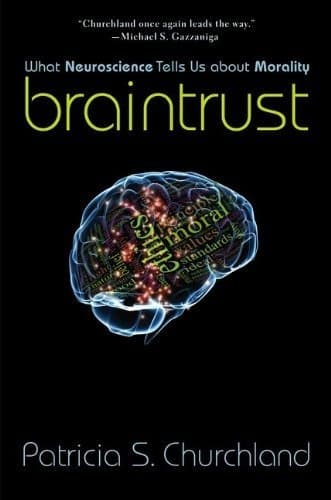
Braintrust: What Neuroscience Tells Us about Morality

Churchland's central claim is that morality is a natural phenomenon rooted in the neurobiology of attachment and bonding, not in pure reason, religion, or abstract rules. The same brain circuitry that motivates mammalian parents to care for offspring—sustained by oxytocin and vasopressin—was co-opted and extended to mates, kin, and wider circles of cooperation. Moral values are thus grounded in the felt pleasures of company and the pains of separation and exclusion. Churchland argues that a naturalistic, brain-based account of morality can be both scientifically grounded and normatively serious, challenging the priority traditionally given to rules and rationality in ethics.
Key Insights
✦What is the central claim of Braintrust, and what does it reject?
Churchland's central claim is that morality is a natural phenomenon rooted in the neurobiology of attachment and bonding—the same circuitry that motivates mammalian parents to care for offspring, extended to mates, kin, and wider social circles . She rejects the view that morality is grounded primarily in pure reason, abstract rules, or religious authority. The book argues that moral values emerge from the felt pleasures of social company and the pains of separation and exclusion, modulated by oxytocin and related neurochemicals . Churchland also challenges the idea that moral philosophy can proceed independently of the biological sciences, insisting that an empirically grounded account of moral capacities is both possible and necessary .
✦What role does oxytocin play in Churchland's account of morality?
Oxytocin is central to Churchland's story. She describes it as an ancient body-and-brain molecule that, by decreasing the stress response, allows mammals to develop the trust necessary for close-knit ties, social institutions, and morality . The oxytocin-vasopressin network underlies attachment between mates and between parents and offspring, and Churchland argues that morality originates in this neurobiology of attachment . Trust between individuals, she notes, has much to do with oxytocin and vasopressin . However, critics have pointed out that while Churchland offers detailed explanations of oxytocin's role in trust and cooperation, she neglects some important evolutionary biological arguments, leaving the account incomplete in that dimension .
✦How does Braintrust relate to Churchland's earlier work in neurophilosophy?
Braintrust extends the neurophilosophical programme Churchland launched with Neurophilosophy (1986) and continued in Brain-Wise (2002). Where those earlier books focused on consciousness, the self, and knowledge, Braintrust applies the same method—using neuroscientific findings to interrogate traditional philosophical questions—to ethics . Churchland's career has been defined by the conviction that philosophy of mind must be answerable to brain science, and Braintrust carries that conviction into moral philosophy. The book's account of morality as rooted in attachment circuitry is continuous with her broader naturalism: just as mental states are brain states, moral capacities are biological capacities shaped by evolution and expressed through specific neural systems.
✦What criticisms have been made of Braintrust's treatment of moral reasoning and rules?
A significant criticism is that Churchland neglects the more cognitivist aspects of moral psychology. One reviewer argues that she focuses on explicit reasoning and rule-following while ignoring the possibility that moral rules may operate unconsciously, as grammatical rules do in language . The same critic identifies a 'social/moral gap': morality and sociality overlap but do not coincide, and Braintrust conflates the two by treating sociality as the whole of morality . John Mikhail, reviewing in Ethics, also notes Churchland's skepticism toward innate moral principles and her treatment of moral rules as potentially overstated, arguing that her reading of Hume's is-ought passage, while sound, does not go far enough in addressing Hume's internalism about moral distinctions .
✦What is Churchland's response to the is-ought problem?
Churchland distinguishes between two senses of 'infer.' If 'infer' means 'logically derive,' she accepts that one cannot derive an ought from an is alone. But if 'infer' means 'figure out,' she argues that we regularly and legitimately figure out what we ought to do based on facts and background understanding . Most real-world problem-solving, she observes, is not deductive but satisficing—finding an acceptable solution given constraints. The warning against deriving ought from is, on her view, applies only to deductive inference and has little bearing on practical moral reasoning. This move allows her to pursue a naturalistic ethics without claiming to bridge the logical gap deductively, though critics have questioned whether it adequately addresses the normative force of moral claims.
✦How was Braintrust received by reviewers across disciplines?
Reception was generally positive but discipline-dependent. Antonio Damasio praised it as 'vintage Churchland, only better,' and Michael Gazzaniga called it 'a terrific, clear, and finely sensitive account' . A reviewer in the Quarterly Review of Biology recommended it for all readers interested in the behavioral sciences' relevance to morality . A review in Ethics acknowledged the book as 'informative and often quite illuminating' and said Churchland's principal thesis 'deserves to be taken seriously by scientists and philosophers alike,' while identifying weaknesses in her Hume interpretation and treatment of moral rules . The most pointed criticisms came from philosophers who felt the book's naturalism, while forceful, left important normative and cognitivist dimensions of morality unaddressed .
Wealthy Psyche is an intellectual archive. We do not host, distribute, or sell book copies — physical or digital. We provide structured knowledge to help you think better, faster.