


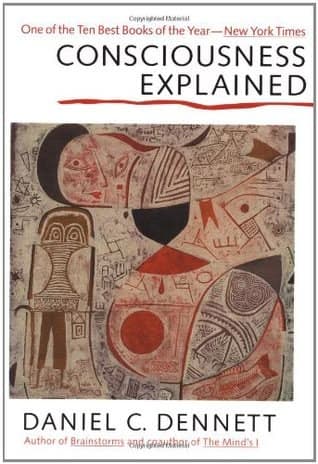
Consciousness Explained

Consciousness Explained argues that the subjective stream of experience is not a unified show playing in a private theater but a product of 'multiple drafts' of reality composed by parallel brain processes. Dennett's central move is to demolish the 'Cartesian Theater'—the intuition that there is a single place in the brain where 'it all comes together' for an inner observer—and replace it with a model in which consciousness is a gappy, edited, retrospectively narrated construction. The book's distinctive claim is that once the theater is dismantled, the remaining mysteries of qualia and the self dissolve into explainable cognitive and cultural mechanisms.
Key Insights
✦What is the central argument of Consciousness Explained, and what does it reject?
The book's argument proceeds in two stages. Destructively, Dennett attacks the 'Cartesian Theater'—the intuitive picture that somewhere in the brain there is a screen where conscious contents are displayed for an inner observer. He argues this picture is incoherent because it leads to an infinite regress: who watches the inner screen? Constructively, he proposes the 'Multiple Drafts' model, in which the brain continuously edits and revises parallel streams of information, and what we call consciousness is the result of these distributed processes, not a single unified show . What Consciousness Explained rejects is the premise that consciousness is a special, irreducible medium distinct from the physical processes that produce it. For Dennett, once the theater is dismantled, the 'hard problem' of qualia loses its grip.
✦What is 'heterophenomenology,' and why does Dennett insist on it?
Heterophenomenology is Dennett's method for studying consciousness scientifically. It treats a subject's verbal reports about their experience as data to be interpreted, not as authoritative revelations. The researcher listens seriously to what the subject says about how things seem, but brackets the question of whether those reports accurately describe an inner reality, treating them instead as expressions of the subject's beliefs . Dennett argues this is already the standard method of psychophysics and cognitive psychology. The point is to avoid the 'lone-wolf autophenomenology' that takes first-person reports as incorrigible. Heterophenomenology allows consciousness to be studied from a third-person perspective without dismissing the first-person data; it simply refuses to grant those data metaphysical privilege. Critics have objected that this method smuggles in a behaviorist dismissal of subjective experience.
✦How does Dennett's view differ from David Chalmers's 'hard problem' of consciousness?
The disagreement is fundamental. Chalmers argues that even after we explain all the cognitive and neural functions associated with consciousness, there remains a further question: why is there subjective experience at all? Why does information processing feel like something? Dennett's book is an extended argument that this 'hard problem' is an illusion generated by the Cartesian Theater picture. If consciousness is not a unified inner show but a set of distributed, edited processes, then there is no separate 'what it is like' over and above those processes to be explained. Dennett does not deny that we have experiences; he denies that experience is a mysterious extra ingredient requiring a non-physical explanation. Chalmers's position, and the zombie thought experiment that supports it, are precisely what Dennett's book aims to dismantle.
✦How was the book received by critics, and what were the main lines of attack?
Reception was polarized. The New York Times praised Dennett's 'brilliant' exposition and his skill at making difficult material accessible . But academic critics were sharply divided. One philosopher accused Dennett of employing 'rhetorical sleights of hand' that mask the weakness of his materialist case, arguing that his arguments fade away on close inspection . A review in a neuroscience journal called the book an 'instructive failure,' arguing that Dennett's functionalism denies consciousness any distinct cognitive ontology and that his critique of the Cartesian Theater misfires because parallel processing is compatible with some versions of the theater model . Other critics argued that heterophenomenology covertly dismisses the very first-person data it claims to respect. The book's reputation has endured, but it remains a flashpoint in the consciousness debates.
✦What is the 'Joycean machine,' and how does it fit into Dennett's theory?
The Joycean machine is Dennett's name for the 'virtual machine' that he believes distinguishes human consciousness from that of other animals. It is a software-like system installed in the brain by language and cultural transmission. Dennett proposes that human consciousness is shaped by 'memes'—units of cultural information that colonize the brain and create new patterns of thought. The Joycean machine is the result: a controller that filters the cacophony of parallel brain processes into a serial narrative, the 'stream of consciousness' . The name is a reference to James Joyce, whose stream-of-consciousness writing Dennett sees as a literary model for the kind of self-narration the brain performs. The concept is central to Dennett's claim that consciousness is not a biological given but a cultural achievement, an operating system installed on top of the hardware of the brain.
✦How does Consciousness Explained relate to Gilbert Ryle's The Concept of Mind?
The relationship is one of extension and radicalization. Ryle's 1949 book attacked the 'ghost in the machine'—the Cartesian idea of a non-physical mind inhabiting the body—as a category mistake. Dennett explicitly builds on Ryle's critique of the Cartesian picture, but he goes further. Where Ryle was content to dissolve the mind-body problem by analyzing mental language, Dennett wants to construct a positive, empirically informed theory of how consciousness is produced by the brain . He also updates Ryle's critique with findings from cognitive psychology and neuroscience, arguing that the Cartesian Theater is not just a philosophical error but a picture that experimental evidence actively undermines. The book can be read as a sustained attempt to fulfill the promise of Ryle's early critique while providing the scientific detail Ryle did not attempt.
Wealthy Psyche is an intellectual archive. We do not host, distribute, or sell book copies — physical or digital. We provide structured knowledge to help you think better, faster.