


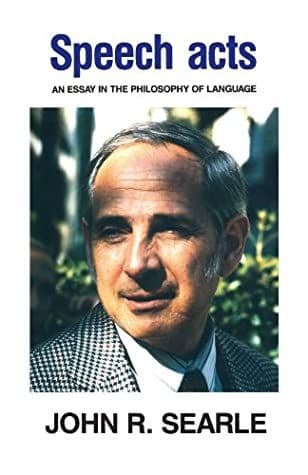
Speech Acts: An Essay in the Philosophy of Language
Searle's central thesis is that speaking a language is engaging in a rule-governed form of behaviour, and that the minimal unit of linguistic communication is not the symbol but the speech act—promising, asserting, requesting, warning. He develops a taxonomy of illocutionary acts grounded in constitutive rules, showing how institutional facts like promises and marriages are created by utterances that count as something in a context. The book rejects the view that language is primarily a system for representing the world, arguing instead that meaning is rooted in the speaker's intentions and the conventions that allow those intentions to be recognized.
Key Insights
✦What is the central claim of Speech Acts, and what does it reject?
Searle's central claim is that speaking a language is performing speech acts according to systems of constitutive rules. The minimal unit of communication is not the word or sentence but the illocutionary act—the act of promising, ordering, asserting, or warning. The book rejects the dominant view in philosophy of language that treats meaning as primarily a matter of reference and truth conditions, arguing instead that meaning is grounded in speaker intentions and the conventions that enable hearers to recognize those intentions. It also rejects the behaviourist and ordinary-language tendency to dissolve philosophical problems without systematic theory. Searle's aim is a general theory of speech acts that explains how utterances can create commitments, obligations, and institutional facts .
✦How does Searle's account differ from J. L. Austin's original theory of speech acts?
Searle builds on Austin's 1955 lectures, published as How to Do Things with Words, but systematizes what Austin left programmatic. Austin introduced the distinction between constative and performative utterances and sketched a taxonomy of illocutionary acts, but he did not provide a unified theory of the rules governing them. Searle's contribution is to formulate the constitutive rules that make illocutionary acts possible and to develop a principled taxonomy based on illocutionary point, direction of fit, and expressed psychological state. He also introduces the distinction between regulative rules (which govern antecedently existing activities) and constitutive rules (which create the very possibility of the activity), a distinction that becomes central to his later work on social ontology . Speech Acts thus transforms Austin's insights into a systematic framework.
✦What is the distinction between regulative and constitutive rules, and why does it matter?
Regulative rules govern activities that exist independently of the rules—traffic laws regulate driving, which could occur without them. Constitutive rules create the very possibility of the activity they govern: the rules of chess do not regulate a pre-existing game but define what it is to play chess. Searle argues that speech acts are governed by constitutive rules of the form 'X counts as Y in context C'—uttering certain words under certain conditions counts as making a promise, issuing an order, or placing a bet. This distinction matters because it explains how language can create institutional realities that are not reducible to physical facts. Promises, marriages, and money exist only because communities accept constitutive rules that assign status functions to utterances and objects .
✦What is the relationship between Speech Acts and Searle's later book Intentionality?
Intentionality (1983) provides the theoretical foundation that Speech Acts presupposed but did not fully articulate. In the earlier book, Searle analyzes illocutionary acts in terms of their conditions of satisfaction—what must be the case for a promise or assertion to succeed. Intentionality generalizes this analysis to all mental states, arguing that beliefs, desires, and intentions also have conditions of satisfaction and direction of fit. The later book reverses the explanatory order: the intentionality of language is derived from the intrinsic intentionality of the mind, not the other way around. Speech Acts is thus the application of a theory of meaning that Intentionality later grounds in a general theory of mental representation .
✦How has Speech Acts been received and criticized?
The book was immediately recognized as a major contribution and established Searle as a leading philosopher of language. It is widely credited with systematizing Austin's insights and providing the framework for subsequent work in pragmatics, including Gricean implicature and relevance theory. Criticisms have focused on the adequacy of Searle's taxonomy and the universality of his constitutive rules. Some linguists and anthropologists have argued that the specific illocutionary categories he identifies are culture-bound rather than universal. Others, including Derrida in his famous exchange with Searle, have questioned the stability of the distinction between serious and parasitic uses of language that Searle's theory relies on. Despite these debates, the book remains a foundational text in speech act theory and pragmatics.
✦What is a common misconception about what Speech Acts claims?
A frequent misconception is that Searle is claiming that all utterances are performatives or that language is nothing but action. That is not his view. Searle distinguishes between the propositional content of an utterance and its illocutionary force: the same proposition ('the door is closed') can be asserted, questioned, ordered, or wished, and the illocutionary act is what the speaker does with that content. He is not denying that language represents the world; he is arguing that representation is itself a kind of act governed by rules. Another misreading treats the constitutive rules as descriptions of how people actually speak, when Searle presents them as the underlying conventions that make communication possible, whether or not speakers can articulate them.
Wealthy Psyche is an intellectual archive. We do not host, distribute, or sell book copies — physical or digital. We provide structured knowledge to help you think better, faster.