


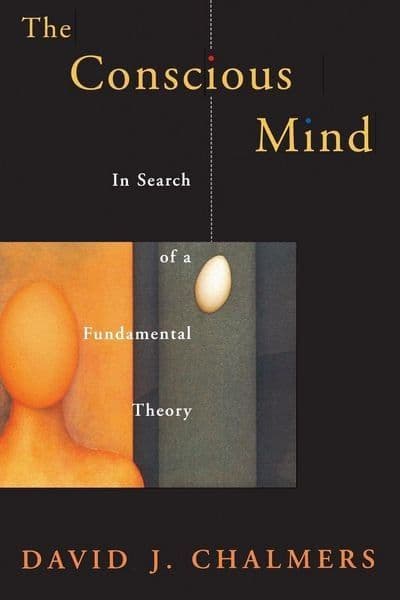
The Conscious Mind: In Search of a Fundamental Theory

The Conscious Mind introduces the 'hard problem' of consciousness: even after we explain all the cognitive and neural functions associated with experience, the question of why those processes are accompanied by subjective experience remains. Chalmers argues that consciousness cannot be reduced to physical processes and proposes a nonreductive theory in which phenomenal properties are fundamental, related to physical properties by natural laws he calls 'psychophysical laws.' The book's distinctive claim is that consciousness is not a puzzle to be solved by more neuroscience but a feature of reality requiring its own explanatory framework, with the 'zombie argument' and the 'knowledge argument' as its central supports.
Key Insights
✦What is the central argument of The Conscious Mind, and what does it reject?
The book's central argument is that consciousness cannot be reduced to physical processes without remainder. Chalmers distinguishes the 'easy problems' of consciousness—explaining cognitive functions like discrimination, integration, and reportability—from the 'hard problem': why physical processes are accompanied by subjective experience at all . He argues that no functional explanation can bridge this gap, and he proposes a nonreductive theory in which phenomenal properties are fundamental, related to physical properties by natural laws he calls psychophysical laws. What The Conscious Mind rejects is the materialist assumption that consciousness is simply another functional capacity to be explained by neuroscience. Chalmers does not deny that the brain produces consciousness; he denies that the production can be understood in purely functional terms.
✦What is the 'zombie argument,' and why is it central to the book?
The zombie argument is a thought experiment: imagine a being physically and functionally identical to you, living in a physically identical world, but with no conscious experience—'all is dark inside.' If such a zombie is conceivable, then consciousness is not logically entailed by the physical facts, and physicalism is false . Chalmers argues that the conceivability of zombies establishes the possibility of zombies, and that this possibility refutes physicalism. The argument has been fiercely debated. Critics, including Daniel Dennett, argue that the conceivability of zombies is an artifact of our imagination, not evidence of a genuine metaphysical possibility. Chalmers's response is that the burden of proof lies with those who claim the conceivability is illusory, and that no one has provided a convincing account of why the intuition should be discarded.
✦What are 'psychophysical laws,' and how do they fit into Chalmers's theory?
Psychophysical laws are the principles that relate physical processes to phenomenal properties. Chalmers proposes that just as physics has laws relating fundamental physical properties to one another, a complete theory of consciousness would include laws relating physical states to experiential states. He calls this 'naturalistic dualism': consciousness is not reducible to the physical, but it is part of the natural order, governed by lawful regularities . The psychophysical laws are not yet known, and Chalmers does not claim to have discovered them. His argument is that a science of consciousness must posit such laws, just as physics posits laws governing fundamental particles. This is why he describes consciousness as a 'fundamental feature' of reality—not because it is supernatural, but because it cannot be derived from more basic physical facts.
✦How was The Conscious Mind received, and what were the main criticisms?
Reception was polarized. The book was widely praised for its clarity and for putting the hard problem on the philosophical map . But critics attacked the zombie argument, the conceivability-possibility inference, and the coherence of naturalistic dualism. Daniel Dennett, in particular, became Chalmers's most prominent critic, arguing in Consciousness Explained and later work that the hard problem is an illusion generated by the Cartesian Theater picture . Other critics objected that psychophysical laws are ad hoc and untestable, and that Chalmers's view leaves consciousness causally inert. A review in the Journal of Consciousness Studies called the book 'a major contribution' but noted that its central arguments 'will not convince those not already sympathetic' . The book remains a flashpoint, and its vocabulary—'hard problem,' 'zombie,' 'easy problems'—has become standard in the field.
✦How does The Conscious Mind relate to Chalmers's later work, particularly The Character of Consciousness and Constructing the World?
The Conscious Mind is the foundation of Chalmers's philosophical project. The Character of Consciousness (2010) collects essays written in the intervening years, replying to critics and refining the arguments . Constructing the World (2012) embeds the hard problem within a comprehensive ontological framework, arguing that all truths are scrutable from a base of physical and phenomenal facts . The later books presuppose the framework established in The Conscious Mind: the irreducibility of consciousness, the reality of phenomenal properties, and the need for a nonreductive metaphysics. Readers approaching the later books without familiarity with the first will find them difficult, because they assume the vocabulary and arguments that The Conscious Mind introduced.
✦What is the 'knowledge argument,' and how does Chalmers use it?
The knowledge argument, originally formulated by Frank Jackson, asks us to imagine Mary, a color scientist who knows all physical facts about color but has never seen red. When she finally sees red, she learns something new—what it is like to experience red. Chalmers uses this argument to support his claim that physical facts do not exhaust all facts . If Mary learns something new, then there is a fact about experience that is not captured by the physical description. Chalmers's version of the argument emphasizes the epistemic gap between physical knowledge and phenomenal knowledge, and he argues that this gap is best explained by the irreducibility of phenomenal properties. Critics, including Dennett, have argued that Mary does not learn a new fact but gains a new ability or a new mode of representation.
Wealthy Psyche is an intellectual archive. We do not host, distribute, or sell book copies — physical or digital. We provide structured knowledge to help you think better, faster.