


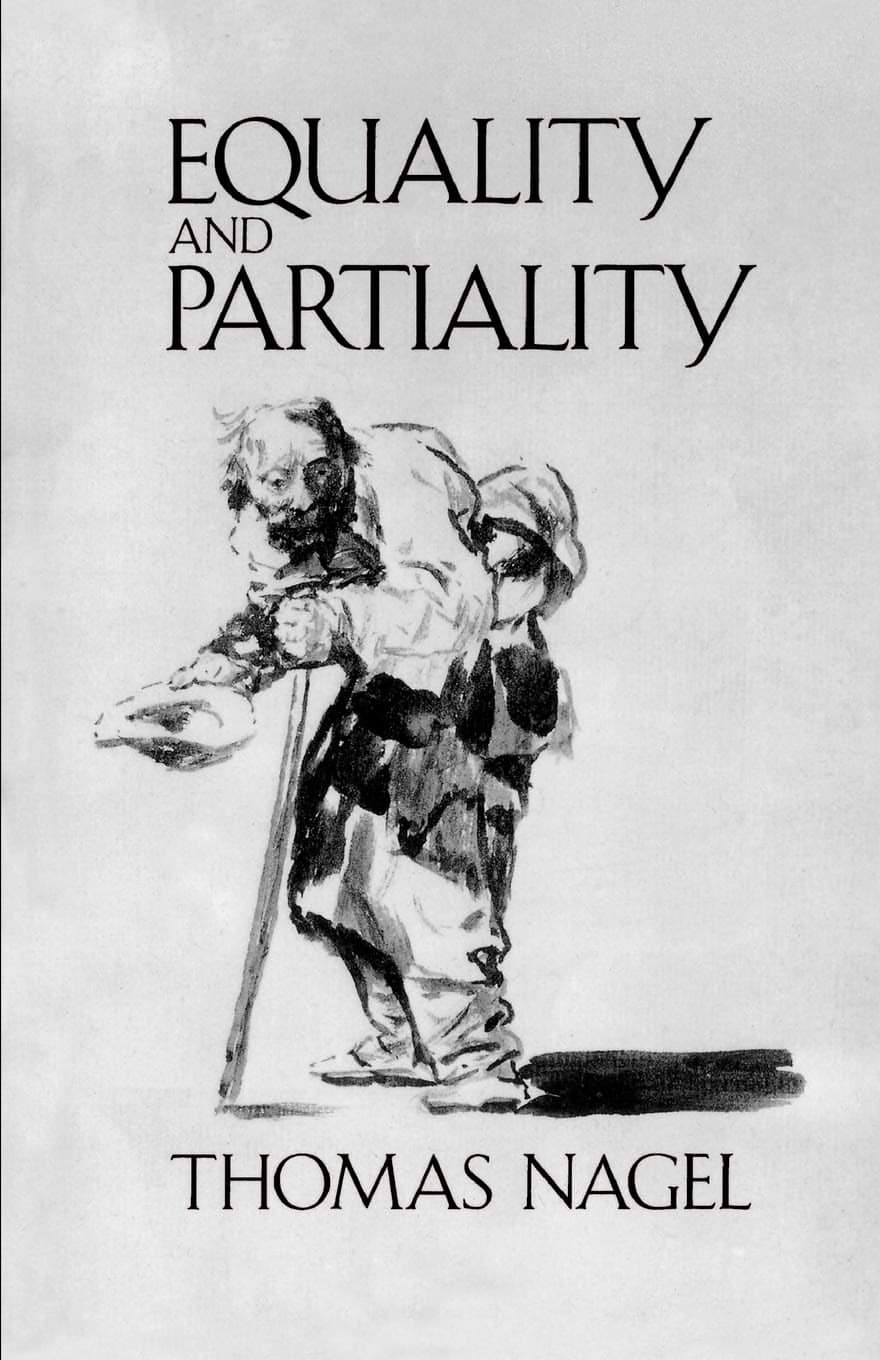
Equality and Partiality

Nagel's central claim is that political philosophy's fundamental problem is the conflict within each person between the impersonal standpoint, which demands universal impartiality and equality, and the personal standpoint, which generates individualistic motives and allegiances. Any legitimate political system must integrate these two standpoints within the divided self. Derived from his 1990 Locke Lectures, the book argues that neither utilitarianism nor Rawlsian egalitarianism adequately reconciles these demands, and that a nonutopian political ideal must accommodate both the impersonal claims of justice and the personal claims of individual life .
Key Insights
✦What is the central claim of Equality and Partiality, and what does it reject?
Nagel's central claim is that political philosophy must begin from the division within each person between the impersonal standpoint—which demands universal impartiality and equality—and the personal standpoint—which generates individualistic motives, allegiances to family and friends, and claims of one's own life . A legitimate political system must integrate both standpoints within the divided self. Nagel rejects 'utopian' political ideals that, by definition, individuals cannot be motivated to live by . He also rejects existing theories—utilitarianism, Kantianism, and Rawlsian egalitarianism—on the grounds that each fails to do justice to one or the other standpoint, demanding sacrifices of the well-off that they could not reasonably consent to, or ignoring the impersonal claims of the worse-off .
✦How does the book relate to Nagel's earlier The View from Nowhere?
Equality and Partiality applies the framework of The View from Nowhere to political philosophy. In the earlier book, Nagel argued that the tension between subjective and objective standpoints is the root of philosophical problems generally. In Equality and Partiality, he translates this into the political domain: the impersonal standpoint corresponds to the objective view, demanding impartiality and equality, while the personal standpoint corresponds to the subjective view, generating individual motives and attachments . The book is thus the political application of Nagel's broader philosophical method, showing how his central distinction illuminates problems of justice, legitimacy, and social inequality. A Cambridge companion chapter notes that Equality and Partiality expresses his views on political philosophy most comprehensively and shows how his political thought is shaped by his overall conception of philosophy .
✦What is the relationship between Equality and Partiality and Rawls's A Theory of Justice?
The book is Nagel's most significant engagement with Rawls's political philosophy. A Cambridge Rawls Lexicon entry identifies Equality and Partiality as Nagel's most important treatment of Rawls's ideas, noting that Nagel uses his distinction between objective and subjective standpoints to address the feasibility of Rawlsian egalitarianism . Nagel's concern is that Rawls's theory focuses on the basic structure of society to the exclusion of personal choice, and that a legitimate political order must leave enough personal space for individuals to realize the subjective values of their own lives . Nagel is not rejecting Rawls wholesale but revising and complicating the egalitarian project by insisting that the personal standpoint cannot be simply overridden by impersonal demands of justice.
✦What practical political conclusion does Nagel reach, given his skepticism about full legitimacy?
Nagel doubts that any currently conceivable political system can command universal rational consent, because the two standpoints pull in different directions and no institutional arrangement fully satisfies both . He therefore favors what he takes to be the best workable nonutopian approximation to legitimacy: something close to a 'guaranteed minimum' view, provided that it includes a high social minimum with healthy, comfortable, decent conditions of life and self-respect for everyone, in addition to fair equality of opportunity . He also insists on basic rights that protect the personal standpoint . Nagel acknowledges that this minimalist position is 'hardly an unworthy goal' and suggests that nothing beyond it may be seriously pursued until it has been achieved and entrenched .
✦How was the book received by reviewers in political philosophy?
Reception was generally positive. The American Political Science Review praised it as a 'short and illuminating book' that stimulates serious thought across a wide range of issues in contemporary political theory, noting that Nagel's style is 'deceptively simple, masking an unusual depth and complexity of view' . The Times Literary Supplement called Nagel 'just about the most interesting philosopher of our day' and praised his 'deftness of touch and delicacy of intellectual imagination' . The Review of Politics described it as 'required reading for those working in the area of political philosophy' . The Philosophical Review went further, suggesting that in a more rational world the book would have best-seller status . The book has not attracted the same level of sustained critical debate as Rawls's work, but it remains a significant contribution to the literature on equality and political legitimacy.
✦What is a common misconception about the book's argument?
A frequent misconception is that Nagel is arguing for a straightforward form of egalitarianism or that he believes the impersonal standpoint should simply override personal attachments. Neither is correct. Nagel insists that both standpoints are legitimate and irreducible, and that a political system which ignores the personal standpoint—demanding sacrifices individuals cannot reasonably accept—fails the test of legitimacy just as surely as one that ignores the impersonal claims of the worse-off . The book's title signals this dual commitment: equality and partiality are both essential, and the problem is how to reconcile them. Nagel's pessimism about full reconciliation is not a rejection of equality but an acknowledgment of the difficulty of achieving it without violating the personal claims that give individual lives their meaning.
Wealthy Psyche is an intellectual archive. We do not host, distribute, or sell book copies — physical or digital. We provide structured knowledge to help you think better, faster.