


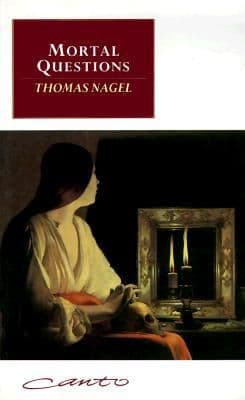
Mortal Questions

Nagel's central claim is that philosophical problems about life's meaning, value, and consciousness cannot be separated from the subjective point of view of the person who lives them. The collection's essays—on death, absurdity, moral luck, war, equality, and consciousness—are unified by the last essay's argument that subjective and objective standpoints are each irreducible and indispensable. Nagel rejects reductive accounts that would eliminate the personal perspective, insisting that a philosophical method adequate to mortal questions must combine theoretical understanding with self-knowledge.
Key Insights
✦What is the central claim of Mortal Questions, and what does it reject?
The central claim is that philosophical questions about death, meaning, value, and consciousness must be approached from a method that incorporates the personal, subjective standpoint rather than aiming for a purely detached objectivity. Nagel rejects the assumption that philosophical clarity requires eliminating the first-person perspective. The volume's fourteen essays, published between 1969 and 1978, are unified by the final essay, 'Subjective and Objective,' which argues that the two standpoints are irreducible to each other and each indispensable for understanding ourselves in the world . Nagel's preface frames the project as an attempt to combine theoretical results with a framework of self-knowledge, acknowledging the risk that 'large, relevant questions too easily evoke large, wet answers' .
✦What specific concept did the essay 'Moral Luck' introduce, and why is it significant?
'Moral Luck' introduced the now-standard philosophical problem that our moral judgments of agents depend partly on factors beyond their control. Nagel's essay, originally published in the Proceedings of the Aristotelian Society in 1976 as a reply to Bernard Williams's paper of the same name, examines how we hold people morally responsible for outcomes that were not fully within their control . The concept has become central to debates about free will, responsibility, and the conditions of moral appraisal. Its inclusion in Mortal Questions helped establish the problem as a permanent feature of ethical theory, and the essay remains one of the collection's most widely cited contributions alongside 'What Is It Like to Be a Bat?' .
✦How does the book relate to Nagel's later The View from Nowhere?
Mortal Questions is the seedbed for the systematic project Nagel would develop in The View from Nowhere (1986). The final essay, 'Subjective and Objective,' sketches the tension between the two standpoints that the later book would elaborate across metaphysics, epistemology, free will, and ethics. A seminar reading list notes that The View from Nowhere may serve as a useful general background for themes introduced in Mortal Questions, and that the earlier collection reflects more general philosophical views that the later book systematizes . The essay 'Subjective and Objective' is published here for the first time, making the 1979 volume the original public statement of the framework that would define Nagel's mature philosophy .
✦What is the publication history of the collection?
Mortal Questions was published by Cambridge University Press in 1979. The volume collects twelve previously published essays from 1969 to 1978, with chapters 13 and 14 ('Panpsychism' and 'Subjective and Objective') appearing here for the first time . The essays originally appeared in venues including Nous, Journal of Philosophy, Philosophy & Public Affairs, Synthese, and The Philosophical Review, with various revisions and some changes of title for the collection . The book runs xv + 215 pages in the original Cambridge edition . A Canto Classics paperback edition (ISBN 9781107604711) is currently in print, keeping the collection accessible to students and general readers .
✦How was Mortal Questions received by contemporary reviewers?
Reception was strongly positive. P. F. Strawson, reviewing in the New York Review of Books, called it 'a fine achievement' and observed that 'few professional philosophers have written so rationally and agreeably on such a variety of difficult and serious problems' . Strawson's review essay, 'Stands to Reason,' engaged substantively with Nagel's treatment of the subjective-objective antithesis in ethics, praising the essays on war, public life, and equality as 'a substantial contribution to ethical theory, rationally argued and undogmatic in tone, balanced and civilized in treatment' . R. A. Duff in The Literary Review noted that the essays 'convey to an interested non-philosopher a real sense of the excitement and significance of philosophical enquiry' . The New Statesman praised Nagel's clarity and plainness of style, predicting he could 'seize and keep the general reader's attention' .
✦What is a common misconception about the collection's unity?
A frequent misconception is that Mortal Questions is a miscellaneous collection with no unifying thread beyond Nagel's authorship. In fact, the volume is carefully structured to culminate in the theoretical statement of 'Subjective and Objective,' which retroactively illuminates the ethical and metaphysical essays that precede it. The Modern Schoolman's review observed that although each of the twelve previously published essays 'stands on its own head,' the unity of the whole becomes clear in the final essay, where Nagel maintains that there are two irreducible and indispensable ways of thinking . The ethical essays on moral luck, war, and equality are applications of the subjective-objective tension, while 'What Is It Like to Be a Bat?' and 'Panpsychism' apply it to the philosophy of mind.
Wealthy Psyche is an intellectual archive. We do not host, distribute, or sell book copies — physical or digital. We provide structured knowledge to help you think better, faster.