


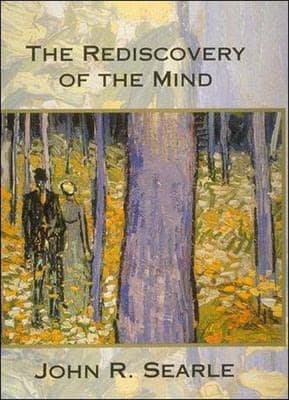
The Rediscovery of the Mind
Searle's central target is the neglect of consciousness in philosophy of mind and cognitive science, which he argues renders both sterile. His positive thesis is 'biological naturalism': consciousness is a real, subjective, first-person phenomenon caused by neurophysiological processes in the brain, yet irreducible to them—like liquidity is a feature of water. The book rejects both materialism (which denies the irreducibility of subjective experience) and dualism (which posits a separate mental substance). It also attacks computationalism, arguing that syntax is not intrinsic to physics and that unconscious 'deep' mental states posited by cognitive science are conceptually incoherent.
Key Insights
✦What is the central claim of The Rediscovery of the Mind, and what does it reject?
Searle's central claim is that consciousness is a real, subjective, first-person phenomenon that is a biological feature of the brain, caused by neurophysiological processes yet not reducible to them. He calls this position 'biological naturalism' . The book rejects materialism in its various forms—identity theory, behaviourism, functionalism—for denying or explaining away the irreducible subjectivity of conscious experience. It equally rejects dualism, insisting that once you start counting types of substance you are on the wrong track . Searle's diagnosis is that the philosophy of mind has been paralysed by a false choice between materialism and dualism, and that accepting consciousness as an ordinary biological phenomenon dissolves the apparent dilemma.
✦What is the 'connection principle,' and why is it central to the book's critique of cognitive science?
The connection principle is Searle's thesis that the only coherent notion of an unconscious mental state is one that is in principle accessible to consciousness—what he calls the 'shallow unconscious.' States that are in principle inaccessible to consciousness—the 'deep unconscious' posited by Chomsky's universal grammar, Marr's visual processing models, and Fodor's input systems—are not genuinely mental states at all . Searle argues that unconscious intentional states must have 'aspectual shape' (a content or mode of presentation), but aspectual shape cannot be exhaustively characterised in third-person neurophysiological terms. The only way to make sense of unconscious mentality is as a disposition to produce conscious states. Since cognitive science relies heavily on deep unconscious computational processes, the connection principle amounts to a refutation of its core explanatory strategy .
✦How does Searle's attack on computationalism in this book differ from the Chinese Room argument?
The Chinese Room targets the claim that running a program is sufficient for understanding or intentionality. In The Rediscovery of the Mind, Searle adds a different line of attack: the problem of universal realizability. He argues that syntactic features are not intrinsic to physical states; they are assigned by observers. Any physical object can be described as implementing some program, so being a digital computer cannot be what distinguishes brains from other physical systems in virtue of producing consciousness . The Chinese Room argues that syntax is not sufficient for semantics; the new argument adds that syntax is not even a physical feature of the system but an observer-relative ascription. Together they aim to show that computationalism mistakes an assigned description for an intrinsic causal power.
✦How has the book been received, and what are the main criticisms?
The book was recognised as a forceful and iconoclastic intervention. A critical notice in Dialogue described its dual goals as ridding philosophy of mind of fundamental confusions and setting the field on a path to progress, acknowledging the sheer scope of Searle's work even for those who disagree . The most sustained criticism concerns the connection principle. Critics have argued that Searle offers no explicit argument for the assumption that the concept of a mental state is logically tied to consciousness; he treats it as an obvious truth rather than defending it . Others have questioned whether biological naturalism is a stable middle ground or a modest dualism in disguise, noting that Searle's insistence on the irreducibility of subjective experience sits uneasily with his claim to have rejected dualism .
✦What is a common misreading of Searle's biological naturalism?
A frequent misreading treats biological naturalism as a form of property dualism—the view that mental properties are distinct from and irreducible to physical properties. Searle explicitly denies this. His claim is that consciousness is a biological feature of the brain in the same sense that liquidity is a feature of water: it is caused by the microstructure of the system and is a real feature of it, not an additional substance or a separate realm of properties . The misreading arises because Searle insists on the irreducibility of first-person ontology, which sounds dualist to materialist ears. But his point is about the ontology of subjective experience, not about the existence of non-physical stuff. Consciousness is a higher-level feature of a physical system, not a ghostly addition to it.
✦How does this book relate to Searle's earlier work on intentionality and speech acts?
The Rediscovery of the Mind extends the programme of Intentionality (1983) by applying its framework to consciousness and to the unconscious. Searle reaffirms that the derived intentionality of language is grounded in the intrinsic intentionality of the mind/brain, and that a theory of language is incomplete without an account of this relation . The book also develops themes from the Chinese Room argument, broadening the attack on computationalism. But it introduces a new emphasis: consciousness, rather than intentionality alone, becomes the central explanatory target. Searle argues that intentionality without consciousness is parasitic, and that the neglect of consciousness is what has made cognitive science and philosophy of mind barren. The book thus represents a shift in emphasis rather than a break with his earlier positions.
Wealthy Psyche is an intellectual archive. We do not host, distribute, or sell book copies — physical or digital. We provide structured knowledge to help you think better, faster.