


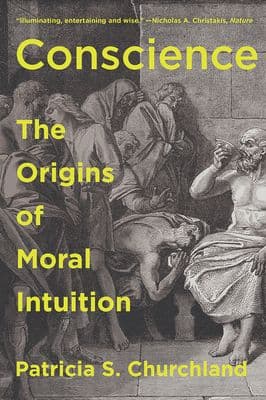
Conscience: The Origins of Moral Intuition

Churchland argues that conscience is not a faculty of pure reason or a set of universal laws inscribed in the soul, but a neurobiological construct built from mammalian attachment circuitry. Her formula is direct: attachment begets caring, and caring begets conscience. The same oxytocin-mediated bonding that binds mothers to infants and mates to each other was extended by evolution into a reward system that internalizes social norms through the pleasure of approval and the pain of exclusion. Moral intuition is thus felt before it is reasoned, and philosophy must answer to the brain that produces it.
Key Insights
✦What is the central claim of Conscience, and what does it reject?
Churchland's central claim is that conscience is neurobiological in origin—a brain construct forged by evolution from the ancient circuitry of mammalian attachment. Her formula is 'Attachment begets caring; caring begets conscience' . She rejects the view, dominant in much contemporary moral philosophy, that conscience stems from universal moral laws accessible to pure reason. She also rejects the idea that morality requires divine authority or a special non-natural faculty. Instead, she argues that human neurobiology possesses a reward system that internalizes social norms through the pleasure of social approval, and that this system produces the felt voice of conscience. The book positions Churchland with the 'wisdom seekers'—Aristotle, Hume, the Dalai Lama—against the 'rule purveyors' from Kant onward .
✦How does the vole research figure in Churchland's argument?
The vole research is Churchland's key empirical anchor. Two vole species—prairie voles, adapted to plains, and montane voles, adapted to mountain ecosystems—differ in the number and location of oxytocin receptors in the brain. Prairie voles, with more oxytocin receptors in certain areas, mate and stay together to raise offspring, showing signs of emotional dependence and altruistic behaviour toward partners. Montane voles do not . For Churchland, this link between a physical adaptation to environment and a disposition toward caring behaviour demonstrates a biological basis for what we call moral behaviour. The vole studies show that attachment and care are not cultural inventions layered onto a selfish animal nature but are rooted in specific neurochemical systems that evolution can modify.
✦What role does oxytocin play in the book's account of conscience?
Oxytocin is the neurochemical hub of Churchland's story, though she is careful to note that no single hormone or genetic inheritance accounts for moral behaviour . Oxytocin dampens fear and anxiety, producing a felt sense of trust and reducing the stress response that would otherwise inhibit close social bonds. It facilitates attachment between mothers and infants and between mates, and Churchland argues that this ancient molecule is central to the trust necessary for close-knit ties, social institutions, and morality . The extension of oxytocin-mediated bonding beyond immediate kin to wider circles of cooperation is, on her account, the evolutionary path by which conscience emerged. Conscience is thus not a purely cognitive achievement but a felt disposition shaped by neurochemistry.
✦How does Conscience relate to Churchland's earlier book Braintrust?
Conscience extends the argument of Braintrust (2011), which first laid out Churchland's neurobiological account of morality as rooted in attachment and oxytocin. Braintrust established the basic framework: morality originates in the biology of the brain, specifically in the circuitry of care and bonding. Conscience deepens and broadens that framework, adding new research on twins, psychopaths, and the development of norms in children, and engaging more extensively with the philosophical tradition from Socrates and Aquinas to contemporary thinkers like Owen Flanagan . Where Braintrust was primarily a constructive naturalistic account, Conscience is also a polemic against the rule-based, reason-centered tradition in moral philosophy, positioning Churchland's view as a corrective to what she sees as philosophy's long neglect of the brain's role in moral life.
✦How was Conscience received by reviewers?
Reception was largely positive, with praise focused on Churchland's ability to synthesize philosophy and neuroscience for a general audience. Nature called it 'illuminating, entertaining and wise' . Frans de Waal praised it for providing 'a much-needed correction to the usual emphasis on reasoning and logic in moral philosophy' . Publishers Weekly described it as 'intellectually rigorous yet highly readable' and noted the clarity of Churchland's central opposition between 'wisdom seekers' and 'rule purveyors' . Kirkus called it 'a thoughtful, accessible, and enlightening book' . The New York Times noted 'fascinating nuggets' in the research cited, though the review was more measured in its overall assessment . The book was not without critics, but the published reviews available are predominantly favourable.
✦What is a common misconception about Churchland's naturalistic account of morality?
A frequent misconception is that grounding morality in brain science diminishes its value or reduces moral commitment to mere neurochemistry. Churchland explicitly rejects this. In her CBC interview, she insisted that rooting morality in biology does not diminish the value of our moral aims: 'these rather humbling things are so charming and they make us feel our biology in this wonderful, warm way' . Her point is that understanding the biological origins of conscience should deepen rather than deflate our appreciation of it. A second misconception treats her account as a form of genetic determinism, when she emphasizes the interaction of nature and nurture: children learn norms through repetition and rewards, and the brain's reward system internalizes social approval in ways that shape conscience over development .
Wealthy Psyche is an intellectual archive. We do not host, distribute, or sell book copies — physical or digital. We provide structured knowledge to help you think better, faster.