


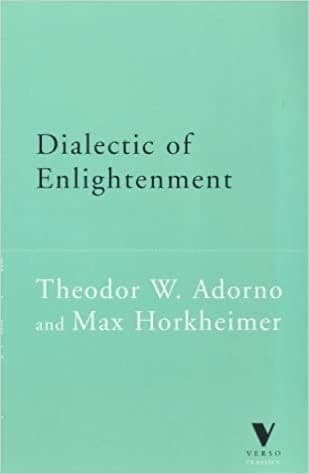
Dialectic of Enlightenment: Philosophical Fragments (Dialektik der Aufklärung: Philosophische Fragmente)

Written in wartime exile and circulated in a 1944 mimeograph before its 1947 publication, this collection of fragments argues that Enlightenment reason contains its own reversal: the drive to master nature for self-preservation culminates in a new form of myth, domination, and ultimately barbarism. The work's distinctive thesis is that instrumental reason, not premodern superstition, is the source of modern unfreedom, and that the culture industry completes the administered world by manufacturing conformity under the guise of choice. Myth is already enlightenment, and enlightenment reverts to myth.
Key Insights
✦What is the central thesis of Dialectic of Enlightenment, and what does it reject?
The central thesis is that Enlightenment rationality, in its drive to master nature for the sake of self-preservation, contains within itself the seeds of its own reversal into myth and domination. The book rejects the standard narrative that Enlightenment reason liberates humanity from superstition and arbitrary power. Instead, it argues that instrumental reason—reason reduced to a tool for calculating means—produces a new form of unfreedom, culminating in the administered society and the barbarism of fascism. The famous formulation is that myth is already enlightenment, and enlightenment reverts to myth: the very structure of rational mastery reproduces the logic of sacrifice it claims to overcome.
✦What is the publication history of the text, and how does the 1944 mimeograph differ from the 1947 edition?
The book was first circulated in 1944 as a mimeographed typescript titled Philosophische Fragmente, printed by the Social Studies Association in New York. The formal publication followed in 1947 through Querido in Amsterdam under the title Dialektik der Aufklärung . The 1944 version is significantly shorter: it lacks the chapter on the culture industry and the 'Elements of Anti-Semitism,' which were added for the 1947 edition. The 1944 mimeograph was itself a revision of an earlier 1943 typescript. The book's fragmentary form is not incidental; the authors describe it as a collection of notes and drafts, and the 'Culture Industry' chapter is explicitly called 'more fragmentary' than the rest .
✦How does John Cumming's English translation mediate the text for Anglophone readers?
John Cumming's translation, first published by Herder and Herder in 1972 and later reissued by Verso, has been the standard English access to the text for decades . Cumming rendered the German for a general readership, but his translation has been criticized for flattening some of Adorno's terminological precision and for occasional inaccuracies. The translation also reflects the 1947 German edition, not the earlier 1944 mimeograph. Readers should be aware that key terms—Aufklärung, instrumentelle Vernunft, Kulturindustrie—carry philosophical weight that Cumming's English does not always preserve. A more recent Cambridge translation by Edmund Jephcott (2002) is often preferred by scholars for its greater fidelity.
✦How has the book's argument held up since its publication, and what are the main criticisms?
The book remains enormously influential but has faced sustained criticism. The most common objection is that its diagnosis is too totalizing: by identifying instrumental reason as the root of domination everywhere, it leaves no standpoint from which resistance is possible. Habermas famously argued that the book's critique of reason is self-undermining, since it uses reason to condemn reason, and that the Frankfurt School's later turn to communicative rationality was necessary to escape this dead end . Other critics have challenged the empirical adequacy of the culture industry thesis, arguing that it underestimates audiences' capacity for critical reception. Defenders respond that the book is deliberately hyperbolic—'only exaggeration is true,' as one fragment puts it—and that its rhetorical form is integral to its critical purpose .
✦What is the relationship between Dialectic of Enlightenment and Adorno's later Negative Dialectics?
Negative Dialectics (1966) is often read as Adorno's systematic attempt to work through the philosophical implications of the earlier book's impasse. Where Dialectic of Enlightenment diagnoses the reversal of Enlightenment reason into domination, Negative Dialectics develops a method—'negative dialectics'—that refuses the reconciliation of concept and object, insisting on the non-identity that identity thinking suppresses. Adorno's project in both works is continuous: to use 'the strength of the subject to break through the fallacy of constitutive subjectivity' . The earlier book provides the historical-philosophical diagnosis; the later one provides the methodological elaboration. Adorno's defenders argue that the charge of a 'dead end' misses this continuity.
✦What common misreading of the book should readers avoid?
A persistent misreading treats Dialectic of Enlightenment as a simple rejection of reason or a counsel of irrationalism. This misconstrues the argument. Adorno and Horkheimer are not against reason as such; they are against instrumental reason's reduction of everything to calculable means. Their critique aims at rescuing a broader conception of reason that would remain open to ends, to the non-identical, to what cannot be subsumed under concepts. Another misreading treats the book as a unified treatise. It is a collection of fragments written by two thinkers with distinct temperaments, and the tension between them is part of the text's design. Reading it as a systematic theory rather than a provocation to thought misses what the authors themselves called its experimental character .
Wealthy Psyche is an intellectual archive. We do not host, distribute, or sell book copies — physical or digital. We provide structured knowledge to help you think better, faster.