


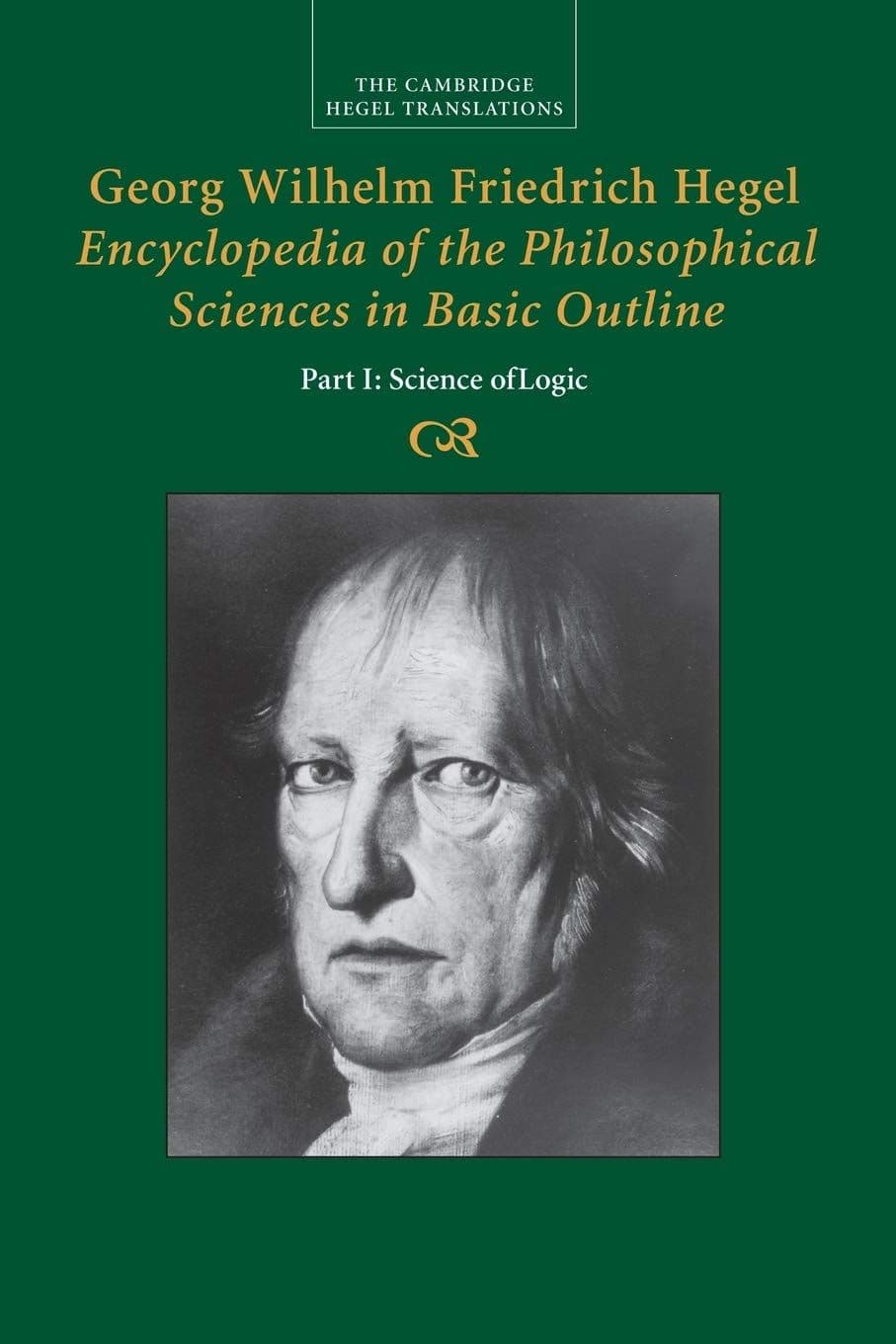
Encyclopedia of the Philosophical Sciences in Basic Outline (Enzyklopädie der philosophischen Wissenschaften im Grundrisse)

Hegel's Encyclopedia is the only work in which he published his entire mature system, presented as a compact outline for his lectures. Its distinctive structure moves through three parts—Logic, Philosophy of Nature, and Philosophy of Spirit—each disclosing the 'truth' of the preceding one. The work's central claim is that reality is a rationally articulated whole whose parts must be grasped through their systematic interconnection, not in isolation. This outline, revised across three editions, is the indispensable map to Hegel's philosophy as a unified enterprise.
Key Insights
✦What is the central claim of Hegel's Encyclopedia, and what does it reject?
The Encyclopedia's central claim is that philosophy must be a system—a rationally articulated whole in which Logic, Nature, and Spirit are not separate disciplines but moments of a single movement of thought. Each part discloses the 'truth' of the preceding one, so that the Philosophy of Spirit cannot be understood without the Logic, and the Logic finds its actuality in Nature and Spirit. Hegel rejects the fragmentation of philosophy into isolated specialisms and the Kantian idea that reason cannot grasp reality in its totality. The Encyclopedia is his answer to the question of what philosophy can be after Kant: not a critique of reason's limits but the systematic unfolding of reason's actuality.
✦Why are there three editions of the Encyclopedia, and how do they differ?
Hegel published the Encyclopedia three times: the first edition appeared in Heidelberg in 1817, the second, much enlarged edition in 1827, and the third, somewhat less expanded, in 1830 . The first edition still carries what Karl Rosenkranz called the 'creative breath' of first production, while the later editions are fuller in detail and polemical notes . The 1817 version was first translated into English in full only relatively recently, while the standard English access to the Logic and Philosophy of Spirit has typically been through editions based on the later versions. Readers should be aware that 'the Encyclopedia' is not one text but a series of increasingly elaborate outlines, and the choice of edition matters for interpretation.
✦How does the Encyclopedia relate to Hegel's other major works?
The Encyclopedia is the systematic frame within which Hegel's other works find their place. The Science of Logic was published separately in expanded form, but its outline appears as Part I of the Encyclopedia. The Philosophy of Right, published in 1821, is an expansion of the 'Objective Spirit' section of Part III, the Philosophy of Spirit . The Phenomenology of Spirit (1807) was initially conceived as the 'pathway to science,' but by the time of the Encyclopedia, Hegel had reorganized his system so that the Phenomenology's material was absorbed into the Philosophy of Spirit . Reading any of Hegel's major works in isolation risks missing the systematic relations that the Encyclopedia maps.
✦What is the significance of the 'Additions' (Zusätze) to the Encyclopedia, and how reliable are they?
The published Encyclopedia consists of Hegel's numbered paragraphs and remarks, but standard editions include 'Additions' compiled by editors from student lecture notes. For the Philosophy of Spirit, these were supplied by Boumann when the material was republished in 1845 . The Additions are often indispensable for understanding Hegel's compressed main text, but they are not from Hegel's hand and their editorial reliability varies. M. J. Petry's edition of the Philosophy of Nature and Philosophy of Spirit provides more rigorous scholarly apparatus than older translations, indicating variations between the 1827 and 1830 editions and noting manuscript sources. The authoritative critical edition of all three editions has been published in the Gesammelte Werke, with the first edition in volume 13 .
✦Why has the Encyclopedia been relatively neglected compared to the Phenomenology and the Philosophy of Right?
Despite Hegel's own claims about the centrality of the Encyclopedia system, both critics and supporters have largely devoted their efforts to the Phenomenology, the Science of Logic, or the Philosophy of Right . The reasons are partly stylistic and partly structural. The Encyclopedia is an outline for lectures, not a work of continuous prose, and its numbered paragraphs can seem forbidding without the lecture context. Its systematic scope also makes it difficult to excerpt or teach in fragments. Recent scholarship, such as the Cambridge volume on Hegel's Encyclopedia, has begun to redress this neglect by treating the Encyclopedia as the key to understanding Hegel's philosophy as a unified project rather than a collection of discrete texts.
✦What common misreading of the Encyclopedia should readers avoid?
A common misreading treats the Encyclopedia as a mere summary or abridgment of Hegel's 'real' philosophy found elsewhere—a kind of study guide to the Logic or the Philosophy of Right. This inverts the relationship. The Encyclopedia is the only form in which Hegel published his entire mature system, and the separate works are expansions or outgrowths of its parts . Another misreading assumes the three editions are substantially the same text. In fact, the differences between 1817, 1827, and 1830 are significant enough that scholars distinguish them carefully, and the first edition in particular has a concision and energy that the later expansions sometimes obscure.
Wealthy Psyche is an intellectual archive. We do not host, distribute, or sell book copies — physical or digital. We provide structured knowledge to help you think better, faster.