


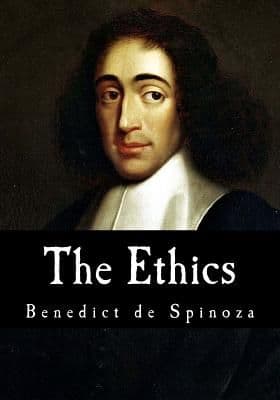
Ethics (Ethica Ordine Geometrico Demonstrata)

Spinoza's Ethics derives an account of the good life from a monistic metaphysics in which God and Nature are identical and everything follows by necessity. Written in the geometric method—definitions, axioms, propositions, demonstrations—it moves from substance and its attributes through the mind-body relation and the passions to the intellectual love of God. The work's distinctive thesis is that virtue is not obedience to external command but knowledge of necessity: only understanding, which increases our power of acting, is truly good in itself.
Key Insights
✦What is the central claim of Spinoza's Ethics, and what does it reject?
The Ethics argues that the good life consists in understanding, and that this understanding is possible only on the basis of a correct metaphysics in which God and Nature are one substance and all things follow from its necessity. It rejects the idea that God issues commands, that the will is free in an undetermined sense, and that values are external impositions on nature. For Spinoza, good and bad are relational: something is good if it increases our power of acting and understanding, bad if it diminishes them. The ethical project is therefore continuous with the metaphysical one.
✦What is the significance of the geometric method Spinoza uses?
Spinoza presents the Ethics more geometrico, in the manner of Euclid: definitions, axioms, propositions with demonstrations, corollaries, and scholia. The form is not ornamental. It expresses Spinoza's conviction that philosophical truths can be ordered deductively from self-evident starting points, and that the reader's mind can be retrained by following the demonstrations to see how conclusions follow necessarily. The scholia, where Spinoza comments in a more conversational voice, provide crucial context and polemic, but the deductive spine is meant to carry the philosophical weight. Whether the geometric form actually succeeds as demonstration has been debated since the work's publication.
✦How did the Ethics fare in its immediate reception, and why was it so controversial?
Published posthumously in 1677 in the Opera Posthuma, the Ethics was widely attacked as atheistic and morally subversive. Dutch Calvinists, Cartesian philosophers, and figures such as Pierre Bayle condemned its identification of God with Nature, its denial of divine intellect and will, and its necessitarianism, which seemed to abolish human freedom and moral responsibility. The work was read by many contemporaries through the lens of the scandal surrounding the Tractatus Theologico-Politicus, and Spinoza's philosophy was often dismissed unread. Its influence on the eighteenth-century pantheism controversy and on later German idealism came only after a long period of neglect and caricature.
✦How does the Ethics differ from Descartes' philosophy?
Spinoza accepts Descartes' conception of substance as that which is conceived through itself but draws a conclusion Descartes resisted: there can be only one substance, since a plurality of substances would limit one another. Where Descartes posits God as creator and two finite created substances, mind and body, Spinoza identifies God with the single substance and treats thought and extension as attributes of that one substance. The mind and body are not two interacting things but the same thing conceived under different attributes. Spinoza also rejects Descartes' doctrine of the free will as an independent faculty, holding that the will is not a faculty distinct from particular volitions, and that apparent freedom is the consciousness of necessity.
✦What is the intellectual love of God, and how does it conclude the Ethics?
The intellectual love of God (amor Dei intellectualis) is the culminating affect of the Ethics, presented in Part V as the mind's blessedness. It is not a sentiment of devotion toward a personal deity but the mind's adequate knowledge of God or Nature as the necessary order of things, accompanied by joy. Because this knowledge is eternal in its essence, Spinoza argues that it gives the mind a kind of eternity that is not dependent on the imagination or memory. The final propositions describe human blessedness not as a reward for virtue but as virtue itself: we do not love God because we are blessed; we are blessed because we love God, that is, because we understand.
✦How has the Ethics been misread or oversimplified?
A persistent misreading treats Spinoza as a 'pantheist' in the sense of one who divinizes the sum of finite things, or alternatively as an atheist who equates God with mere matter. Both readings miss Spinoza's insistence that God is substance and finite things are modes, not parts that add up to the whole. Another common oversimplification is to read the Ethics as a coldly rationalist denial of emotion. In fact, Spinoza devotes extensive analysis to the affects, treating them as natural phenomena to be understood rather than condemned, and his ethics aims at transforming passive affects into active ones through knowledge. The famous closing line about all things excellent being as difficult as they are rare is not irony but an acknowledgment of the work's practical demands.
Wealthy Psyche is an intellectual archive. We do not host, distribute, or sell book copies — physical or digital. We provide structured knowledge to help you think better, faster.