


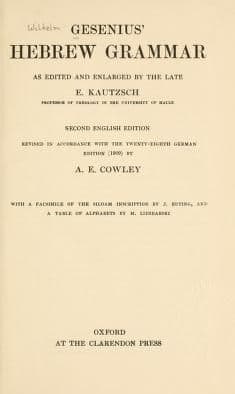
Hebrew Grammar (Compendium Grammatices Linguae Hebraeae)
Spinoza's unfinished Hebrew grammar, left in manuscript at his death and published in the 1677 Opera Posthuma, is not a devotional aid but a rationalist reform of Hebrew linguistics. Against the reverential treatment of Hebrew as a singular 'holy tongue,' Spinoza analyzes its forms as ordinary linguistic phenomena governed by general rules, aiming to account even for apparent anomalies through logical-historical reasoning. The work engages medieval Jewish grammatical debates while serving his broader exegetical project: a philological method for reading Scripture that separates textual meaning from theological dogma.
Key Insights
✦What is the central argument of Spinoza's Hebrew Grammar, and what does it reject?
The Compendium advances a rationalist account of Hebrew as a natural language whose forms, however irregular they appear, can be explained through general grammatical principles. Spinoza rejects the contemporaneous treatment of Hebrew as a uniquely 'holy tongue' exempt from ordinary linguistic analysis, seeking instead to demystify its grammar. This aligns with his broader philosophical project of reading Scripture through philological method rather than theological presupposition, treating biblical language as human language rather than as a vessel of supernatural meaning.
✦How does the Grammar relate to Spinoza's Tractatus Theologico-Politicus?
The Grammar serves as a technical companion to the exegetical method outlined in the Tractatus. In the TTP, Spinoza argues that Scripture should be interpreted from its own linguistic and historical context rather than through dogmatic theology. The Hebrew Grammar provides the linguistic groundwork for that program, offering the kind of systematic philological analysis Spinoza deemed necessary for understanding the biblical text. The two works share a common aim: to place scriptural interpretation on a rational, historical footing rather than a confessional one.
✦Why is the Grammar considered unfinished, and how does that affect its use?
Spinoza left the Compendium incomplete at his death in 1677. The editors of the Opera Posthuma noted in their preface that the work was unfinished, and internal evidence confirms this: Spinoza promises a fuller treatment of syntax that never materializes . The result is a sketch rather than a comprehensive grammar, valuable more for its methodological orientation and polemical stance than for complete pedagogical utility. Readers seeking a systematic reference grammar will not find it here; the work's interest lies in its philosophical approach to language.
✦How have modern scholars assessed the accuracy of Spinoza's grammatical claims?
Modern critics have often been quick to identify 'mistakes' in Spinoza's grammar when judged by later standards of Biblical Hebrew scholarship. Nineteenth-century editors such as Vloten and Land emended the text to make it more acceptable to contemporary grammatical expectations . However, revisionist scholarship argues that such corrections misunderstand Spinoza's project: his treatment of the shewa, for instance, responds to medieval Jewish grammatical disputes rather than anticipating modern descriptive linguistics. Judging the work by anachronistic standards obscures its actual intellectual context and argumentative purpose.
✦What is the editorial history of the text, and how reliable is the standard edition?
The Grammar first appeared in the 1677 Opera Posthuma, published posthumously by Spinoza's friends in Amsterdam. The editorial team, including Lodewijk Meyer and Jarig Jelles, worked rapidly to prepare Spinoza's manuscripts for print . Later editors, particularly Vloten and Land, made substantive emendations to the text, altering readings they deemed grammatically incorrect. The first English translation by Maurice J. Bloom appeared in 1962 . The work thus has a layered textual history in which editorial interventions have shaped how Spinoza's grammatical views have been received.
✦What common misconception about the Grammar should readers avoid?
A persistent misconception is that the Compendium is merely a beginner's primer or an elementary introduction to Hebrew. This reading underestimates the work's polemical and philosophical dimensions. Spinoza was not simply compiling rules for language learners; he was intervening in a long-standing debate about the nature of Hebrew and its relationship to scriptural authority. The Grammar's brevity and incomplete state have contributed to this misreading, but its content reveals a sophisticated engagement with medieval grammatical tradition and a deliberate program of linguistic demystification.
✦How does Spinoza's approach to Hebrew grammar differ from that of his Jewish predecessors?
Spinoza drew on medieval Jewish grammarians—Rashi, Abraham ibn Ezra, the Qimhi family, and others—yet departed from them in a crucial respect. Where traditional grammars often treated Hebrew as the language of divine revelation, requiring special hermeneutical deference, Spinoza approached it as a human language to be analyzed by the same rational methods applicable to any idiom . He used his predecessors' empirical observations while rejecting the theological framework that had often constrained their work, thereby transforming Hebrew grammar into a branch of naturalistic philology.
Wealthy Psyche is an intellectual archive. We do not host, distribute, or sell book copies — physical or digital. We provide structured knowledge to help you think better, faster.