


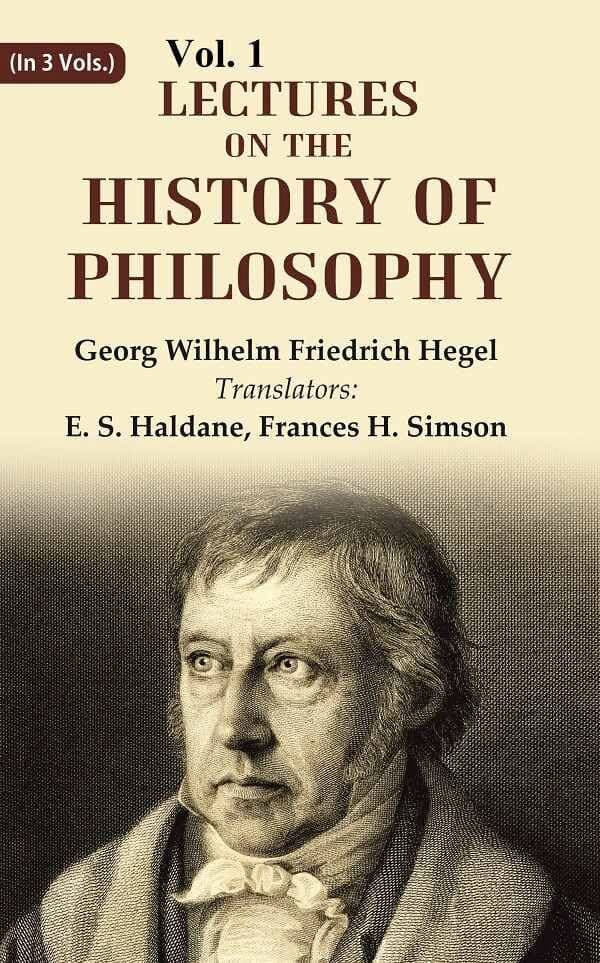
Lectures on the History of Philosophy (Vorlesungen über die Geschichte der Philosophie)

Hegel's Berlin lectures on the history of philosophy advance the provocative thesis that the history of philosophy is not a graveyard of opinions but philosophy itself—reason's progressive coming-to-self-consciousness through time. The lectures organize the whole history of thought from the Orient to Hegel's present as a single systematic development, in which each philosophy is a necessary moment in spirit's self-articulation. The work's distinctive method is immanent critique: the historian of philosophy must grasp each thinker's principle from within before demonstrating its one-sidedness and its sublation into a higher form.
Key Insights
✦What is the central claim of Hegel's Lectures on the History of Philosophy, and what does it reject?
The central claim is that the history of philosophy is not a collection of dead opinions or a mere succession of errors, but philosophy itself in its temporal unfolding. Reason or spirit develops through history, and each philosophical system is a necessary stage in that development. Hegel rejects the antiquarian approach that treats past philosophies as objects of mere historical curiosity, as well as the skeptical view that the history of philosophy proves the futility of philosophical inquiry. For Hegel, the succession of systems is not a refutation of philosophy but its actualization—the process through which spirit comes to know itself.
✦How did Karl Ludwig Michelet's editorial work shape the published text, and why is it controversial?
Michelet compiled the lectures from Hegel's manuscripts and student transcripts, publishing the first edition in 1833–36 and a revised second edition in 1840–44. The second edition, which the standard Haldane-Simson English translation renders, is widely regarded as the more problematic of the two: Michelet smoothed over differences among the lecture cycles to produce a text that reads like a single coherent book from Hegel's hand, but in doing so he blurred the development of Hegel's thought and the distinctiveness of individual lecture courses . Modern critical scholarship treats Michelet's editions as editorially constructed narratives rather than faithful transcriptions, though the first edition remains the richest compilation of source material available.
✦Why is the Haldane-Simson English translation considered outdated by contemporary scholars?
The Haldane-Simson translation, first published between 1892 and 1896, was based on Michelet's second German edition of 1840–44—the edition that modern editors regard as the least reliable because of its aggressive smoothing and blending of source materials . The translation thus transmits a doubly mediated text: Michelet's editorial reconstruction rendered into English. Since the late twentieth century, new critical editions of the Berlin lectures have reconstructed individual lecture cycles from surviving transcripts, most notably the 1825–26 course, which is attested by five separate transcripts . Robert F. Brown's 2009 Oxford translation of the 1825–26 lectures offers English readers access to a more philologically responsible reconstruction, though it complements rather than replaces the fuller Michelet compilation.
✦How does Hegel's approach to the history of philosophy differ from Kant's or from the historicist traditions that followed?
Hegel's approach differs from Kant's in denying that the history of philosophy is merely a chronicle of reason's errors and approximations. For Hegel, the history of philosophy has a rational structure because reason itself is historical: the sequence of philosophical systems is the necessary self-explication of the Idea. This also distinguishes Hegel from later historicists who treat philosophical systems as products of their cultural or social contexts. Hegel does not reduce thought to context; he argues that the context is itself a moment in the development of thought. The history of philosophy is therefore neither a contingent sequence nor a neutral record but the systematic science of spirit's self-knowledge in time.
✦What role do the Oriental philosophy sections play in the lectures, and how have they been received?
The lectures begin with Chinese and Indian philosophy, which Hegel treats as the earliest, most abstract forms of spirit's self-consciousness. These sections have been criticized for relying on limited and often secondhand sources and for imposing a Eurocentric developmental schema on non-Western thought. The new critical edition of the 1825–26 lectures devotes its first volume to the Introduction and Oriental Philosophy, making available for the first time in English a reliable reconstruction of what Hegel actually said in a single course . The Oriental sections remain valuable less as accurate historical scholarship than as evidence of Hegel's systematic ambition and the limits of his philosophical universalism.
✦What common misreading of the lectures should readers avoid?
A common misreading treats the lectures as a neutral history of philosophy that can be consulted for Hegel's views on individual thinkers without engaging his systematic claims. This obscures the work's polemical purpose: Hegel is arguing that the history of philosophy is itself a philosophical science, not a subordinate discipline. Another misreading assumes Hegel simply imposes his own system onto the past, distorting each thinker to fit a predetermined schema. While Hegel's interpretations are certainly shaped by his system, his method of immanent critique requires him to grasp each philosophy on its own terms before demonstrating its limitations. The lectures are not a projection but an argument about how to read the history of thought philosophically.
Wealthy Psyche is an intellectual archive. We do not host, distribute, or sell book copies — physical or digital. We provide structured knowledge to help you think better, faster.