


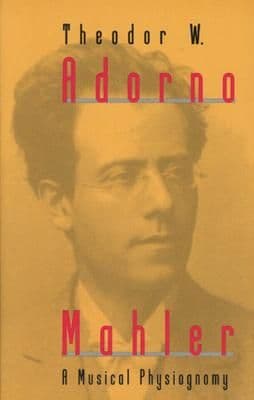
Mahler: A Musical Physiognomy
Adorno's study of Mahler rejects conventional thematic analysis in favor of reading the music's surface as a physiognomy—a legible inscription of historical and social experience. The central mechanism is the 'breakthrough' (Durchbruch): Mahler's symphonies stage the eruption of utopian possibility only to register its failure, and this failure is the music's truth. Mahler's collagelike absorption of banal, vulgar, and anachronistic material—street songs, marches, kitsch—is not a weakness but the compositional technique through which the damaged world becomes audible within the artwork's form.
Key Insights
✦What does Adorno mean by a 'musical physiognomy,' and what does it reject?
Adorno's term signals a method of reading musical surfaces for traces of historical and social experience, much as one reads a face. He explicitly rejects traditional thematic analysis, which he argues misses the music's substance by fixating on procedural identification of themes and their development . Instead, the physiognomist attends to the idiosyncratic, the seemingly incidental, the ruptures and discontinuities in Mahler's texture—the marches, folk tunes, and banal fragments that conventional analysis treats as noise or weakness. These surface features are legible as sedimented social content. The method is anti-systematic by design, refusing to reduce Mahler's symphonies to a unified organic development.
✦What is the 'breakthrough' in Mahler, and why does its failure matter?
The breakthrough (Durchbruch) is Adorno's name for the moment in Mahler's symphonies when the music seems to rupture its own formal immanence and gesture toward something beyond—a utopian arrival. But the breakthrough always fails; it cannot be sustained, and the music falls back into the world's course. For Adorno, this failure is not an artistic defect but the music's truth-content. To realize the breakthrough musically would be to attest to its realization in reality, which is false. Mahler's symphonies therefore keep faith with the possibility of redemption precisely by refusing to depict it as achieved. The recapitulation after a breakthrough shrinks, the moment passes, and the music registers the damage rather than healing it.
✦Why does Adorno celebrate Mahler's absorption of kitsch and vulgar material?
Adorno argues that Mahler's symphonies deliberately draw in what culture has spurned as wretched and mutilated—street ballads, popular songs, banal marches . This is not a lapse of taste but a compositional strategy: the artwork opens its arms to the derelict residue of the social world. In Mahler, what was 'involuntarily vulgar' in earlier music becomes a provocative alliance with vulgarity . The construction of the symphony unties the tongue of the kitsch, allowing it to speak rather than merely decorate. For Adorno, this distinguishes Mahler from the culture industry's administered pleasure: the vulgar material is not smoothed over but held in tension, registering the world from which it was cut.
✦How does this book relate to Adorno's Philosophy of Modern Music?
Mahler: A Musical Physiognomy extends the material theory of music developed in Philosophy of Modern Music but applies it to a composer who fits neither the Schoenberg nor the Stravinsky pole. Mahler's music, for Adorno, resists the total rationalization of twelve-tone technique while also refusing neoclassical restoration. Instead, it works through rupture, interruption, and the absorption of heterogeneous material. The book thus functions as a third term in Adorno's musical dialectic: a modernism that achieves critical force not through systematic construction but through the physiognomic registration of social contradiction. Adorno had already defended Mahler against the charge of late-Romantic obsolescence in his 1930 essay 'Mahler Today,' and the monograph deepens that defense .
✦How faithful is Edmund Jephcott's translation, and what is the text's publication history?
The German original, Mahler: Eine musikalische Physiognomik, was first published in 1960 by Suhrkamp Verlag . Edmund Jephcott's English translation appeared in 1992 from the University of Chicago Press, with a paperback edition in 1996 . Jephcott was an experienced translator of Adorno, and the Chicago edition is generally regarded as serviceable and readable, though Adorno's prose poses inherent difficulties that any translation must negotiate. Scholarship on translating Adorno—such as Susan Gillespie's work on the relation between his language and music—notes that his style resists smooth English rendering, and the translator's choices inevitably shape the reader's encounter with the argument . Readers should approach the English text as an interpretation, not a transparent window.
✦What is a common misreading of Adorno's Mahler book?
A frequent misreading treats Adorno's admiration for Mahler as a straightforward endorsement of the composer's emotional expressiveness or Romantic sincerity. In fact, Adorno's Mahler is deeply suspicious of subjective expression as a transparent category. He insists that the subjectivity projected into Mahler's music is fictive, not a direct transcription of the artist's psyche . The music's desubjectivization—its tendency to let material speak rather than the composer's ego—is central to its critical force. Adorno's Mahler is not a late Romantic pouring out feeling but a composer who lets the damaged world's fragments sound within the symphonic form, which is a far more austere and modernist claim.
Wealthy Psyche is an intellectual archive. We do not host, distribute, or sell book copies — physical or digital. We provide structured knowledge to help you think better, faster.