


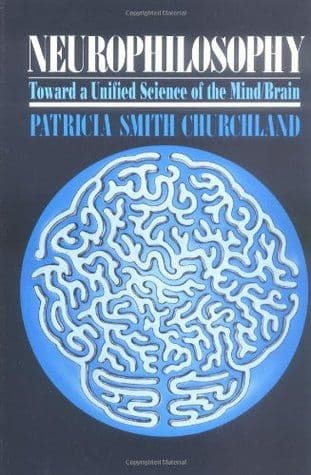
Neurophilosophy: Toward a Unified Science of the Mind-Brain

Churchland's central claim is that philosophy of mind must be conducted within the framework of neuroscience, not as an autonomous a priori discipline. Mental processes are brain processes, and the categories of folk psychology will either be reduced to or replaced by a mature neurobiology. The book's method is intertheoretic reduction: showing how psychological theories can be integrated with neuroscientific ones through co-evolution, with each discipline correcting and reshaping the other. Churchland argues that philosophers who ignore the brain are working with an obsolete picture of what the mind is, and that a unified science of the mind-brain is both possible and necessary.
Key Insights
✦What is the central claim of Neurophilosophy, and what does it reject?
Churchland's central claim is that mental processes are brain processes, and that philosophy of mind must be conducted within the framework of the neurosciences rather than as an autonomous discipline of conceptual analysis. She rejects the view that philosophy can determine the nature of mind through a priori reasoning alone, arguing that detailed knowledge of the organization and structure of nervous systems is necessary for an adequate theory of the mind/brain . The book's method is intertheoretic reduction: showing how psychological theories and neuroscientific theories can co-evolve and eventually mesh, with each correcting the other . Churchland's target is not philosophy as such but the anti-scientific bias she sees in much mainstream philosophy of mind.
✦What role does intertheoretic reduction play in the book's argument?
Intertheoretic reduction is the book's central methodological tool. Churchland argues that the relationship between psychology and neuroscience should be understood on the model of reduction in the physical sciences: a reduced theory is explained by a reducing theory, with corrections made along the way. She likens the co-evolution of the two disciplines to 'two rock-climbers making their way up a wide chimney by bracing their feet against the wall, each braced against the back of the other' . This model allows her to argue that psychology need not be eliminated outright; it can be corrected and integrated into a unified neurobiology. The concept of reduction is important because she sees the reducibility of psychology to neuroscience as the central question in philosophy of mind .
✦How was Neurophilosophy received by contemporary reviewers?
Reception was mixed but acknowledged the book's pioneering status. MIT Press quotes F.H.C. Crick calling it 'a pioneering work,' and Daniel Dennett praising it as exactly the introduction philosophers need to neuroscience and neuroscientists need to philosophy . However, Kathleen Akins, reviewing in The Journal of Philosophy, argued that the book attempts too much: 'the scope of this project is too wide—what Neurophilosophy does is to compress the work of several volumes into one,' resulting in a work that is 'both philosophically sketchy and, at points, unclear in its intent' . A reviewer in the British Medical Journal was more sharply critical of Churchland's treatment of property dualism, arguing that her response to Nagel and Jackson 'founders on the fallacy of equivocation' and misses the point .
✦What is the book's structure, and how does it serve its argument?
The book is divided into three parts. The first, 'Some Elementary Neuroscience,' sketches the history of nervous system science and provides an introduction to neurophysiology, neuroanatomy, and neuropsychology . The second, 'Recent Developments in the Philosophy of Science,' places the mind-body problem within the philosophy of science and develops the account of intertheoretic reduction . The third, 'A Neurophilosophical Perspective,' discusses theoretical developments in functional neurobiology and connectionist models in AI . This structure embodies Churchland's argument: philosophers need enough neuroscience to engage the literature, and neuroscientists need enough philosophy to understand the conceptual stakes. The tripartite organization is itself a pedagogical enactment of the unification the book advocates.
✦How does Neurophilosophy relate to Churchland's later work, particularly Brain-Wise?
Brain-Wise (2002) is the explicit sequel to Neurophilosophy. MIT Press describes Brain-Wise as the follow-up to 'the book that launched a subfield,' examining old questions about consciousness, the self, and free choice within the new framework of the brain sciences . Where Neurophilosophy laid out the programme and its methodological commitments, Brain-Wise applies the neurophilosophical approach to specific philosophical problems and takes stock of developments in neuroscience over the intervening sixteen years. Churchland's later books, including Braintrust (2011) and Conscience (2019), extend the same naturalistic method into ethics. Neurophilosophy remains the foundational statement of the project that these later works develop and apply.
✦What is a common misconception about Neurophilosophy's relationship to eliminative materialism?
A frequent misconception is that Neurophilosophy is a straightforward manifesto for eliminative materialism—the thesis that folk psychology will be eliminated rather than reduced. Churchland's position is more nuanced. She argues that folk psychology is 'in trouble' and may require significant revision, but she does not claim that all mentalistic vocabulary will simply disappear . In later interviews, Churchland has said she no longer uses the term 'eliminative materialism' because it is widely misunderstood, while maintaining that how much folk theory will change remains an open question . The book's central argument is about the relationship between philosophy and neuroscience, not about the wholesale elimination of mental talk. The reductionist framework allows for correction and integration, not only replacement.
Wealthy Psyche is an intellectual archive. We do not host, distribute, or sell book copies — physical or digital. We provide structured knowledge to help you think better, faster.