


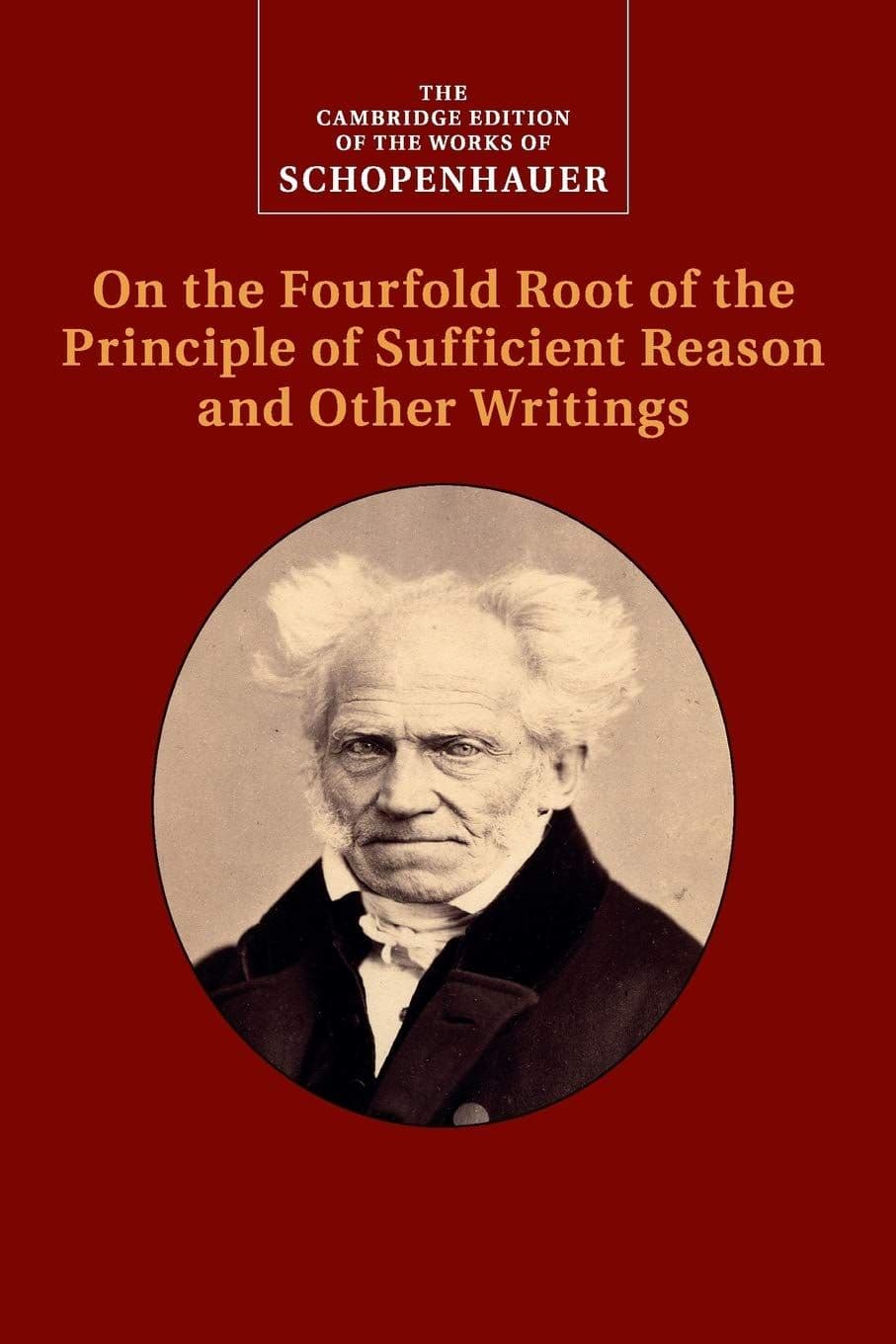
On the Fourfold Root of the Principle of Sufficient Reason
On the Fourfold Root is Schopenhauer's 1813 doctoral dissertation, and its distinctive mechanism is the demonstration that the principle of sufficient reason—far from being a single axiom—articulates four irreducible forms of explanation corresponding to the four classes of objects. Schopenhauer argues that confusion in philosophy arises from illegitimately applying a form of explanation proper to one class of objects to another. The text's central claim is that the principle is rooted in the subject-object structure of representation itself, making it the formal condition of all inquiry rather than a metaphysical ground of reality.
Key Insights
✦What is the central argument of the Fourfold Root, and what does it reject?
Schopenhauer's governing claim is that the principle of sufficient reason (PSR)—the assumption that everything has a reason or ground—is not a single, univocal law but articulates four distinct forms of explanation, each corresponding to a class of objects: becoming (causality), knowing (logical grounding), being (spatiotemporal determination), and acting (motivation) [citation:14]. What the text rejects is the rationalist tendency to treat the PSR as a metaphysical principle that can explain reality as a whole. Schopenhauer argues that the PSR is rooted in the subject-object structure of representation and therefore governs only the relations among representations, not the thing-in-itself [citation:14]. Philosophical errors arise when one form of explanation is illegitimately applied to a domain governed by another.
✦What are the four classes of objects and their corresponding forms of the principle?
The four classes are: (1) intuitive, empirical representations (objects of perception in space and time), governed by the principle of sufficient reason of becoming, or causality; (2) abstract concepts (objects of reason), governed by the principle of sufficient reason of knowing, or logical grounding; (3) pure intuitions of space and time (the forms of intuition themselves), governed by the principle of sufficient reason of being, or mathematical determination; and (4) the subject of willing, governed by the principle of sufficient reason of acting, or motivation [citation:14]. Schopenhauer contends that these four exhaust the ways subject and object can be fundamentally related, and that each form of explanation is irreducible to the others.
✦How does the Fourfold Root relate to Kant's Critique of Pure Reason?
The text is a critical revision of Kant. Schopenhauer adopts Kant's fundamental insight that the world of experience is structured by the subject's cognitive forms, and he follows Kant in seeking the a priori conditions of experience. But he rejects Kant's attempt to derive a single table of categories and his notion of a thing-in-itself that is entirely unknowable. Schopenhauer argues that the fourfold structure of the PSR is more fundamental and more accurate than Kant's twelve categories, and he insists that the thing-in-itself is not a mysterious beyond but is accessible as the will [citation:2][citation:14]. The Fourfold Root thus lays the epistemological groundwork for the metaphysics of will that Schopenhauer would develop six years later.
✦Why did Schopenhauer revise the dissertation in 1847, and how does the second edition differ?
The first edition of 1813 was written under Kantian and post-Kantian influences that Schopenhauer later sought to distance himself from. The revised 1847 edition, which became the standard version, is nearly twice as long and contains substantial new material, including a lengthy polemic against Hegel and the German Idealists. Schopenhauer clarified his position, sharpened his critique of Kant's category theory, and integrated the Fourfold Root more explicitly into his mature system. Recent scholarship emphasizes that the 1847 edition should be read as a critical investigation into the limits of metaphysical explanation rather than merely as an early prelude to the will-metaphysics [citation:6]. Readers should be aware that the text they encounter in modern translations is the revised version, not the original dissertation.
✦What is the most common misreading of the Fourfold Root's purpose?
A persistent misreading treats the text as a foundational doctrine for Schopenhauer's metaphysics of will, as though it were simply an early statement of conclusions he would later apply. Recent scholarship argues that the Fourfold Root functions as a critical and immanent framework for structuring possible explanation, not as a metaphysical grounding principle [citation:6]. The text's aim is to constrain illegitimate transitions between epistemic justification and ontological explanation, and to show that causal claims are restricted to intra-phenomenal relations. Reading it as a proto-metaphysics of will misses its critical, Kantian function: it is an investigation into the limits of explanation within experience, not a doctrine of ultimate ontological grounds.
✦Which English translation of the Fourfold Root should a serious reader use?
The standard scholarly translation is E. F. J. Payne's, first published by Open Court and reprinted by Hackett, based on the 1847 second edition [citation:2]. F. C. White's translation of the 1813 first edition, with commentary, is valuable for tracing the text's development [citation:2]. The 1889 Hillebrand translation in Two Essays was the first English version and remains historically significant, but it is based on Frauenstädt's fourth German edition and lacks the precision of Payne's rendering [citation:3][citation:7]. For readers seeking the mature Schopenhauer, Payne is the clear choice; for scholars interested in the dissertation's original form, White's edition is indispensable.
Wealthy Psyche is an intellectual archive. We do not host, distribute, or sell book copies — physical or digital. We provide structured knowledge to help you think better, faster.