


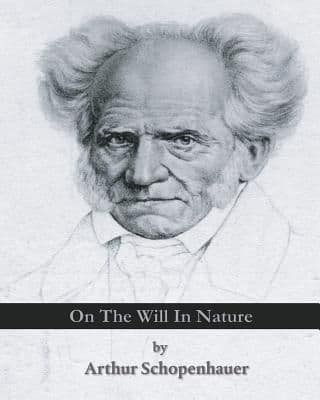
On the Will in Nature
On the Will in Nature is Schopenhauer's attempt to provide empirical corroboration (Bestätigung) for the metaphysical thesis of his earlier masterwork: that the inner essence of every natural phenomenon is will. Its distinctive mechanism is a reversal of argumentative direction. Where The World as Will and Representation begins from the subjective certainty of the will in self-consciousness and moves outward, this text begins from the objective findings of the empirical sciences—physiology, comparative anatomy, plant physiology, astronomy, and even linguistic and Sinology—and argues backward to the same conclusion. Schopenhauer presents the philosopher and the scientist as two workers digging a tunnel from opposite ends until they meet.
Key Insights
✦What is the distinctive argumentative strategy of On the Will in Nature, and how does it differ from The World as Will and Representation?
The text reverses the argumentative direction of Schopenhauer's masterwork. In The World as Will and Representation, the argument proceeds subjectively: it begins with the immediate, inner awareness of the will in one's own body and uses this as the key to understanding the inner nature of all phenomena. On the Will in Nature proceeds objectively: it starts from the findings of the empirical sciences and argues backward to the conclusion that the thing-in-itself behind all natural phenomena is will [citation:2][citation:7]. Schopenhauer himself described the two approaches as two people digging a tunnel from opposite ends who meet in the middle—the philosopher from within, the scientist from without [citation:6]. The book's central concept is Bestätigung: the scientific corroboration of philosophical knowledge [citation:7].
✦Why did Schopenhauer publish this work in 1836, seventeen years after his main work?
Schopenhauer was deeply frustrated by the neglect of The World as Will and Representation after its publication in 1819. He believed his philosophy explained the existence of the world with revolutionary clarity, and he sought a new way to disseminate it [citation:7]. Breaking what he called a 'silence after seventeen years,' he published On the Will in Nature as a strategic intervention. Rather than restating his metaphysics abstractly, he gathered empirical evidence from contemporary natural science to demonstrate that his doctrine was not speculative fantasy but was confirmed by the best available research. In an 1851 letter, he described the essay as having 'great specific value' because it 'proclaims the kernel of my metaphysics, the real nervus probandi of the thing' more exhaustively than any other treatise he had written [citation:7].
✦What specific scientific fields does Schopenhauer draw upon as corroboration?
The text ranges across an ambitious array of disciplines. The chapters include Physiology and Pathology, Comparative Anatomy, Physiology of Plants, Physical Astronomy, Linguistics, Animal Magnetism and Magic, Sinology, and a Reference to Ethics [citation:4]. In comparative anatomy, he argues that the structural adaptations of animals reveal an underlying striving that is best understood as will. In plant physiology, he examines tropisms—the spontaneous movements of plants toward light and moisture—as evidence of a force analogous to will operating below consciousness [citation:15]. In physical astronomy, he finds in the harmony of celestial motions a reflection of the same unitary will that manifests in human striving. The Sinology chapter engages with Confucian thought, particularly the concept of Tian (Heaven), as an indirect confirmation of his own philosophy, though recent scholarship shows his understanding was mediated by secondhand translations and selective reading [citation:14].
✦What is the most serious philosophical tension in On the Will in Nature's method?
The tension is between the text's realistic, scientific standpoint and Schopenhauer's usual idealistic framework. In his earlier works, Schopenhauer argues from a Kantian-inspired idealism: space, time, and causality are forms imposed by the knowing subject, and the entire phenomenal world—including the brain—is a representation constituted by these forms. In On the Will in Nature, however, he adopts what scholars describe as a realistic standpoint, treating physical nature as fundamental and treating the brain as an organ situated within nature [citation:6]. This creates a circularity: the text uses the brain to explain the world, while the world (including the brain) was previously explained as a product of the subject's cognitive forms. Schopenhauer was aware of this methodological shift but did not fully resolve it, presenting the two standpoints as complementary approaches to the same truth rather than a single consistent argument.
✦How was the text received, and what is its status in Schopenhauer scholarship?
For much of the twentieth century, On the Will in Nature was marginalized in Schopenhauer scholarship, treated as a lesser supplement to The World as Will and Representation. Marco Segala's 2010 study noted that the book is 'generally underestimated by scholars interested in Schopenhauer's philosophy' [citation:7]. However, more recent scholarship has begun to reassess its importance. Segala argues that the text is crucial for understanding Schopenhauer's conception of the relationship between philosophy and empirical science, and that its notion of Bestätigung reveals how Schopenhauer thought metaphysical claims could be validated. The 1992 translation by E. F. J. Payne, edited by David E. Cartwright, made the text more widely available in English and contributed to this reassessment .
✦What is the most common misreading of On the Will in Nature?
A persistent misreading treats the text as an attempt to prove the existence of the will through empirical evidence, as though Schopenhauer were offering inductive arguments from science to metaphysics. This misunderstands the concept of Bestätigung. Schopenhauer does not claim that science proves his metaphysics; he claims that science, properly interpreted, corroborates what philosophy has already established through a different route. The empirical findings are not premises from which the conclusion follows but confirmations that the philosophical insight is not arbitrary [citation:7]. Reading the text as a work of natural science or as an inductive proof misses its rhetorical and strategic function: it was written to persuade a scientific age that Schopenhauer's metaphysics was consonant with, not opposed to, empirical inquiry.
Wealthy Psyche is an intellectual archive. We do not host, distribute, or sell book copies — physical or digital. We provide structured knowledge to help you think better, faster.