



Panchikarana
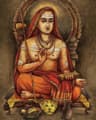
The Panchikarana is a brief Prakarana treatise attributed to Adi Shankara that explains how the five subtle elements (tanmatras) combine to form the gross elements (mahabhutas) that constitute the physical world. Its central mechanism is a precise numerical formula: each subtle element is divided into two halves, one half is further divided into four parts, and each quarter is combined with one half of each of the other four elements. This quintuplication (panchikarana) accounts for the mixed, composite nature of gross matter and the corresponding physical body, explaining how insentient elements give rise to the differentiated universe without compromising Advaita's non-dual reality.
Book Archives
Detailed research articles, summaries and analyses from this book.
 Archive
The Mechanics of Liberation: Understanding Jivanmukti
 Archive
Consciousness and the Quantum Vacuum: A Vedantic Perspective
 Archive
Refuting The External World: Gaudapada’s Karika Analyzed
 Archive
Vichara-Sagara: A Deep Dive into Non-Dual Enquiry
 Archive
The Silence of the Sages: Understanding Dattatreya's Avadhuta Gita
 Archive
The Role of Negation (Neti Neti) in Absolute Realization
 Archive
The Secret Logic Behind Advaita's Theory of Maya
 Archive
Why Shankaracharya Rejected Buddhist Emptiness
 Archive
Brahma Sutra Bhashya: Decoding the Bhashyakara's Method
 Archive
The Hidden Meaning of Turiya in the Mandukya Upanishad
Key Insights
✦What is the central argument of the Panchikarana, and what does it explain?
The Panchikarana's central argument is that the gross elements (mahabhutas) and the physical body are not simple, homogeneous substances but composite products of the five subtle elements (tanmatras) through a precise process of division and recombination. The text opens by tracing the emanation from Brahman through the unmanifest (avyakta), Mahat, Ahamkara, and the five tanmatras to the gross elements and the entire world [citation:1]. Its purpose is to explain how the differentiated, insentient material world can arise from a non-dual reality without compromising Advaita's claim that Brahman is the sole reality. The Panchikarana thus provides the cosmological framework that complements Advaita's epistemology and soteriology, accounting for the physical universe that serves as the field of bondage and liberation.
✦What is the exact numerical formula of panchikarana, and how does it work?
The formula is precise: each of the five subtle elements is divided into two halves. One half remains intact. The other half is divided into four quarters. Each of these quarters is then combined with one half of each of the other four elements. The result is a gross element that is predominantly (one half) its own subtle source, with one-eighth portions of each of the other four elements . For example, the gross element 'earth' consists of one half subtle earth, one-eighth subtle water, one-eighth subtle fire, one-eighth subtle air, and one-eighth subtle ether. This quintuplication explains why gross elements exhibit mixed qualities rather than pure ones, and why the physical body, composed of these gross elements, is a composite of all five rather than any single element.
✦What is the scholarly debate about the authenticity of the Panchikarana's attribution to Shankara?
The attribution has been both defended and questioned. Vidyasankar Sundaresan's 2002 study in Philosophy East and West argues that through comparative analysis with Shankara's commentaries on the Gita and principal Upanishads, the Panchikarana is 'most probably genuine' . The text's authenticity is also supported by the existence of a Varttika (verse commentary) by Sureshvaracharya, Shankara's direct disciple, and commentaries by Anandagiri and others [citation:10][citation:12]. However, some scholars have doubted the attribution because the text's terminology—tanmatra, avyakta, mahat, ahamkara—suggests a Samkhya influence that some consider uncharacteristic of Shankara. Defenders respond that Shankara elsewhere accepts Samkhya terminology for describing the gunas while rejecting its dualistic metaphysics [citation:10].
✦How does the Panchikarana relate to the Chandogya Upanishad's teaching of trivritkarana?
The Panchikarana extends and modifies the Chandogya Upanishad's earlier teaching of trivritkarana (threefold division), in which each element is divided into three parts rather than five . The shift from threefold to fivefold division reflects a later cosmological refinement within the Vedantic tradition. F. Max Müller noted that panchikarana is 'not to be found in the ancient Vedanta' but belongs to 'the refinements, and not always improvements, of a later age' [citation:7]. Shankara's Panchikarana thus represents a stage in the development of Advaita cosmology where the earlier Upanishadic model was replaced by a more elaborate scheme capable of explaining the full complexity of gross matter and the physical body. The text's authority in the Advaita tradition derives from its attribution to Shankara, even though the fivefold model itself postdates the earliest Upanishads.
✦What role does the Panchikarana play in the broader Advaita teaching on the body and liberation?
The Panchikarana provides the cosmological groundwork for Advaita's analysis of the body as non-self. By explaining how the physical body is composed of quintuplicated gross elements, the text demonstrates that the body is a product of insentient matter, not the conscious self. This supports the practice of discrimination (viveka) between the self and the five sheaths (pancha kosha), which is central to Advaita pedagogy. The text is often studied alongside works like Atma Anatma Viveka, which explicitly uses the panchikarana process to clarify the gross universe's origin and establish the difference between Atman and the body [citation:15]. Understanding panchikarana thus serves both a cosmological and a soteriological function: it explains the world and simultaneously undermines the identification with the body that perpetuates bondage.
Wealthy Psyche is an intellectual archive. We do not host, distribute, or sell book copies — physical or digital. We provide structured knowledge to help you think better, faster.