


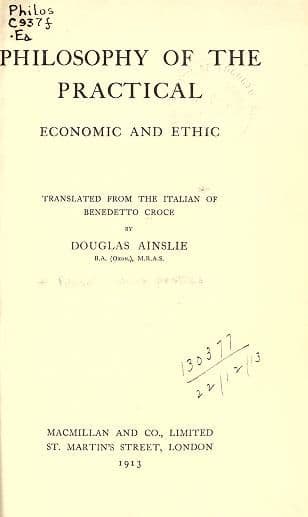
Philosophy of the Practical: Economic and Ethic (Filosofia della Pratica: Economica ed Etica)

Croce's Philosophy of the Practical completes his Philosophy of the Spirit by analyzing volition as a distinct spiritual activity with two internal forms: the economic, which pursues individual ends, and the ethical, which wills universal ends. The work's distinctive thesis is that these forms stand in a relation of 'double degree' rather than parallel species: economic action can exist independently of ethics, but ethical action is inconceivable without the utility it transcends. Croce uses this structure to dismantle the Kantian notion of 'disinterested' moral action, arguing that every ethical act is always also 'ethico-useful.'
Key Insights
✦What is the central argument of Philosophy of the Practical, and what does it reject?
The central argument is that practical activity divides into two forms—the economic and the ethical—related not as parallel species but as a 'double degree.' Economic activity wills what corresponds only to an individual's actual conditions; ethical activity wills the universal while remaining rooted in those same conditions. The work rejects the Kantian schema of 'disinterested' moral action, which Croce regarded as an absurd abstraction. Every ethical act, he argues, is 'ethico-useful': it always passes through individual utility even as it transcends it toward universality. The rejection of abstract moralism is the polemical core of the book.
✦What does Croce mean by the 'double degree' of economic and ethical activity?
The 'double degree' (doppio grado) is Croce's structural claim that the economic form of volition can be conceived in its independence from the ethical, but the ethical cannot be conceived without the economic. Utility has its own autonomous sphere—it is not yet morality, but it is not immoral either. Ethics, by contrast, is always embodied in actions that are also useful; there are no ethical acts that float free of the conditions of fact in which an agent finds himself. This structure is meant to correct the traditional error of treating economy and ethics as two coordinated species of a common genus, a schema Croce traced to Kant and other moralists who imagined 'actions disinterested' in any contact with utility.
✦How does the Philosophy of the Practical relate to Croce's earlier Aesthetic and Logic?
The Philosophy of the Practical is the third volume of Croce's Philosophy of the Spirit, following the Aesthetic (1902) and the Logic (1909). The earlier volumes established the two forms of theoretical activity—intuition and concept—and the practical volume completes the system by analyzing the two forms of volition. In the architecture of the system, practical activity presupposes theoretical activity: we cannot will what we have not first intuited and thought. But the practical sphere has its own autonomy. The Aesthetic dealt with images, the Logic with concepts; the Philosophy of the Practical deals with actions, and its task is to show how the will creates the future rather than merely reproducing what the intellect has already grasped.
✦How did the book's first English translation and its reception shape its Anglophone legacy?
Douglas Ainslie's translation appeared in 1913 with Macmillan, five years after the Italian original. A contemporary review in the International Journal of Ethics described the work as 'fundamentally Hegelian' in temper, noting that Croce's system treats Reality as Spirit and divides spiritual activity into theoretical and practical forms. The reviewer observed that Croce had dealt with theoretical activity in two earlier works and was now completing his exposition of reality. Ainslie's preface claimed the book contained 'hardly a trace of Hegel,' a judgment the reviewer found difficult to square with the dialectical structure of the argument. The translation has been reprinted numerous times and remains the standard English access to the text, though its philosophical vocabulary mediates Croce's Italian for an Anglophone audience.
✦What is the significance of Croce's claim that 'we err only because we wish to err'?
This claim, developed in the section on the practical origin of error, is one of the book's most original and controversial moves. Croce argues that theoretical error cannot arise from the theoretical sphere alone, since the intellect as such is not the source of falsity. Error requires an act of will: a practical act that simulates the theoretical one, abusing the means of communication—words or expressions as physical facts—to signify what cannot genuinely be signified. The doctrine has Cartesian precedents, since Descartes located error in the will's extension beyond the intellect's limits, but Croce rejects Descartes' theological framework and reverses the emphasis: the will is not a boundless faculty but the very medium through which error enters thought. The claim has been criticized for making error seem voluntary in a way that strains credulity, but it is integral to Croce's insistence on the unity of the spirit.
✦What common misreading of the Philosophy of the Practical should readers avoid?
A common misreading treats Croce's defense of the autonomy of the economic sphere as an endorsement of utilitarianism or laissez-faire economics. This mistakes his philosophical point for a normative program. Croce is not arguing that economic action is the highest form of life or that utility should govern conduct; he is arguing that utility is a genuine and irreducible form of spiritual activity that cannot be dissolved into ethics or dismissed as merely natural. The economic form has its own logic and dignity, but it is the lower degree of practical activity. The ethical form does not abolish it but incarnates itself within it. The misreading that sees Croce as a theorist of pure utility misses the 'double degree' entirely.
Wealthy Psyche is an intellectual archive. We do not host, distribute, or sell book copies — physical or digital. We provide structured knowledge to help you think better, faster.