


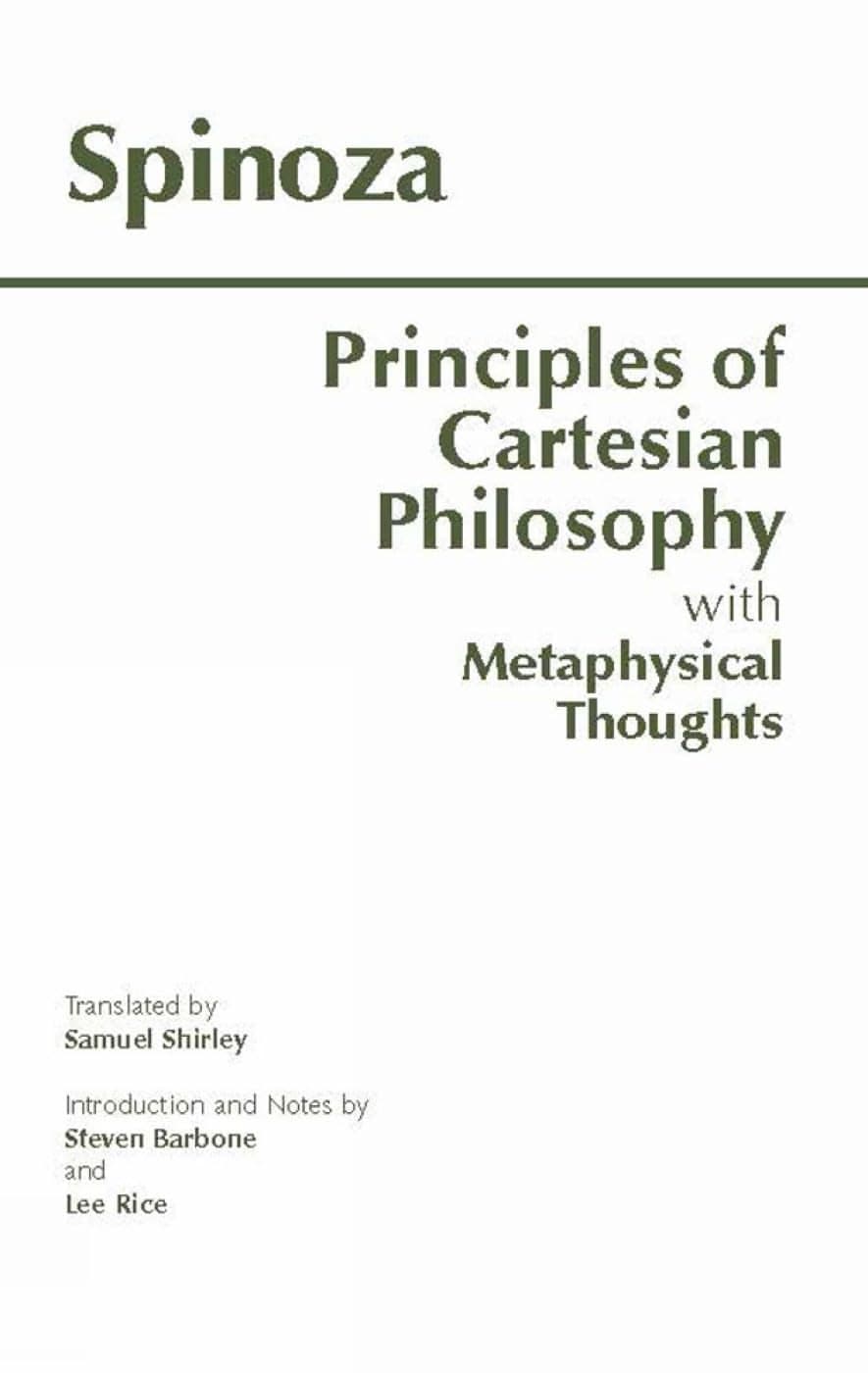
Principles of Cartesian Philosophy

Spinoza's first published work is not an expression of his own philosophy but a geometrical reconstruction of Descartes's Principles of Philosophy, undertaken to demonstrate the synthetic method to a pupil. Its distinctive contribution lies in the appendix, Metaphysical Thoughts, where Spinoza quietly interpolates his own positions on essence, existence, and God beneath the Cartesian surface. The work is thus a pedagogical exercise that doubles as a laboratory for the critiques later systematized in the Ethics—most notably the rejection of Cartesian free will and the redefinition of substance.
Key Insights
✦Is this a work of Spinoza's own philosophy, or a faithful exposition of Descartes?
It is both, unequally. The main body is a geometrical demonstration of Descartes's Principles, written at the request of a student and published with a preface by Lodewijk Meyer clarifying that the views expressed are Descartes's, not necessarily Spinoza's . But the appendix, Metaphysical Thoughts (Cogitata Metaphysica), is where Spinoza speaks more directly. Marilena de Souza Chaui has argued that this appendix deserves close study as a prolegomenon to Spinoza's own thought, since it criticizes both scholastic metaphysics and Cartesian positions on essence, existence, and the will . The volume is therefore a pedagogical exercise that doubles as a record of Spinoza's intellectual departures from his master.
✦What specific doctrinal shifts appear in Metaphysical Thoughts that anticipate the Ethics?
The most consequential is Spinoza's treatment of the will. Descartes held that the will is infinite and free, and that error arises from the misjudgment of a finite intellect. In Metaphysical Thoughts Spinoza begins to undermine this faculty psychology, moving toward the position that will and intellect are not distinct powers. He also reworks the Cartesian account of essence and existence, denying that existence is a perfection added to essence in the way Descartes's proofs of God require. These are not yet the fully developed positions of the Ethics, but they are the fault lines along which the later system will break with Cartesianism .
✦Why did Spinoza publish this work under his own name when the Ethics remained anonymous?
The Principles appeared in 1663 with Spinoza's name, unlike the Ethics, which was published posthumously by his friends. The reason is likely strategic and social: the work was written for a pupil, Johannes Casearius, and functioned as a teaching text within Spinoza's circle in Amsterdam. Publishing it openly identified him as a Cartesian, a respectable philosophical identity in the Dutch Republic, rather than as the author of the radical theological-political views that would later make him notorious . The preface by Meyer served as a buffer, explicitly distancing Spinoza from any implication that he endorsed every Cartesian doctrine he was expounding.
✦How does the geometric method in this work differ from its use in the Ethics?
The method is formally the same—definitions, axioms, propositions, demonstrations, corollaries—but its function is different. In the Principles, Spinoza is applying the synthetic method to someone else's conclusions, demonstrating that Cartesian physics and metaphysics can be reconstructed more geometrico. In the Ethics, the geometric order is not a pedagogical presentation of received views but the necessary unfolding of a single substance from its definitions. The Principles thus tests the method on Descartes before Spinoza turns it against him. Lodewijk Meyer's preface explicitly praises the synthetic method as the means by which Spinoza rewrote Cartesian philosophy, and the success of that demonstration is part of what gave Spinoza confidence to employ it for his own system .
✦What did Spinoza omit from Descartes's Principles, and why does that matter?
Spinoza omitted or truncated several sections of Descartes's physics, most notably the treatment of the Eucharist and the notorious question of the Earth's motion. Descartes had introduced the notion of 'superficies' to explain transubstantiation and had developed a relativistic theory of motion partly to avoid condemning Copernicanism after Galileo. Spinoza, knowing this context, simply left these topics aside . The omission is philosophically significant: it shows that Spinoza was not a neutral transmitter but a selective editor who understood the theological and political pressures shaping Descartes's text, and who chose not to reproduce the compromises those pressures had produced.
✦How does the English translation history affect how this work is understood?
The first English translation was Halbert Hains Britan's 1905 Open Court edition, which remained standard for over half a century. Harry Wedeck's 1961 translation for Philosophical Library was widely reviewed but is now dated in its terminology . The current scholarly standard is the 1998 Hackett edition edited by Lee Rice and Steven Barbone, which includes the Metaphysical Thoughts together with Lodewijk Meyer's inaugural dissertation on matter, appearing for the first time in English, along with cross-references to Descartes's Principles and an extensive bibliography . Readers using older editions that omit the appendix or present it as a mere supplement miss the portion of the volume where Spinoza's own voice is most audible.
✦What is the most common misreading of this work's place in Spinoza's corpus?
The common misreading treats it as either a transparent summary of Descartes with no Spinozistic content, or as a proto-Ethics in which the later system is already fully present. Neither is accurate. The main body is genuinely Cartesian, and Spinoza's own positions are not systematically developed there. But the appendix contains real departures, and the work as a whole documents a transitional moment. Reading it as merely derivative ignores the evidence of Spinoza's selective omissions and interpolations; reading it as a completed Ethics in miniature overstates the coherence of positions that are still being worked out under Cartesian terminology.
Wealthy Psyche is an intellectual archive. We do not host, distribute, or sell book copies — physical or digital. We provide structured knowledge to help you think better, faster.