


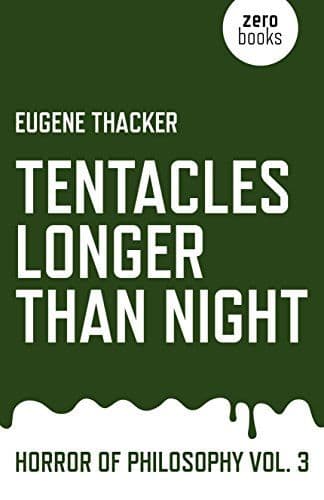
Tentacles Longer Than Night

The final volume of Thacker's Horror of Philosophy trilogy makes its most audacious claim: horror fiction should be read not as illustration of philosophical ideas but as philosophy itself. Thacker treats Poe, Lovecraft, Lautréamont, Blackwood, and Ligotti as thinkers driven by a speculative urge to question human knowledge and the human-centric view of the world. The book's mechanism is a deliberate inversion—where philosophy usually domesticates horror as an aesthetic category, Thacker lets horror do philosophy's work, pushing thought to its limit until thought undermines itself. The result is a nihilism that is neither argued nor celebrated but performed through the genre's own materials.
Key Insights
✦What is the central claim of Tentacles Longer Than Night, and what does it reject?
The book's spine is the proposition that horror fiction should be read as philosophy rather than as mere narrative entertainment illustrated by philosophical concepts. Thacker rejects the standard division of labor in which philosophy supplies ideas and horror supplies examples. Instead, he argues that horror stories are driven by a speculative urge—a desire to question human knowledge and the human-centric view of the world—that is itself philosophical. The genre's obsession with monsters, madness, and the unknowable is not a symptom of irrationality but a form of thought pushing against its own limits. The title names this condition: something unhuman and tentacular reaches longer than the night of human comprehension, and the book asks us to think from within that reach rather than from the safety of philosophical distance.
✦How does this volume differ from Starry Speculative Corpse?
The second volume worked primarily through canonical philosophers—Descartes, Kant, Nietzsche, the mystics—reading them as horror stories. Tentacles Longer Than Night reverses the operation: it works primarily through horror and weird fiction—Poe, Lovecraft, Lautréamont, Blackwood, Ligotti—reading them as philosophers . The chapters are organized by genre-adjacent categories: the demonic (Dante, Argento), the Gothic (Lautréamont's Maldoror), and the weird (Blackwood, Lovecraft, Ligotti) . This makes the final volume more accessible to readers steeped in horror fiction and more demanding for those expecting conventional philosophical argument. The payoff is a demonstration of the trilogy's core thesis: that philosophy and horror are not separate domains but two names for the same confrontation with thought's limits.
✦What role does Lautréamont's Maldoror play in the book's argument?
The chapter on Lautréamont, titled 'Book of Beasts,' is one of the book's most sustained engagements. Thacker reads Maldoror as a text that enacts an invasion of the human by the unhuman, collapsing the subject-object distinction through metamorphosis and animality . The significance is not merely thematic. Lautréamont's violent, hallucinatory prose performs a kind of philosophical work that argument cannot: it makes the reader experience the dissolution of the human perspective rather than merely being told about it. Thacker's reading resists treating Maldoror as either mere provocation or straightforward nihilism. The text, on his account, remains ambivalent—it negates the human while remaining bound to a human reader, and this tension is precisely what makes it philosophically productive rather than simply destructive.
✦How does Thacker read Lovecraft, and does this differ from other philosophical treatments?
Thacker's Lovecraft is not the cosmic horror writer celebrated by fans of weird fiction, nor the reactionary xenophobe critiqued by some scholars. He is a philosopher of the limits of human knowledge. The chapter 'The Vast and Seething Cosmos' treats Poe and Lovecraft together as writers who confront a universe indifferent to human concerns and whose fiction enacts the collapse of anthropocentric perspective . This reading differs from treatments that emphasize Lovecraft's mythology or his prose style. Thacker is interested in the structural problem Lovecraft's fiction poses: how to think a world that does not include the human as its center or measure. The answer, for Thacker, is not to resolve the problem but to inhabit it—to let horror do the work of philosophy by refusing the consolation of a human-centered cosmos.
✦What is a common misreading of this book's title and project?
The title 'Tentacles Longer Than Night' invites a reading of the book as a celebration of monster imagery or a genre study of tentacled creatures. This misses the philosophical point. The tentacle, for Thacker, is a figure for the reach of thought beyond the human—an appendage that extends into darkness and encounters something it cannot grasp. Similarly, the series title 'Horror of Philosophy' is often misread as 'the horror genre as treated by philosophy.' Thacker's inversion is the reverse: it is philosophy that is horrifying, because when pushed to its limit, it confronts a thought that undermines thought itself . The book is not a defense of horror as a legitimate cultural form. It is an argument that horror has always been doing philosophy's most difficult work, and that philosophy has been too afraid to admit it.
✦Where does this volume leave the Horror of Philosophy trilogy as a whole?
Tentacles Longer Than Night completes a trajectory that moves from the unhuman world (In the Dust of This Planet) through the dark thought of the philosophical tradition (Starry Speculative Corpse) to the genre that has most persistently confronted the unhuman (Tentacles). The trilogy does not culminate in a synthesis or a solution. It ends, as it began, at a limit. Thacker's contribution is not a new theory of horror or a new philosophy of nihilism but a demonstration that the two are inseparable. The final chapter's fragmentary 'As if...' sections suggest that the proper response to this condition is neither system nor despair but a kind of aphoristic persistence—thinking on, in the dark, without the promise of illumination.
Wealthy Psyche is an intellectual archive. We do not host, distribute, or sell book copies — physical or digital. We provide structured knowledge to help you think better, faster.