


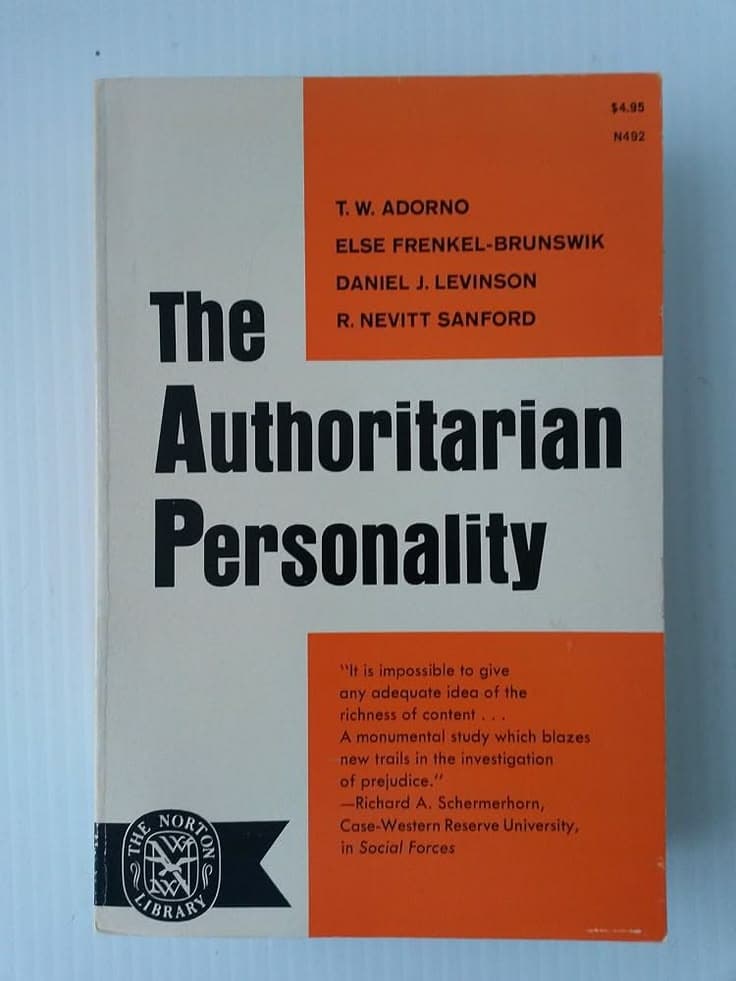
The Authoritarian Personality

Co-authored by Adorno with Else Frenkel-Brunswik, Daniel Levinson, and Nevitt Sanford, this landmark study of prejudice develops the F-scale to measure a personality syndrome characterized by rigid conformity, submission to authority, and aggression toward outgroups. Its distinctive claim is that authoritarianism is not merely a set of political opinions but a deep psychological structure shaped by family dynamics and social conditions, linking psychoanalytic theory to empirical social research. The work introduced the concept of the 'authoritarian personality' that became foundational for studies of prejudice and the rise of fascism.
Key Insights
✦What is the central claim of The Authoritarian Personality, and what does it reject?
The central claim is that authoritarianism is not merely a set of political opinions but a deep-seated personality syndrome—a structured pattern of attitudes, values, and psychological needs rooted in family dynamics and social conditions. Adorno and his colleagues developed the F-scale (F for fascism) to measure this syndrome, identifying nine dimensions including conventionalism, authoritarian submission, authoritarian aggression, anti-intraception, superstition, and power and toughness. The work rejects the reduction of prejudice to mere ideological difference or rational economic interest, arguing instead that authoritarian attitudes satisfy deep psychological needs and arise from early childhood experiences, particularly harsh and punitive parenting.
✦What is the F-scale, and how did it attempt to measure authoritarianism?
The F-scale is a questionnaire designed to measure authoritarian tendencies indirectly, by asking respondents to agree or disagree with statements that express authoritarian themes—such as belief in conventional values, submission to authority, aggression toward deviants, and suspicion of introspection and imagination . The scale was constructed to avoid appearing ideological, so that respondents would not easily recognize what was being measured. The items were selected from a much larger pool based on their correlation with the E-scale (ethnocentrism) and other measures of prejudice. The F-scale was enormously influential and widely used in subsequent research, but it also drew sustained criticism for methodological problems including response-set bias and the difficulty of separating psychological structure from ideological content.
✦What are the main methodological criticisms of the study, and how have scholars responded?
The study faced extensive criticism from its 1950 publication onward. The most common objections concern the sample—which was drawn from a narrow middle-class population and cannot be treated as representative—and the problem of response-set bias, where agreement with the F-scale items may reflect general agreeableness rather than authoritarianism . Later scholarship, such as the edited volume by Stone, Lederer, and Christie (1993), contextualized the work in its historical moment, noting that the researchers anticipated many criticisms and that the theoretical framework has proved more durable than the specific findings . Critics have also challenged the reduction of political attitudes to personality structure, arguing that social and ideological factors cannot be so neatly psychologized.
✦How does the book relate to Adorno's broader critical theory and to Dialectic of Enlightenment?
The Authoritarian Personality can be seen as an empirical application of the diagnosis advanced in Dialectic of Enlightenment: that instrumental reason and the administered world produce new forms of domination and conformity. The study's focus on the 'authoritarian syndrome'—rigid conformity, submission to power, and aggression toward outsiders—is a concrete psychological investigation of the 'barbarism' that Adorno and Horkheimer had identified as the dark side of Enlightenment. The book also reflects Adorno's broader commitment to using empirical social research in the service of critical theory, a commitment that distinguished the Frankfurt School's later work from purely philosophical critique.
✦How did the book's reputation change over the decades following its publication?
The book was enormously influential in the 1950s and 1960s, shaping research on prejudice, political psychology, and the study of the Holocaust. By the 1980s, however, it had become the object of sustained methodological and theoretical critique, and many of its specific findings were questioned. The 1993 edited volume by Stone, Lederer, and Christie marked a turn toward more balanced assessment, recognizing the study's historical significance while acknowledging its limitations . Recent scholarly reassessments have emphasized the originality of the conceptual framework—the idea that authoritarianism is a structured personality syndrome with deep psychological roots—and the study's role in initiating the field of political psychology.
✦What common misreading of The Authoritarian Personality should readers avoid?
A common misreading treats the book as an attempt to pathologize conservatism or right-wing politics. This is not accurate. The F-scale was designed to measure a psychological syndrome, not a political ideology, and the authors explicitly acknowledged that authoritarianism could manifest in left-wing or liberal contexts as well. Another misreading assumes the study offers a definitive account of the causes of fascism. The authors present their findings as preliminary and exploratory, and they acknowledge the limitations of their sample and methods. The book is best read as a historically situated, methodologically ambitious attempt to bring psychoanalytic and empirical resources to bear on the problem of prejudice and authoritarianism, not as a final theory of political evil.
Wealthy Psyche is an intellectual archive. We do not host, distribute, or sell book copies — physical or digital. We provide structured knowledge to help you think better, faster.