


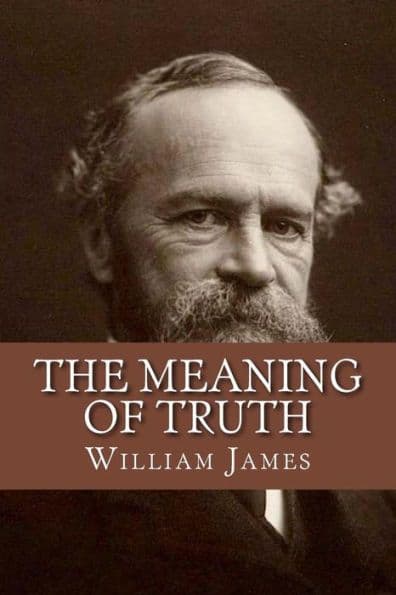
The Meaning of Truth: A Sequel to 'Pragmatism'
This book is James's sustained defence of the pragmatist theory of truth against its critics. Its central framework is that true ideas are those that can be verified in experience: a belief is true if it works, if it successfully connects our experiences and guides action, and if it can be cashed out in practical consequences. James argues that this is not a denial of objective truth but a clarification of what truth means. The book collects essays written between 1907 and 1909, responding to critics such as Bertrand Russell and F. H. Bradley, and it includes a preface clarifying that pragmatism is a method, not a metaphysics.
Key Insights
✦What is James's pragmatist theory of truth, and what does it reject?
James's theory is that true ideas are those that can be verified in experience. A belief is true if it works, if it successfully connects our experiences and guides action, and if it can be cashed out in practical consequences. Truth is not a static property that inheres in a proposition independently of its use; it is a process, a becoming, a relation between an idea and its verification . James rejects the correspondence theory of truth, which holds that truth is a static relation of copying between an idea and a reality external to it. He also rejects the view that truth is absolute or unconditioned. For James, truth is inseparable from the experiences in which it is verified, and this makes it pluralistic and dynamic rather than fixed and singular.
✦How does the book respond to Bertrand Russell's critique of pragmatism?
Russell was one of the most important critics of James's theory of truth. He argued that pragmatism confuses the criterion of truth with the nature of truth: it tells us how we come to know that a belief is true, but not what truth itself is . James responds in the essays collected here, arguing that Russell has misread the pragmatist position. James insists that truth is not a mere matter of practical utility; it is a matter of verification in experience. The essays engage with Russell's objections directly, and they include James's most sustained attempt to clarify what pragmatism means by 'working.' The debate between James and Russell is a classic confrontation between pragmatism and analytic realism, and it remains relevant to contemporary discussions of truth.
✦What is the relationship between The Meaning of Truth and Pragmatism?
The Meaning of Truth is a sequel to Pragmatism (1907), written to defend and clarify the theory of truth presented in the earlier book. James states in the preface that the essays collected here are intended to answer the criticisms that Pragmatism had provoked . The book is not a systematic treatise but a collection of occasional pieces, written over two years, responding to specific critics. The relationship is thus one of defence rather than extension: the earlier book presents the theory, and the later book defends it. James wrote in a letter that the two books are 'intimately connected' and should be read together. Readers who want the full picture should read Pragmatism first and then The Meaning of Truth.
✦How was the book received, and what were the main criticisms?
The book received a mixed reception. Many reviewers praised James's clarity and his willingness to engage critics, but others argued that his theory of truth was still confused. The main criticisms were that pragmatism reduces truth to utility, that it makes truth subjective or relative, and that it cannot account for the difference between a belief that works and a belief that is true . James responded to these criticisms in the essays themselves, but the debate continued. Some critics, such as F. H. Bradley, argued that pragmatism was a form of subjectivism; others, such as Russell, argued that it confused the criterion of truth with its nature. James's defenders argue that these criticisms rest on a misreading of his position, and that his theory is more subtle than the caricature suggests.
✦What is the most common misunderstanding of James's theory of truth?
The most common misunderstanding is that James equates truth with whatever is useful or comforting. This is a caricature. James does not say that a belief is true because it makes us feel good; he says that a belief is true if it can be verified in experience and if it successfully guides action . A belief that is useful in the short term but fails to connect with experience is not true on James's account. A related misunderstanding is that James denies the existence of objective truth. He does not: he argues that truth is objective in the sense that it is grounded in experience, but he denies that it is a static, absolute property that can be grasped independently of practice. The theory is a form of verificationism, not subjectivism.
Wealthy Psyche is an intellectual archive. We do not host, distribute, or sell book copies — physical or digital. We provide structured knowledge to help you think better, faster.