


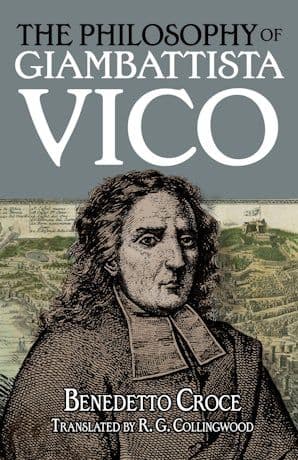
The Philosophy of Giambattista Vico

Croce's 1911 monograph rescued Vico from obscurity by reading him as the first philosopher of the human spirit's historical development. Croce argues that Vico's central achievement is the thesis that truth is made (verum ipsum factum): we can know history because we have made it, while nature remains opaque to us. This anti-Cartesian position grounds Vico's rejection of rationalist abstraction and his account of language, myth, and custom as genuine forms of knowledge through which humanity has progressively understood itself.
Key Insights
✦What is Croce's central interpretive claim about Vico in this book?
Croce's central claim is that Vico's significance lies in his discovery that historical knowledge is possible because the human mind has made history. The principle verum ipsum factum—the true is the made—means that we can have genuine knowledge of civil society, language, and custom because these are products of human activity, whereas the natural world, being divine artifact, remains ultimately opaque to us. Croce presents this as a decisive break with Cartesian rationalism, which had treated history as mere opinion and mathematics as the model of knowledge. For Croce, Vico's insight inaugurates the historicist tradition that Croce himself would carry forward.
✦Why did Croce write this book, and what role did it play in Vico's modern reception?
Croce wrote the monograph as part of his sustained campaign to recover Italian philosophical heritage from what he saw as neglect and misunderstanding. When it appeared in 1911 as the second volume of his Saggi filosofici, Vico was known mainly to antiquarians and had little presence in international philosophy. Croce's study, translated into English by R. G. Collingwood in 1913 and soon into French and German, gave Vico a new audience . The book did not merely paraphrase Vico's works; it interpreted them through Croce's own idealism, presenting Vico as the precursor of the philosophy of spirit. This interpretive framing was decisive in establishing Vico as a major figure in twentieth-century thought.
✦How does Croce's reading of Vico relate to his own philosophical system?
Croce reads Vico through the categories of his own Philosophy of the Spirit, and the book is as much an intervention in Croce's system as a work of historical scholarship. Vico's distinction between the certain (the world of custom and authority) and the true (the world of philosophical reflection) is mapped onto Croce's distinction between intuition and concept, and Vico's account of the ages of gods, heroes, and men is read as a prefiguration of Croce's dialectic of the spirit's forms. The book thus extends Croce's historicism by discovering in Vico a genealogy for it. Croce's Vico is not a neutral reconstruction but a philosophical appropriation, and this is both the book's strength and its limitation.
✦How was the book received by Croce's contemporaries, and what criticisms did it face?
The book was immediately translated into English and French, and Giovanni Gentile praised it as a work that made Vico 'clear, simplified and illuminated' . But it also drew attacks from younger intellectuals such as Giuseppe Borgese and Giovanni Papini, who accused Croce of domesticating Vico's radical energy and reducing his thought to a version of Croce's own idealism. Croce defended his method as a work of 'interior philosophical criticism,' insisting that reconstructing Vico's thought required distinguishing its living insights from its obsolete scaffolding. The controversy reflects a genuine question about the book: whether Croce's Vico is a faithful historical reconstruction or a projection of Croce's own philosophical priorities.
✦What is the significance of R. G. Collingwood's English translation?
Collingwood's 1913 translation for Macmillan was not a neutral act of transmission. Collingwood was himself a philosopher of history deeply engaged with Vico's ideas, and his translation helped shape Anglophone Vico reception for decades. The choice of Collingwood as translator was felicitous: his own work on the philosophy of history, particularly The Idea of History, bears the marks of Vico's influence as mediated by Croce . The translation is readable and philosophically informed, though it inevitably reflects the state of Croce's text as of 1911 and the interpretive priorities of its translator. Later editions and reprints, including the Russell & Russell edition of 1964, kept Collingwood's version in circulation .
✦What common misreading of Croce's book should readers avoid?
A common misreading treats the book as a straightforward introduction to Vico's philosophy, a neutral summary that can be used as a substitute for reading Vico himself. This underestimates the extent to which Croce's interpretation is a philosophical intervention. Croce is not merely reporting Vico's views; he is selecting, organizing, and evaluating them according to his own idealist framework. The Vico who emerges from these pages is a Vico understood through the lens of Croce's historicism. Readers seeking a neutral exposition should consult other works; readers seeking to understand how Vico became a modern philosophical presence will find Croce's book indispensable precisely because it is not neutral.
Wealthy Psyche is an intellectual archive. We do not host, distribute, or sell book copies — physical or digital. We provide structured knowledge to help you think better, faster.