


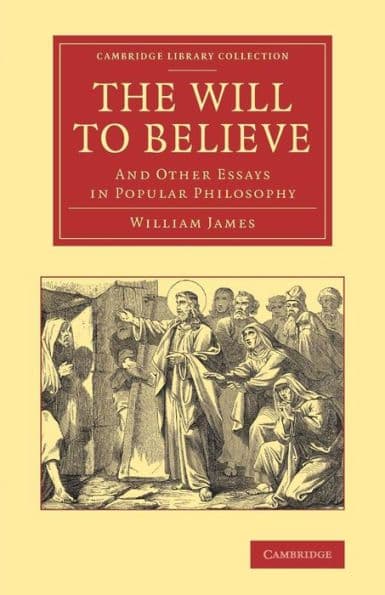
The Will to Believe
This lecture, delivered in 1896, defends the legitimacy of holding certain beliefs without prior proof when the choice is live, forced, and momentous. James's central framework is a pragmatic account of belief: the question is not whether a belief can be proven in advance, but whether holding it is useful for living. He argues that in cases where the evidence cannot decide and the stakes are high, we have the right to believe, because the belief itself may help bring about its own verification. The essay is a landmark in the ethics of belief, arguing against Clifford's evidentialism.
Key Insights
✦What is James's central argument in 'The Will to Believe,' and what does it reject?
James argues that in certain cases we have the right to hold a belief without prior proof. The cases are defined by three conditions: the choice must be live (both options are genuine possibilities for the believer), forced (not avoidable), and momentous (not trivial). When the evidence cannot decide the matter and the stakes are high, James claims, we have the right to believe, because the belief itself may help bring about its own verification . He rejects the evidentialist position of W. K. Clifford, who had argued that it is always wrong to believe anything on insufficient evidence. James's target is not evidence itself but the demand for evidence in cases where the evidence cannot be had in advance and the choice cannot be avoided.
✦How does James's essay respond to Clifford's 'The Ethics of Belief'?
Clifford's essay, published in 1877, argued that it is always wrong to believe anything on insufficient evidence, and that believing without evidence undermines the general reliability of human testimony. James directly challenges this position, accusing Clifford of an 'irrational' demand for certainty that would paralyze action in cases where action is required . James argues that Clifford's maxim, if taken seriously, would prevent us from holding many beliefs that are essential to life—belief in other minds, in the reliability of our faculties, in the possibility of moral progress. The debate between James and Clifford remains the classic formulation of the conflict between evidentialism and pragmatism in the ethics of belief, and James's essay is generally read as the pragmatist response to Clifford's rigorism.
✦What are the three criteria James gives for a genuine option, and why do they matter?
James defines a genuine option by three criteria. A live option is one where both alternatives are real possibilities for the person, not dead hypotheses that no one could seriously entertain. A forced option is one where there is no way to avoid choosing—not choosing is itself a choice. A momentous option is one where the opportunity is unique and the stakes are significant, not trivial or reversible . These criteria matter because they restrict the scope of James's argument: he is not saying that we may believe anything we like, regardless of evidence. He is saying that in cases where the option is genuine and the evidence cannot decide, the will has a legitimate role in belief. The criteria thus protect the argument from the charge of irrationality.
✦What role does James's pragmatism play in the essay, and how is it related to his later work?
The essay anticipates the pragmatist account of truth that James would develop more fully in Pragmatism (1907). The key move is the idea that a belief can be justified by its practical consequences, not only by prior evidence. James argues that in cases of genuine options, the belief may help bring about the conditions that verify it: if I believe that I can accomplish a task, that belief may increase my chances of succeeding . This is a pragmatic justification of belief, not an evidential one. The essay is thus a precursor to James's mature pragmatism, and it is often read alongside Pragmatism and The Meaning of Truth as part of his sustained defence of the practical dimension of belief. The later work develops the theory of truth that the essay presupposes.
✦How was the essay received, and what were the main criticisms?
The essay provoked immediate controversy. Critics charged that James was defending credulity and undermining the norms of rational belief. Some argued that his criteria for genuine options were too vague and could be used to justify any belief. Others argued that his pragmatist justification was circular: if a belief is justified by its good consequences, then any belief that makes one feel better would be justified. James responded to these criticisms in later essays, particularly in The Meaning of Truth and in his correspondence. The essay's defenders argue that it has been misread: James does not say that we may believe anything we want, but that in cases where the evidence cannot decide and the choice is unavoidable, the will has a legitimate role. The debate continues in contemporary epistemology.
✦What is the most common misunderstanding of 'The Will to Believe'?
The most common misunderstanding is that James is saying we can believe whatever we want, regardless of evidence, and that belief is justified by its comforting effects. This is a caricature. James explicitly restricts his argument to cases where the option is live, forced, and momentous, and where the evidence cannot decide the matter . He is not defending wishful thinking or the belief in anything that makes us feel better. A related misunderstanding is that the essay is a defence of religious faith in particular. While it was delivered to a philosophical audience and has been influential in philosophy of religion, James's argument is general: it applies to any genuine option where evidence is inconclusive, including moral and personal decisions. The essay is a contribution to the ethics of belief, not a tract for any particular religion.
Wealthy Psyche is an intellectual archive. We do not host, distribute, or sell book copies — physical or digital. We provide structured knowledge to help you think better, faster.