


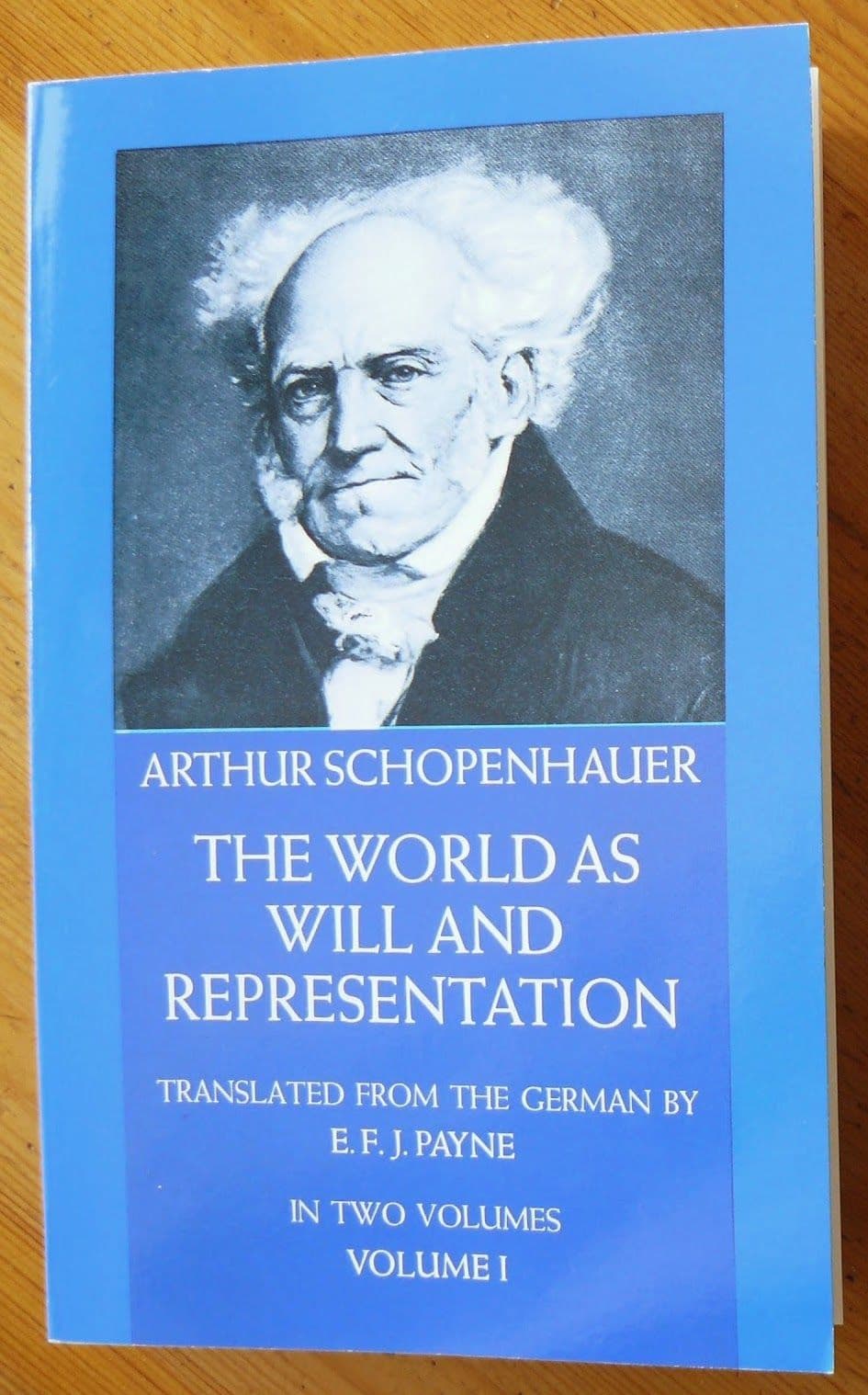
The World as Will and Representation
Schopenhauer's central work argues that the world has a double aspect: as representation, it exists only for a cognizing subject under the forms of space, time, and causality; as Will, it is the blind, striving, thing-in-itself that objectifies itself in every natural phenomenon, from gravity to human desire. The four books move from epistemology through ontology and aesthetics to ethics, culminating in the denial of the Will as the only escape from suffering. The 'single thought' Schopenhauer claimed to convey is this identity of Will and representation, unfolded from four irreducible perspectives.
Key Insights
✦What exactly is Schopenhauer's 'single thought,' and why does he insist the work is organic rather than linear?
The single thought is that the world is at once Will and representation, and that these are not two worlds but one reality considered from two irreducible standpoints. Representation is the world as it appears to a subject under the forms of space, time, and causality; Will is what that world is in itself, a blind, endless striving that objectifies itself in grades from inorganic matter to human consciousness. Schopenhauer says the four books—epistemology, ontology, aesthetics, and ethics—are perspectives on this one thought, each presupposing the others rather than following in a chain . This is why he advises reading the work twice, since the beginning is clarified only by the end.
✦How does Schopenhauer claim to know the thing-in-itself, when Kant said it was unknowable?
Kant held that the noumenon can never be known, only thought as a limiting concept. Schopenhauer argues that we have one privileged access to the thing-in-itself: our own body. We know ourselves from within as willing, and this willing is not a representation among others but the immediate self-apprehension of the subject. By analogy, he extends this inner essence to all of nature, interpreting gravity, magnetism, and organic drive as grades of the same Will . Critics including Christopher Janaway have pressed whether this 'analogy' is legitimate or whether Schopenhauer simply smuggles anthropomorphic willing into the inorganic world, a charge that remains central to Schopenhauer scholarship .
✦What is the role of the Platonic Ideas in the work's aesthetics, and how do they mediate between Will and representation?
In Book III, Schopenhauer introduces the Platonic Ideas as an intermediate ontological level: they are the immediate objectifications of the Will, prior to their fragmentation in space and time. Aesthetic experience, especially in music but also in the contemplation of natural beauty and visual art, temporarily suspends the subject's bondage to individual willing and allows cognition to become a 'pure subject' that mirrors these Ideas. Music occupies a special place: Schopenhauer says it does not copy Ideas but directly objectifies the Will itself, which is why it can express the inner movement of striving without the mediation of images. This hierarchy of the arts is one of the work's most influential and most disputed contributions to aesthetics.
✦How does the work's pessimism follow from its metaphysics, rather than being an independent mood?
The pessimism is structurally derived, not merely temperamental. If the thing-in-itself is Will—endless striving without final satisfaction—then every attained goal merely yields to a new lack, and pleasure is only the brief negation of a prior pain. Since the Will objectifies itself in all beings, this structure is universal, not a personal complaint. Book IV argues that the only genuine escape is the denial of the Will, achieved through aesthetic contemplation, compassion, and finally asceticism. Critics such as Julian Young have examined whether this 'salvation' is coherent within Schopenhauer's own system, or whether it covertly reintroduces a goal-oriented agency the metaphysics forbids.
✦What changed between the 1819 first edition and the expanded 1844 and 1859 editions, and does this affect how the book should be read?
The first edition appeared as a single volume in 1819, though published at the end of 1818 . The 1844 second edition reprinted the first volume with revisions and added an entirely new second volume of supplementary essays, longer than the original . The 1859 third edition incorporated further additions. The Cambridge translation edited by Judith Norman, Alistair Welchman, and Christopher Janaway follows the Hübscher edition, which essentially tracks the 1859 text while noting editorial interventions from Frauenstädt onward . Readers using older translations may be reading a text that conflates editions; the 1844 supplements, in particular, contain Schopenhauer's most extended clarifications and should not be treated as mere appendices.
✦How did the English translation history shape the work's reception in the Anglophone world?
The first English version was the Haldane and Kemp translation, published in three volumes from 1883 to 1886 under the title The World as Will and Idea . It dominated for seventy years despite nearly a thousand errors and omissions. E. F. J. Payne's 1958 translation decisively replaced it, correcting those errors and translating the work's many quotations from multiple languages for the first time . The Cambridge edition of 2010 and 2018, translated by Norman, Welchman, and Janaway, is now the scholarly standard, with an introduction by Janaway and detailed notes on variants . The shift from 'Idea' to 'Representation' for Vorstellung is itself significant: Richard Aquila has argued that 'representation' obscures the active presentational sense of the German .
✦How does the work relate to Schopenhauer's earlier dissertation, and why did he insist it be read first?
Schopenhauer demanded that On the Fourfold Root of the Principle of Sufficient Reason, his 1813 doctoral dissertation, be read as an introduction to The World as Will and Representation. In the preface to the first edition, he states that understanding the main work is 'absolutely impossible' without familiarity with that essay, whose contents are presupposed throughout . The Fourfold Root establishes the four forms of sufficient reason—becoming, knowing, being, and acting—that structure the world as representation. Without that apparatus, the first book of the main work is unintelligible. This insistence reflects Schopenhauer's view that his philosophy is a single edifice, not a collection of separable insights, and it is why responsible commentary treats the two works as a unit.
Wealthy Psyche is an intellectual archive. We do not host, distribute, or sell book copies — physical or digital. We provide structured knowledge to help you think better, faster.