


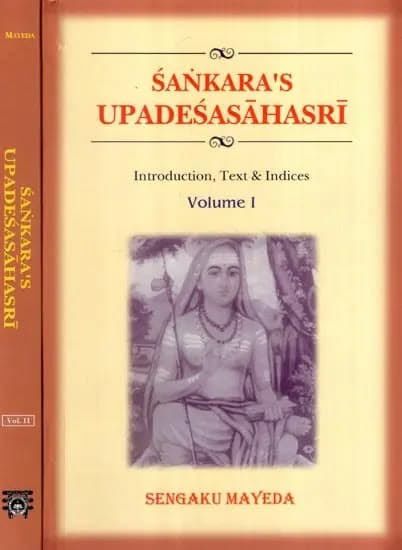
Upadesasahasri
The Upadesasahasri is widely regarded by modern scholarship as the only independent, non-commentarial work that can be securely attributed to Adi Shankara. Its central mechanism is a two-part pedagogical structure: a metrical section that systematically refutes rival schools and establishes the self (Atman) as pure consciousness distinct from the body and mind, and a prose section that explains how a teacher should guide a qualified pupil toward liberation through hearing, reflection, and meditation on the identity of Atman and Brahman. The text is not a systematic treatise but a thousand teachings, varied in form and emphasis.
Book Archives
Detailed research articles, summaries and analyses from this book.
 Archive
The Mechanics of Liberation: Understanding Jivanmukti
 Archive
Consciousness and the Quantum Vacuum: A Vedantic Perspective
 Archive
Refuting The External World: Gaudapada’s Karika Analyzed
 Archive
Vichara-Sagara: A Deep Dive into Non-Dual Enquiry
 Archive
The Silence of the Sages: Understanding Dattatreya's Avadhuta Gita
 Archive
The Role of Negation (Neti Neti) in Absolute Realization
 Archive
The Secret Logic Behind Advaita's Theory of Maya
 Archive
Why Shankaracharya Rejected Buddhist Emptiness
 Archive
Brahma Sutra Bhashya: Decoding the Bhashyakara's Method
 Archive
The Hidden Meaning of Turiya in the Mandukya Upanishad
Key Insights
✦What is the central teaching of the Upadesasahasri, and what does it reject?
The Upadesasahasri teaches that Atman, the self, is pure consciousness (chaitanya) and is not the body, mind, or intellect. Liberation (moksha) comes solely through knowledge of this truth, not through action or ritual. The text rejects the validity of all action performed under ignorance as a means to liberation, arguing that action is inherently associated with the misconception of oneself as an agent. In the metrical part, Shankara refutes the teachings of Lokayata, Buddhist, Jain, Samkhya, and Vaisheshika schools with considerable vigor. The prose part then explains how a teacher should guide a qualified pupil through the stages of hearing (sravana), reflection (manana), and meditation (nididhyasana) on the identity of Atman and Brahman.
✦Why is the Upadesasahasri considered the only authentic independent work of Shankara?
Sengaku Mayeda, the text's foremost modern authority, states that the Upadesasahasri is 'the only independent and non-commentary work that can safely be attributed to' Shankara, and that 'the other independent writings traditionally ascribed to him are all probably spurious' [citation:5][citation:8]. This scholarly consensus reflects the text's consistency with Shankara's authentic commentaries in doctrine and terminology, unlike works such as the Vivekachudamani, which modern scholarship has shown to contain doctrinal developments characteristic of later Advaita. The Upadesasahasri's two-part structure and its pedagogical method also align with the concerns of Shankara's bhashyas, making it a reliable window into his own philosophical voice rather than a later tradition's reconstruction.
✦What is the structure of the text, and how do its two parts differ?
The Upadesasahasri consists of a metrical (verse) part and a prose part, which manuscripts indicate were regarded as independent works and studied or commented upon separately [citation:1]. The metrical part comprises nineteen chapters (prakaranas) in various meters, discussing basic Advaita problems from different angles, often in dialogue form, and refuting rival schools. The prose part contains three chapters that explain how to teach the means to final release, corresponding roughly to the three stages of hearing, reflection, and meditation. Mayeda notes that the reading of the text may begin anywhere, as any single chapter could be selected, copied, and studied apart from the rest [citation:1]. This structure reflects the text's pedagogical purpose rather than a systematic exposition.
✦How does the Upadesasahasri treat the mahavakya 'Tat tvam asi'?
Chapter 18 of the metrical part, the longest chapter with 230 verses, is devoted entirely to the great sentence 'Tat tvam asi' (Thou art That) [citation:1]. Shankara argues that the 'I'-notion is self-evident, and the statement 'I am the existent' refers to the basis of this notion, the inner Atman. The scripture separates the perishable notions of 'my' and 'this' from the immovable and imperishable Consciousness and Seer. The statement 'Tat tvam asi' is meaningful because it refers to Atman, and recognizing oneself as 'the Existent-Brahman' through scriptural teaching removes the delusion of the hearer. Shankara insists that right knowledge arises at the moment of hearing, though he also discusses the role of meditation on the meaning of the sentences, with some ambiguity about the precise method.
✦What are the major English translations, and how do they differ?
Swami Jagadananda's translation was published by Sri Ramakrishna Math in 1949 and begins with the prose part. Sengaku Mayeda's translation, published in 1979 and revised in 1992, begins with the metrical part and is accompanied by an extensive introductory essay on Shankara's life and thought [citation:11]. Mayeda's edition is based on his own critical edition of the Sanskrit text, published in 1973, and is widely regarded as the scholarly standard [citation:5]. The two translations differ in sequence: Jagadananda follows the traditional order with the prose first, while Mayeda follows the manuscript order with the metrical part first . Mayeda's notes and introduction make his edition the more useful for serious study, while Jagadananda's remains accessible to general readers.
✦What is a common misconception about the Upadesasahasri's relationship to Shankara's other works?
A common misconception is that because works like the Vivekachudamani and Atmabodha are popularly attributed to Shankara and widely used in Advaita teaching, they represent his authentic philosophical position. Modern scholarship has shown that these texts are likely later compositions, while the Upadesasahasri is the only independent work that can be securely attributed to him [citation:5][citation:8]. This means that readers seeking Shankara's own teaching should prioritize the Upadesasahasri alongside his commentaries, rather than relying on the later manuals that have shaped popular Advaita pedagogy. The misconception matters because the later works introduce doctrinal developments—such as the treatment of avidya as a metaphysical principle and the emphasis on samadhi practices—that differ from Shankara's authentic position.
Wealthy Psyche is an intellectual archive. We do not host, distribute, or sell book copies — physical or digital. We provide structured knowledge to help you think better, faster.