



Vakya Vritti
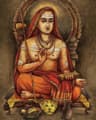
Attributed to Adi Shankara, the Vakya Vritti is a concise Vedantic treatise in fifty-two verses that systematically unpacks the mahavakya 'Tat tvam asi' (That thou art). Its central mechanism is the rigorous distinction between the literal meanings (vachyartha) of 'Tat' (Brahman) and 'Tvam' (the individual self) and their implied meanings (lakshyartha), which alone reveal their identity. The text presents this analysis as a dialogue between a student who confesses that the great saying yields no clear understanding and a teacher who patiently explains how the apparent contradiction between the Lord and the individual is resolved through the witnessing consciousness that underlies both.
Book Archives
Detailed research articles, summaries and analyses from this book.
 Archive
The Mechanics of Liberation: Understanding Jivanmukti
 Archive
Consciousness and the Quantum Vacuum: A Vedantic Perspective
 Archive
Refuting The External World: Gaudapada’s Karika Analyzed
 Archive
Vichara-Sagara: A Deep Dive into Non-Dual Enquiry
 Archive
The Silence of the Sages: Understanding Dattatreya's Avadhuta Gita
 Archive
The Role of Negation (Neti Neti) in Absolute Realization
 Archive
The Secret Logic Behind Advaita's Theory of Maya
 Archive
Why Shankaracharya Rejected Buddhist Emptiness
 Archive
Brahma Sutra Bhashya: Decoding the Bhashyakara's Method
 Archive
The Hidden Meaning of Turiya in the Mandukya Upanishad
Key Insights
✦What is the central argument of the Vakya Vritti, and what does it reject?
The Vakya Vritti's central argument is that the mahavakya 'Tat tvam asi' teaches the identity of the individual self (Tvam) and Brahman (Tat), but this identity can only be grasped by distinguishing between the words' literal meanings and their implied meanings. The text rejects the view that the mahavakya can be understood through its surface meaning alone, since 'Tat' refers to the omniscient Lord and 'Tvam' to the limited, suffering individual—an apparent contradiction. The teacher in the dialogue resolves this by showing that the limiting attributes (upadhis) associated with each term are negated, leaving the pure witnessing consciousness that is the same in both. The text thus rejects both the identity of the limited individuals and the complete difference between self and Brahman.
✦What specific method does the text use to reconcile 'Tat' and 'Tvam'?
The Vakya Vritti employs the method of lakshyartha (implied meaning) to resolve the apparent contradiction between 'Tat' (the Lord, omniscient and omnipotent) and 'Tvam' (the individual, limited and ignorant). The text proceeds by first analyzing each term's literal meaning, showing that they refer to apparently incompatible entities, and then applying the principle of bhaga-tyaga-lakshana—the abandonment of incompatible aspects and retention of the compatible core. What remains after discarding the limiting adjuncts is pure consciousness (cit), which is the witnessing self in the individual and the essence of Brahman. The text's fifty-two verses systematically lead the student from confusion to the direct recognition that the self is Brahman [citation:3].
✦What is the relationship between the Vakya Vritti and the Laghu Vakya Vritti?
The Laghu Vakya Vritti is an abridged or shorter version of the Vakya Vritti, both attributed to Adi Shankara. While the full Vakya Vritti deals with the mahavakya 'Tat tvam asi' in fifty-two verses, the Laghu Vakya Vritti addresses a different mahavakya, 'Aham brahmasmi' (I am Brahman) [citation:2][citation:5]. The Laghu text is also attributed to Shankara in manuscript and printed traditions, and it covers similar ground—the analysis of the individual self and its identity with Brahman—but through a different scriptural sentence. The two texts are thus complementary: one unpacks 'That thou art' and the other 'I am Brahman,' together covering the two most important mahavakyas of Advaita Vedanta.
✦How has the text been transmitted in English translation, and what editions exist?
The Vakya Vritti has been translated into English several times, primarily through the Ramakrishna Mission and the Chinmaya Mission. Swami Jagadananda's translation, published by Sri Ramakrishna Math in Madras, appeared in 1953 and was reprinted in 1967 and 1973, often bound together with the Atmajnanopadeshavidhi . Swami Chinmayananda's translation and commentary, published by Central Chinmaya Mission Trust, became a standard edition in the 1980s [citation:4][citation:5]. The text is also available in Sanskrit with transliteration and translation through online resources like Shlokam, which reproduces Chinmayananda's rendering [citation:15]. These translations have mediated the text's reception in the English-speaking world, with the Ramakrishna and Chinmaya editions reflecting different pedagogical emphases.
✦What is the significance of the opening verse's salutation to Vishnu?
The Vakya Vritti opens with a salutation to Vishnu as the Lord of the universe, endowed with inscrutable power (acintya-shakti), who is the cause of creation, maintenance, and dissolution, yet remains ever-free and is an ocean of boundless happiness [citation:15]. This opening establishes the text's devotional frame: the inquiry into the identity of the self and Brahman is not a purely intellectual exercise but begins with homage to the divine. The salutation also introduces the apparent paradox that the text will resolve: the Lord who is the cause of the universe is also the pure consciousness that is the innermost self. The verse's description of Vishnu as 'vimala-bodha-ghana' (mass of pure consciousness) anticipates the text's central identification of Brahman with witnessing awareness.
✦How does the Vakya Vritti relate to Shankara's Brahma Sutra Bhashya?
The Vakya Vritti is a Prakarana-grantha, a topical treatise, rather than a bhashya (commentary) on a foundational text [citation:3]. It does not follow the sutra-by-sutra format of the Brahma Sutra Bhashya but instead takes a single mahavakya and unfolds its meaning through a pedagogical dialogue. However, the method it employs—the distinction between literal and implied meaning, the analysis of limiting adjuncts, and the sublation of apparent contradictions—is the same method Shankara applies throughout his authentic commentaries. The Vakya Vritti can thus be read as a practical application of the hermeneutic principles developed in the Brahma Sutra Bhashya, showing how the Advaitic method works when brought to bear on a single scriptural sentence rather than a full system of sutras.
Wealthy Psyche is an intellectual archive. We do not host, distribute, or sell book copies — physical or digital. We provide structured knowledge to help you think better, faster.