


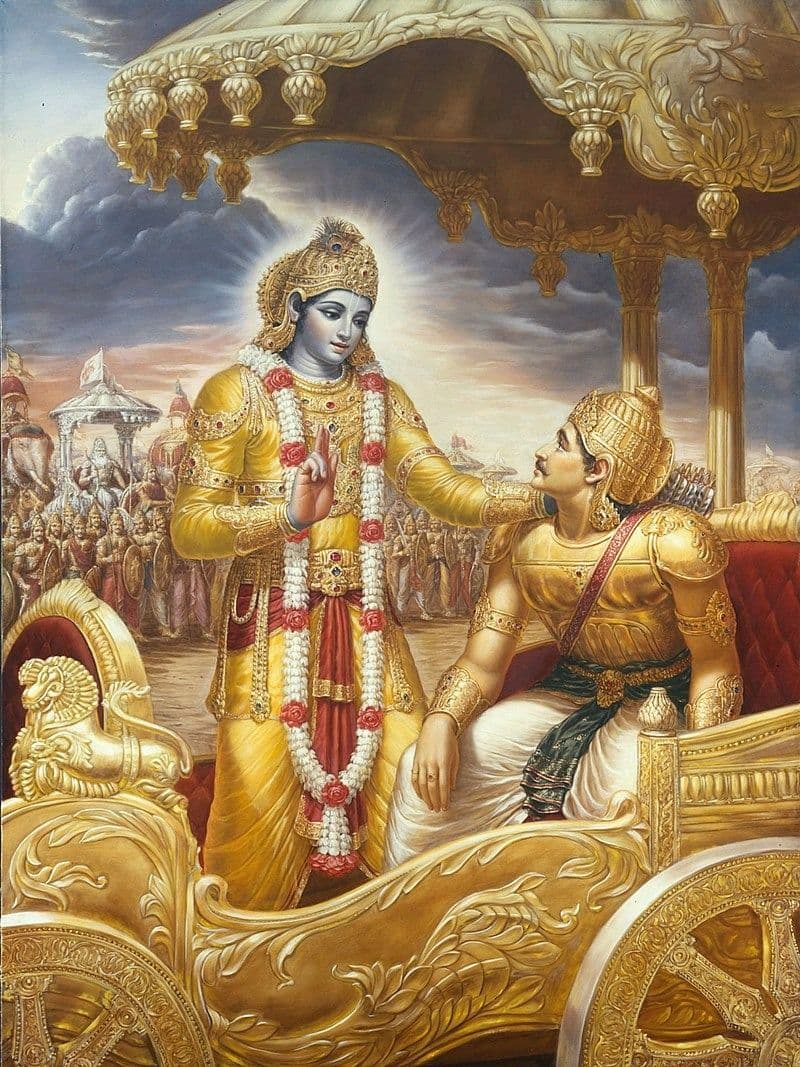
The Bhagavad Gita arrives in the middle of a civil war. Arjuna, the finest warrior of his age, stands paralyzed between two armies, his bow slipping from his hand. His crisis is not philosophical; it is existential. He looks at the faces of his teachers, cousins, and friends arrayed against him, and the conventional meaning of duty collapses. In that moment of utter breakdown, Krishna begins to speak—not with a system, but with a diagnosis. The Gita's non-dual teaching emerges not as abstract metaphysics, but as the only possible response to a mind shattered by the illusion of separation. It is a teaching that refuses to separate the spiritual from the practical, the self from the world, the seeker from the sought.
Many approach the Gita as a book of moral guidance or devotional poetry. Fewer notice the relentless non-dual current running beneath every verse—a current that dissolves the very distinction between Krishna and Arjuna, between God and devotee, between the self that acts and the Self that witnesses. This article does not argue that the Gita is an exclusively Advaitic text; it is a symphony of paths. But it does explore how the Gita uses the language of non-duality to answer the deepest questions of human existence, not through doctrines but through a radical shift in perception. We will examine the psychology of Arjuna's collapse, the nature of the Self as Krishna reveals it, and the lived implications of seeing through the illusion of doership while remaining fully engaged in life.
The Collapse of the Constructed Self
Arjuna's crisis on the battlefield is not a dramatic exaggeration; it is a portrait of what happens when the identities we have carefully built suddenly stop making sense. Arjuna defines himself by his roles: warrior, protector, upholder of dharma. When those roles demand he kill his own kin, the structure fractures. He experiences what we might call a profound cognitive dissonance—but more than that, it is a spiritual vertigo. The ground of “who I am” gives way. From an Advaitic perspective, this is a gift dressed as a catastrophe. The ego's narrative cannot hold, and in that gap, a deeper truth can be heard. Krishna does not rush to comfort Arjuna; he waits, then begins to dismantle the very notion of the self that suffers.
Grief as the Gateway
Arjuna's tears and trembling are not weakness. They are the body's honest response to a falsehood being exposed. The man who has spent a lifetime identifying with his strength, his lineage, his moral code, now sees that these things cannot save him from the sorrow of existence. Krishna's first major teaching, in the second chapter, strikes at the root of this misidentification: “You grieve for those who should not be grieved for, yet speak words of wisdom. The wise grieve neither for the living nor the dead” (2.11). This is not coldness. It is the starting point of non-duality: the recognition that the self we take ourselves to be—the body, the personality, the social identity—is not the real Self. The real Self, Krishna insists, is never born and never dies. It is the unchanging awareness in which all change occurs.
Consider your own moments of crisis—the end of a relationship, the loss of a job, a betrayal. The pain feels personal, unique, unbearable. But what if that pain is the friction of a mistaken identity rubbing against reality? The Gita's non-dual teaching suggests that suffering is not primarily about the external event; it is about the “I” that claims ownership of the event. Krishna does not tell Arjuna to stop feeling. He tells him to see clearly who the feeler is. That seeing does not negate the feeling; it recontextualizes it, so that feeling no longer defines the one who feels.
The Self as the Imperishable Witness
Krishna's initial exposition draws heavily from Samkhya philosophy, distinguishing between the field (prakriti) and the knower of the field (purusha). Yet the Gita seamlessly moves from dualistic terminology into a profound non-duality where Krishna identifies himself as the Self of all beings. The tenth chapter erupts with a cascade of identities: “I am the Self, seated in the heart of all beings; I am the beginning, the middle, and the end” (10.20). This is not a god asserting dominance. It is the voice of consciousness itself, speaking through a form to remind another form that they share the same essence. When Arjuna sees Krishna's cosmic form (Vishvarupa), he is not seeing something outside himself; he is seeing the totality of existence, including his own self, as a single, indivisible reality. The terror and awe are the ego's reaction to its own dissolution.
The Witness in the Midst of Action
One of the most challenging aspects of the Gita's non-duality is that it does not lead to withdrawal. Arjuna is told to fight. How can the witness, the uninvolved consciousness, engage in violent action? This is the paradox that many miss. The non-dual self does not act; it merely witnesses. But from the standpoint of the body-mind, action continues according to its nature. Liberation is not the cessation of action but the cessation of the sense of personal doership. Krishna famously says: “Actions are done by the gunas (qualities) of prakriti; the one deluded by ego thinks, ‘I am the doer'” (3.27). Non-duality in the Gita is thus a lived psychological shift: you still perform your duties, but you no longer imagine that a separate “you” is performing them. The action flows through you, and you abide as the silent witness.
Imagine a pianist who, after years of practice, plays a piece without thinking, without “doing” it—the music plays itself. The sense of a separate controller dissolves into the flow. That is a taste of the non-dual action described in the Gita. It does not require a battlefield; it can be present in writing an email, cooking a meal, or comforting a friend. The key is the collapse of the intermediary ego that claims credit or blame. This is not indifference, because the witnessing consciousness is not cold—it is the very source of love and compassion, but without attachment to outcomes.
Buddhi Yoga: The Yoga of Equanimous Intelligence
Krishna introduces a crucial term: buddhi yoga, the yoga of the discriminative intellect. Buddhi is not the thinking mind (manas) but a higher faculty that can discern the real from the unreal. In the Gita's non-dual framework, buddhi is the inner instrument that turns away from the objects of experience and recognizes its own source. Krishna urges Arjuna to “resort to buddhi” and to perform actions established in equanimity. This equanimity (samatvam) is not emotional suppression; it is the natural poise of consciousness that knows itself to be unlimited, regardless of the fluctuations of fortune. Success and failure, pleasure and pain, are pairs of opposites that belong to the realm of prakriti. The Self remains untouched. Establishing oneself in that understanding is the essence of buddhi yoga.
Equanimity as a Direct Path to Non-Dual Recognition
Equanimity is often misunderstood as a passive, detached state. In the Gita, it is intensely active and discerning. It means meeting every experience with the same openness, not because you have numbed yourself, but because you see the same single reality shining through all appearances. When you receive praise and criticism with the same inner steadiness, you are not suppressing the sting of criticism. You are seeing that both praise and criticism are temporary ripples in the ocean of consciousness, which is what you are. This is not a practice of forced indifference; it is the consequence of a lived non-dual seeing. The Gita's non-duality is not a theory to adopt but a perception to stabilize. Buddhi yoga is the process of stabilization. The intellect, sharpened by teaching and reflection, must become so convinced of the non-dual truth that it no longer wavers in the face of life's dualities.
Normal Mind (Manas) | Buddhi (Discriminative Intellect) |
|---|---|
Reacts to opposites with attraction and aversion | Sees opposites as modifications of the same substance |
Identifies with thoughts and emotions | Witnesses thoughts and emotions as objects in awareness |
Seeks happiness in external conditions | Recognizes happiness as the nature of the Self, independent of conditions |
Creates the sense of doership | Sees action as a play of gunas; dissolves doership |
This discrimination is not philosophical acrobatics. It is the difference between being swallowed by a wave of anger and noticing, “Ah, anger is present,” and feeling the spaciousness around it. That spaciousness is the presence of the witness, the non-dual Self. The more buddhi is cultivated, the more that spaciousness becomes your primary identity, and the waves of emotion lose their power to sweep you away.
Karma, Akarma, and the Mystery of Inaction in Action
One of the Gita's most profound non-dual insights is the distinction between karma (action), akarma (inaction), and vikarma (forbidden action). Krishna says, “One who sees inaction in action, and action in inaction, is wise among humans” (4.18). This is a direct pointer to the non-dual state. From the perspective of the ego, action is something you do, and inaction is the absence of doing. But from the Self, all action is a movement within consciousness, and the Self remains ever inactive, ever still. To see inaction in action means to recognize that while the body and mind are engaged in activity, the Self is not the actor—it is the screen upon which the activity appears. To see action in inaction means that even when the body is still, the gunas are in constant motion, and the witnessing consciousness is ever-present, not inert.
The Psychological Weight of Doership
The burden of doership is the root of much of our existential anxiety. We feel responsible not only for our actions but for their outcomes—a crushing weight that leads to burnout, perfectionism, and fear of failure. The Gita's non-dual teaching does not remove responsibility for our actions in the conventional sense; it removes the existential weight of the separate doer. Krishna tells Arjuna: “You have the right to perform your prescribed duty, but never to its fruits. Do not be the cause of the fruits of action, nor be attached to inaction” (2.47). This is not a call to laziness. It is an invitation to act from a place of fullness, without the ego's need for validation. When you give a presentation at work, you prepare thoroughly, but you release attachment to how it is received. The non-dual vision allows you to pour your whole heart into the act without being emotionally dependent on the applause.
Consider social media: we post, then compulsively check for likes. The action is the posting; the fruit is the engagement. The ego attaches its worth to the fruit. When the likes are few, the ego suffers. The Gita's wisdom reorients: you do what is appropriate, knowing that the real Self needs no validation. The action becomes lighter, more authentic, free from the desperation of outcome. This is not a technique to stop caring; it is the natural byproduct of knowing that you are already whole.
The Cosmic Form and the Dissolution of Separation
In the eleventh chapter, Arjuna asks to see Krishna's divine form. What follows is a terrifying, awe-inspiring vision of all of existence—gods, demons, the entire universe—inside Krishna's body, with countless mouths devouring all beings. This is not a hallucination; it is a direct revelation of non-duality: the totality of reality is a single, living organism, and every apparent individual is a transient expression of that totality. The vision includes Arjuna seeing the warriors on both sides rushing into Krishna's flaming mouths. This is the end of the illusion of personal agency and the separate self. The ego that planned the battle, that worried about killing and being killed, is revealed as a tiny fiction within a vast, self-consuming cosmic dance.
From Dread to Surrender
Arjuna's initial reaction is terror, then a desperate desire for the familiar, gentle Krishna to return. This mirrors the spiritual journey: when the mind first glimpses the magnitude of non-dual truth, it often recoils. The annihilation of the personal self feels like death. But Krishna's return to the human form is not a step back from non-duality; it is a compassionate concession to the mind's need for a form to love. The Gita's non-duality, therefore, does not denigrate the personal form of God (Ishvara) as unreal. Instead, it teaches that Ishvara is the face the formless Brahman wears to meet the devotee. The deepest devotion (bhakti) in the Gita is not worship of a separate deity but a love that culminates in the merging of lover and beloved. Krishna says, “He who sees Me everywhere and sees all in Me, I am never lost to him, nor is he lost to Me” (6.30). That is the language of non-duality expressed through relationship.
“At the end of many births, the wise one takes refuge in Me, realizing that Vasudeva is all. Such a great soul is very rare.” — Bhagavad Gita 7.19
Jnana, Bhakti, and the Collapse of Paths
The Gita presents multiple paths: karma yoga (action), jnana yoga (knowledge), and bhakti yoga (devotion). Popular commentaries often treat them as separate tracks suited to different temperaments. But from a non-dual viewpoint, these paths are not separate; they are concentric circles leading to the same center. Jnana without devotion can become dry intellectualism; devotion without knowledge can remain dualistic worship; action without either can bind. The Gita's non-dual synthesis reveals that true knowledge is devotion, true devotion is knowledge, and true action is the spontaneous expression of a self that knows it is not the doer.
The Non-Dual Devotion of the Jnani
Krishna describes the jnani, the knower of truth, as the highest devotee: “Of these, the knower, ever steadfast and devoted to the One, excels; for I am supremely dear to the knower, and he is dear to Me” (7.17). This is a striking statement. The jnani, who knows the Self as one with Brahman, is the one who loves Krishna most. How can this be, if non-duality erases the distinction between lover and beloved? The answer lies in the mystery of love without separation. The jnani no longer sees Krishna as an external being to be worshiped but as the very Self. Yet, a profound love remains—a love that is not based on need but on the sheer joy of existence. That love is expressed in the world as compassion, service, and celebration. The Gita's non-duality does not erase the heart's devotion; it purifies it into a selfless, all-inclusive love.
The Gunas and the Illusion of the Personal Doer
The Gita's cosmology of the three gunas—sattva (lucidity), rajas (activity), and tamas (inertia)—is central to its non-dual psychology. The gunas are the forces of nature that constitute all experience. The mind, the body, the world, the very sense of “I” are all products of the gunas. Krishna's statement that “actions are done by the gunas” (3.27) implies that the personal ego is itself a guna-created phenomenon. Liberation is not the destruction of the gunas, which would mean the destruction of the universe, but the recognition that the Self, the pure awareness, is beyond the gunas. The one who knows this is called gunatita—beyond the gunas. That person still lives within the play of nature but is no longer identified with its movements.
Typology as a Mirror, Not a Prison
Modern psychology offers personality frameworks; the Gita offers the gunas as a dynamic map of inner states. You might notice that in the morning, the mind is predominantly sattvic—clear, calm. By afternoon, rajas takes over—driven, restless. At night, tamas may prevail—dullness, the pull of distraction. The non-dual teaching asks: Are you any of these states? Or are you the awareness that registers the shift from sattva to rajas to tamas? The witness is not a guna; it is the light by which the gunas are known. This understanding transforms self-improvement from a battle against undesirable traits into a compassionate, detached observation. You no longer wage war on your laziness or ambition; you see them as weather patterns in the field of nature, not as defects of a self. The spiritual battle Arjuna must fight is not against his relatives; it is the inner battle between the clarity of the witness and the seduction of identification with the gunas.
Guna | Characteristic Experience | Non-Dual Insight |
|---|---|---|
Sattva | Peace, knowledge, lightness | Even sattva can bind through attachment to happiness and knowledge; the Self is beyond all three. |
Rajas | Desire, activity, restlessness | Rajas is the engine of samsara; seeing it as not-self frees energy from the ego's grip. |
Tamas | Inertia, ignorance, delusion | Tamas is not a sin but a natural state; witnessing it without judgment weakens its hold. |
This table is not a diagnostic tool to label yourself or others. It is a lens to notice the impersonal dance of qualities that create the illusion of a personal self. In the space of witnessing, the gunas arise and subside like clouds. The sky remains untouched.
The Sthitaprajna: The Ideal of Non-Dual Living
In the second chapter, Arjuna asks Krishna to describe a person of steady wisdom, a sthitaprajna. The description that follows is arguably the most concentrated portrait of non-dual living in world literature. The sthitaprajna has withdrawn the senses from objects, like a tortoise withdrawing its limbs, and has gained a satisfaction independent of the world. Such a person is free from attachment, fear, and anger, moving through the world with a deep inner stillness. But this is not a state of emotional deadness; it is a state of fullness where the need for external stimulation has fallen away. The ocean receives many rivers; the sthitaprajna receives all experiences without being disturbed from their depths.
Sleep, Dream, and the Steady Flame
Krishna uses the metaphor of a lamp in a windless place that does not flicker (6.19) to describe the mind of the yogi. This still mind is not a blank mind; it is a mind so deeply rooted in the Self that the winds of desire and fear no longer agitate it. What is the nature of this stillness? It is the stillness of deep sleep, yet fully awake. In deep sleep, the mind subsides, but the ego's seed remains; upon waking, the world rushes back. In the non-dual state of the sthitaprajna, the ego has been seen through, so the wakeful state has the peace of deep sleep, while deep sleep is permeated with consciousness (for the jnani). This is not a supernatural feat; it is the fruit of sustained self-inquiry and surrender. The Gita's yoga is the path to this integration where all three states (waking, dreaming, deep sleep) are recognized as appearances in the one awareness that is the true Self.
The sthitaprajna is often idealized as a renunciant in a cave, but the Gita's setting insists otherwise. Arjuna is being prepared to be a sthitaprajna on the battlefield. The non-dual state is not reserved for the cloister; it is meant for the market, the office, the family dinner table. The sthitaprajna acts, but action leaves no karmic residue because the doer-sense is absent. This is not amoral; the action naturally aligns with the welfare of all beings because there is no ego to act selfishly. The sthitaprajna is the embodiment of the Gita's non-dual take: fully human, fully divine, fully engaged, yet inwardly untouched.
“One who is unattached to external contacts, finds happiness in the Self; that person, engaged in the yoga of Brahman, attains inexhaustible happiness.” — Bhagavad Gita 5.21
The Non-Duality of the Teaching Moment Itself
A subtle but potent dimension of the Gita is the relationship between Krishna and Arjuna. Krishna is not a remote deity handing down commandments; he is a friend, a charioteer, engaged in intimate dialogue. The teaching situation is itself a non-dual transmission. Krishna, the inner Self, speaks to Arjuna, the confused ego, from a place of complete understanding. The distance between them is not ontological but epistemological. Arjuna does not know who he is; Krishna knows who Arjuna is, because Krishna knows himself as the Self of all. The entire conversation is the Self calling itself back to itself through the vehicle of a human relationship. When we read the Gita, we are Arjuna, and the text becomes the charioteer.
Listening as the First Yoga
Arjuna's initial posture is not of doing but of listening. He says, “I am your disciple, teach me” (2.7). This surrender is the prerequisite for non-dual wisdom. The modern mind, trained in critical thinking and skepticism, finds it difficult to adopt such a posture. But the surrender is not to an external authority; it is to the possibility that one's own self-understanding is incomplete. It is the willingness to be shown what lies beyond the mind's current capacity. This listening is an active, radical openness. When you engage with the Gita's verses, can you listen not as a scholar dissecting a text, but as a consciousness ready to be dismantled? The non-duality of the Gita is not something you understand; it is something you become, through a relationship with the teaching that mirrors Arjuna's with Krishna.
The teaching moment extends to your own life: every crisis, every failure, every moment of intense love or loss is a potential Krishna speaking. The battlefield is wherever you stand, paralyzed by the paradoxes of your existence. The voice that answers is the innate intelligence of the Self, if only you can quiet the clamor of the ego long enough to hear it. The Gita's non-duality thus transforms the entire world into a scripture and every encounter into a guru.
The Gita's Non-Duality and the Problem of Evil and Suffering
One of the sharpest challenges to any non-dual philosophy is the existence of suffering, injustice, and evil. If all is one, if the Self is bliss, why does the world contain such horror? The Gita does not provide a theodicy in the traditional sense. Instead, it reframes the question. In the cosmic vision of chapter eleven, Krishna shows Arjuna that destruction and creation are simultaneous, inseparable aspects of the same reality. The warriors about to die have already been slain by the Self; time itself is the destroyer. This is not a justification of violence but a radical acceptance of the totality of existence. The non-dual vision sees that the categories of good and evil, while operationally necessary, are ultimately mental constructs that arise within the dream of separation. The Self, being the ground of all, is beyond moral duality.
Compassion Without Delusion
This does not lead to callousness. The jnani, seeing the Self in all beings, feels spontaneous compassion for those who suffer under the illusion of separation. That compassion is not pity, which creates a distance between the helper and the helped. It is the movement of the one heart to remove the suffering of its own limbs. The Gita's Krishna repeatedly emphasizes acting for the welfare of all beings (loka-sangraha). The non-dual take on suffering is thus not passive acceptance but active, engaged compassion that does not burn out, because the giver is not losing anything—they are merely being what they are. This is a profound answer to the problem of evil: the evil exists only at the level of appearances, and the response is to wake up from the dream while working to alleviate the dream-suffering of others, without forgetting it is a dream.
The Gita's Legacy and Misappropriation
The Bhagavad Gita has been used to justify everything from nonviolence to holy war. The non-dual core of the teaching has often been suppressed or distorted. When Krishna tells Arjuna to fight, it has been taken literally as a sanction for violence, ignoring the fact that the battle is primarily an inner one, and that the real enemy is ignorance. Similarly, the Gita's caste-related verses have been used to uphold social hierarchy, but the non-dual teaching that the Self is the same in all beings—whether Brahmin, Kshatriya, Vaishya, Shudra, or outcast—radically undercuts such divisions. A truly non-dual reading of the Gita is inherently liberating at all levels: personal, social, and existential. It insists that the same light shines in all eyes, and any system that denies that is based on avidya, ignorance.
The Gita as a Mirror, Not a Rulebook
If you approach the Gita looking for a clear set of rules, you will be disappointed. It speaks in paradoxes: be active and yet inactive; be in the world but not of it; love Krishna with all your heart, yet know you are one with him. These paradoxes are not logical puzzles; they are designed to break the mind's habit of dualistic thinking. The Gita's non-duality is not a philosophy to be intellectually mastered; it is a transmission that occurs when the mind, exhausted by its own contradictions, falls silent. Every generation, every individual, must discover this silence anew. The book is not the teacher; the living consciousness that speaks through it is. That consciousness is your own deepest Self.
Closing Reflection: The Charioteer Within
The Gita ends with Sanjaya's words: “Wherever there is Krishna, the lord of yoga, and Arjuna, the archer, there will be prosperity, victory, glory, and unfailing righteousness.” This is not a prediction of a future utopia. It is a statement about the human soul. Krishna is the ever-present awareness; Arjuna is the human psyche, with all its confusion and courage. When these two are aligned, when the chariot of the body is guided by the inner wisdom, life becomes a flowing, victorious expression of the non-dual truth. The battlefield does not disappear, but it is no longer a place of suffering. It is the stage for the play of consciousness, the divine lila.
The Bhagavad Gita's take on non-duality is not a mere philosophical position; it is a lived solution to the problem of being human. It meets you in your darkest hour, when your old identities have crumbled and you do not know which way to turn. It does not offer a new identity; it offers the end of the need for identity altogether. In that ending, you find not an emptiness, but a fullness that includes everything—the battle, the sorrow, the joy, and the silence that holds them all. The Gita's non-dual truth waits for you, not in the pages, but in the chariot of your own heart, where Krishna has already taken the reins.