


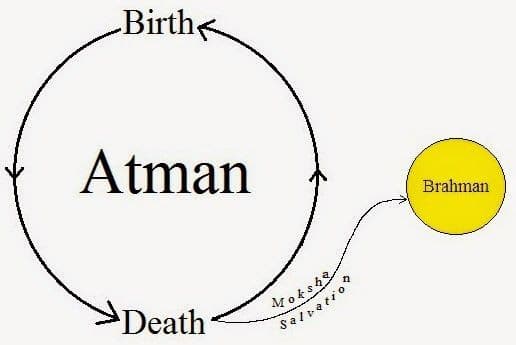
There is a moment, often in the unguarded space between waking and sleep, when the elaborate architecture of identity loosens. The name, the history, the pressing agenda of the day recede, and what remains is a bare sense of existence—a simple, undifferentiated I am. This fleeting, wordless recognition is the human access point to the profoundest teaching of Advaita Vedanta: that the innermost Self, Atman, is not a thing among things but the very light of consciousness, and that this Atman is not a fragment of a larger whole but identical with the boundless reality called Brahman. To understand Brahman and Atman is not to grasp a philosophical doctrine; it is to trace that quiet sense of being back to its source, and to find that the source has no edge.
The terms Brahman and Atman have been domesticated by centuries of commentary, often reduced to abstract placeholders: Brahman as the cosmic absolute, Atman as the individual soul. While not entirely false, such definitions behave like coins passed around so often that the original engravings become unreadable. The purpose of this exploration is to restore the experiential voltage of these words—not by adding more belief, but by investigating the living texture of consciousness, identity, and perception. We will hold these concepts as lenses rather than conclusions, and in doing so, we may discover that the very act of seeking to understand them transforms the one who seeks.
The Map and the Territory: Pointers Beyond Thought
It is essential, from the outset, to recognize that Brahman and Atman are not objects of knowledge. The mind, trained to apprehend objects, naturally wants to make them into something to be learned, like a city on a map. Yet Advaita Vedanta insists that Brahman, the ground of all that exists, is precisely that which cannot be objectified because it is the very subject, the awareness in which all objects—including thoughts about Brahman—arise. Atman, similarly, is not an object inside the body that can be isolated; it is the immediate, irreducible presence of awareness itself. Any attempt to capture them in a net of words ends in paradox.
This is why the classical approach uses the method of adhyaropa-apavada—deliberate superimposition followed by negation. The Upanishads first describe Brahman in positive terms: Sat-Chit-Ananda (Being-Consciousness-Bliss), giving the mind a provisional support. Then they negate even that: “Not this, not this” (neti, neti). The positive description is a ladder used to climb beyond the ladder. The danger, both ancient and modern, is to mistake the ladder for the destination, to cling to the word Brahman as a conceptual possession. This exploration, therefore, will treat every definition as a pointer, and every pointer as an invitation to look directly, not to believe.
Atman: The Felt Sense of “I” Under Investigation
When we use the word “I,” we usually mean a constellation: the body, the memories, the personality traits, the social roles. But if we close our eyes and simply feel into the sense of being, we can notice that these are all accessories, appearing and disappearing within a steady presence. A pain arises, a thought appears, the memory of a failure flits by—but that for which all this appears remains untouched. This steady presence is what Advaita calls Atman. It is not a special experience; it is the common factor of every experience, so close that it is overlooked.
Yet the mind, left to its habits, identifies this presence with one of its passing guests. I am hungry, I am tired, I am a writer, I am unworthy. Each identification creates a miniature self, a contraction of the boundless into a bounded form. Atman, in the Advaitic sense, is the awareness that witnesses these contractions without becoming contracted. It is not an ego or a “higher self” that stands apart; it is the simple light of knowing, the capacity for any experience whatsoever. The inquiry into Atman is thus the inquiry into the nature of the one who inquires—a turning of attention away from what is known and toward the knowing itself.
The Ego’s Shadow and the Light of Atman
A useful distinction is drawn between the ego (ahamkara) and Atman. The ego is a mental function, the sense of being a separate doer and experiencer. Atman is the presence in which that ego-function appears. When the ego says, “I must succeed to be valued,” it narrows the field of consciousness into a tight knot of anxiety. But if we ask, “Who is this I that needs to succeed?” the inquiry itself begins to loosen the knot, pointing toward the ever-present awareness that needs nothing because it is already whole.
In moments of humiliation or failure, this distinction becomes palpably liberating. Suppose a professional rejection arrives. The ego narrates a story of personal defect. Atman does not narrate; it simply witnesses. By shifting the sense of identity from the story to the witness, the sting is not denied but is no longer owned. This is not a psychological trick but a direct consequence of understanding what Atman is—not something to cultivate, but something to recognize as always already the case.
Aspect | Ego (Ahamkara) | Atman (True Self) |
|---|---|---|
Nature | A mental modification, a bundle of thoughts and identifications | The unchanging, self-luminous awareness |
Dependence | Depends on body, mind, memory, external validation | Independent, self-existent |
Response to change | Fluctuates with circumstances; suffers and enjoys | Remains untouched, the witness of change |
Function | Navigates the practical world; can be a tool | Provides the light of consciousness, without which ego cannot function |
Reality | Empirically real, ultimately a superimposition | Absolutely real, the substrate of all superimpositions |
Brahman: The Ground Beyond Conception
If Atman is the inner light of awareness, Brahman is that same light seen from the macrocosmic perspective—the infinite, undifferentiated ground of all existence. Advaita’s radical claim is that these two are not two. The same awareness that shines as the innermost self of a single being is the very stuff of the cosmos. This is not a pantheism that worships the world as God; it is a recognition that the substratum of the world, the reality behind all names and forms, is pure consciousness, and that consciousness is never separate from the awareness that one intimately is.
Brahman is described as Nirguna—without qualities, beyond all attributes—and Saguna—with qualities, as the personal God (Ishvara) accessible through devotion. The Nirguna Brahman is the ultimate, unqualified reality, the silence before the first word. The Saguna Brahman is that same reality seen through the lens of Maya, the creative power that projects the world of duality. This two-tiered description is not a contradiction but a concession to the human mind, which needs a relational anchor before it can release into the non-relational. In practice, one may relate to Brahman as the beloved Lord, or one may inquire directly into the formless ground—both paths, if authentic, lead to the same silence.
Why “Being-Consciousness-Bliss” Is Not a Description
The formula Sat-Chit-Ananda is often taken as a positive definition of Brahman. But a closer look reveals that it is a refusal to limit. Sat (existence) is not a particular kind of existence but existence as such, the fact that anything is at all, prior to the division of subject and object. Chit (consciousness) is not a mental state but the condition of any experience whatsoever. Ananda (bliss) is not a pleasant emotion but the fullness that obtains when the sense of lack, born of separation, dissolves. Together, they do not describe a super-object; they negate the distinctions—being vs. non-being, conscious vs. unconscious, bliss vs. suffering—that define dualistic experience.
The Reality that pervades all existence is not a thing to be seen; it is the very seeing itself. When the eye attempts to see itself, all objects vanish, and only vision remains.
The Mahavakya “Tat Tvam Asi”: A Collision of Identity
No exploration of Brahman and Atman can bypass the great statement (Mahavakya) from the Chandogya Upanishad: Tat Tvam Asi—That Thou Art. On the surface, it seems to equate two separate entities: the distant cosmic principle and the intimate self. But the statement is not a piece of information; it is a verbal sledgehammer meant to shatter the student’s assumed separation. If I am That, then the entire structure of me as a limited body-mind is mistaken. The search for God ends in the startling recognition that the seeker and the sought are the same.
This recognition is not achieved by repeating the words but by unpacking their implication. What is the “That” that I am? Not the phenomenal world, not the ego, not the fleeting thoughts, but the very reality that underlies them. The Mahavakya serves as a focal point for meditation: one probes the meaning of “I” and the meaning of “That” until the conceptual distinction collapses, leaving only the immediate, non-dual fact of being aware. The psychological impact is immense: if I am That, then the eternal wholeness I have been striving for is already my nature. Striving itself becomes suspect.
Table: The Four Mahavakyas and Their Functions
Mahavakya | Source | Core Meaning | Primary Implication |
|---|---|---|---|
Prajnanam Brahma | Aitareya Upanishad | Consciousness is Brahman | Recognize the nature of Brahman as consciousness |
Aham Brahmasmi | Brihadaranyaka Upanishad | I am Brahman | Affirmation of identity; a direct statement of self-realization |
Tat Tvam Asi | Chandogya Upanishad | That Thou Art | Instruction from guru to disciple, collapsing separation |
Ayam Atma Brahma | Mandukya Upanishad | This Self is Brahman | Points to the immediate Atman as the absolute |
Each Mahavakya is a different angle on the same non-dual truth. Together, they dismantle the belief that the self is limited and the absolute is distant. They are not hypotheses but urgent invitations to immediate, living knowledge.
The Three Bodies and the Five Sheaths: Unpacking the Sense of Self
Advaita Vedanta offers a systematic phenomenology of the self through the doctrine of the three bodies and the five sheaths (koshas). This analysis is not intended to create a new belief system; it is a tool for discrimination. By examining the layers of our experience, we can distinguish between what we are not and what we undeniably are. The three bodies are the gross (Sthula, physical body), the subtle (Sukshma, mind, intellect, ego, vital airs), and the causal (Karana, the seed state of ignorance, experienced in deep sleep). The five sheaths map onto these: food sheath (physical), vital air sheath, mental sheath, intellectual sheath, and bliss sheath.
When I say “I am tired,” I identify with the food sheath. When I say “I am angry,” the mental sheath. Each identification feels real until examined. In deep sleep, the gross and subtle bodies are dormant; only the causal body remains as potential. Yet upon waking, I say “I slept well.” That continuity of “I” through the absence of all sheaths indicates a presence that is not any of them. That presence, which cannot be objectified, is Atman. By systematically negating identification with each sheath—neti, neti—the practitioner abides as the witnessing awareness that pervades all.
Table: The Five Sheaths and Their Transcendence
Sheath (Kosha) | Description | Common Identification | Discrimination Insight |
|---|---|---|---|
Annamaya (Food) | Physical body, composed of food | “I am the body” | The body is an object perceived; I am the perceiver |
Pranamaya (Vital) | Vital energy, breath, physiological functions | “I am hungry, tired” | Vital signs change; awareness witnesses them unchanged |
Manomaya (Mental) | Mind, emotions, discursive thought | “I am my thoughts, feelings” | Thoughts appear and disappear; the light in which they appear remains |
Vijnanamaya (Intellectual) | Intellect, discernment, ego-sense | “I am the knower, the decider” | Even the sense of agency is a subtle object; the witness is beyond it |
Anandamaya (Bliss) | Bliss experienced in deep sleep or samadhi | “I am the blissful one” | Bliss is a state of mind; awareness is the constant substratum of all states |
This stepwise negation often meets resistance. The intellect may enjoy the game, but the ego fears its own dissolution. Yet the process is not one of destruction; it is like waking from a dream where one was being chased. The dream character does not die; it is simply recognized as an appearance. The relief is immense.
Maya: The Apparent Separation
What creates the illusion that Atman and Brahman are separate, that the individual self and the cosmic ground are two? Advaita answers with Maya, often translated as illusion, but more accurately as the creative, veiling power of Brahman itself. Maya is not a separate evil force; it is the inexplicable principle that makes the one non-dual reality appear as a multiplicity of subjects and objects. It is both the projecting power (vikshepa) and the veiling power (avarana). The world of names and forms is Maya; it is real at the empirical level but has no independent reality apart from Brahman, just as a wave has no reality apart from water.
Psychologically, Maya is the habitual tendency to see difference—the subject-object split—as fundamentally real. When we feel lonely, the sense of being a separate self cut off from others is a direct experience of Maya’s veiling power. At that moment, we do not feel that we are the wholeness of existence; we feel like a fragile container. The teaching of Maya is not meant to devalue the world but to expose that our suffering arises from mistaking the container for the content, the form for the essence.
Maya in Modern Experience: Social Media and Self-Image
The curated personas on social media are a vivid contemporary expression of Maya. A profile presents a seemingly solid, consistent identity, but it is a composite of moments, chosen and filtered. The “self” that gets likes and comments feels acutely real, yet it dissolves when the screen goes dark. This digital self, like the ego, is a construct that depends on continuous maintenance. The suffering it generates—comparison, envy, validation hunger—stems from taking the construct as the full truth of who we are. The Advaitic insight is not to destroy the profile but to see it as a play (lila) of appearances, while the reality is the aware screen of consciousness on which the play unfolds.
The Rope and the Snake: Misperception and the Mechanism of Suffering
The classic analogy of the rope mistaken for a snake in dim light captures the entire mechanism. A man sees a snake, his heart races, fear grips him. Then a light is brought, and he sees it is only a rope. The snake never existed; it was a mental superimposition (adhyasa) on the rope. Similarly, the world of plurality and the individual self are superimposed on Brahman due to ignorance. When knowledge dawns, the superimposed world does not vanish into nothing; it is simply recognized as nothing other than the rope, i.e., Brahman. The snake was never there; the rope always was.
This analogy holds profound emotional resonance. A person may spend decades haunted by a self-image of worthlessness superimposed on the pure Atman. The self-image feels real, generates endless compensatory behavior, and leads to suffering. The light of inquiry does not “cure” the worthlessness by replacing it with a better story; it reveals that the sense of a worthless self was never a real entity, only a pattern of thoughts and sensations. The Atman, the ever-present awareness, remains unscarred. The relief is a release from a ghost that never lived.
The snake that terrorized you was never born; only the rope is real. The self that suffered was a story; only the Self is real.
The Witness (Sakshi) and the Dissolution of the Observer
In the process of discrimination, the practitioner often stabilizes in the witness attitude (sakshi bhava). One observes thoughts, emotions, and bodily sensations as a detached presence. This is a powerful stage, offering freedom from reactivity. However, Advaita warns that even the witness is a subtle position, a last bastion of duality. As long as there is a witness and a witnessed, there is still a subject-object split. The final step is to inquire into the witness itself: “Who is the witness? What is it made of?” When this inquiry is pursued, the witness dissolves into pure witnessing, which is not an entity but a seamless field of awareness without a center. That is Atman-Brahman, the non-dual reality.
The collapse of the observer has existential repercussions. In daily life, when one no longer feels like an entity behind the eyes watching a world out there, the separation that fuels anxiety diminishes. A critical email arrives; there is no inner “someone” who takes the hit. The event simply unfolds. The full range of human emotion may still arise, but without the glue of a personal victim. This is not dissociation; it is the intimate, unmediated presence that Advaita describes as the natural state (sahaja).
Atman Beyond the Individual: The Cosmic Self
One of the most challenging aspects of understanding Atman is that it is not personal. It is not “my” Atman versus “your” Atman. Space inside a pot is not different from space outside; when the pot breaks, the space remains undivided. The Atman, similarly, is the one consciousness appearing as the many individuals. The feeling of being a separate person is a temporary localization, a knot in awareness. When the knot loosens, the sense of separateness dissolves, and the Atman is known to be ekam, one without a second.
This universality is not a philosophical abstraction; it can be sensed in moments of deep connection—when looking into another’s eyes, when a shared silence becomes more real than the words that preceded it, when the boundary between self and other momentarily flickers. Those moments are fleeting glimpses of the Atman’s non-dual nature, not as a concept but as a lived intimacy. The teaching of Atman as Brahman universalizes these glimpses, insisting that the flicker can become the permanent ground.
Nirguna and Saguna Brahman: The Formless and the Form
The dual description of Brahman—as formless absolute and as God with attributes—often confuses the seeker. The confusion arises because the mind wants to choose one and reject the other. But they are not rivals; they are the same reality viewed from different perspectives. Nirguna Brahman is the view from the absolute; Saguna Brahman (Ishvara) is the same reality seen through the lens of creation. For the devotee, worship of a personal God can be a path to the formless. The love directed toward the ideal purifies the mind and eventually reveals that the lover, the beloved, and the love are one.
In practical terms, this means a person can wholeheartedly engage in devotional practice while understanding the non-dual teaching. The heart’s longing for a personal connection to the divine is not a mistake; it is a valid expression of the same impulse that ultimately seeks the non-dual. The great Advaitic teachers rarely dismissed bhakti; they saw it as a potent means, provided the devotee eventually recognizes the formless in the form and the form in the formless.
Aspect | Nirguna Brahman | Saguna Brahman (Ishvara) |
|---|---|---|
Attributes | Without attributes, beyond all qualities | With attributes: omniscient, omnipotent, creator, sustainer, destroyer |
Relationship to world | Substratum, the reality behind appearance | Efficient and material cause of the world (from empirical view) |
Approach | Jnana (knowledge), self-inquiry | Bhakti (devotion), upasana (worship) |
Ultimate status | Paramarthika satya (absolute truth) | Vyavaharika satya (empirical truth); ultimately non-different from Nirguna |
Common analogy | Space without any object | Space containing the entire cosmos, the cosmic person |
The Psychological Weight: Releasing the Burden of the False Self
Why does understanding Brahman and Atman matter for the anxious professional, the heartbroken lover, the restless student? Because the entire edifice of psychological suffering rests on a case of mistaken identity. The ego is a relentless manager, constantly trying to control, to secure, to prove. It lives in a state of existential debt, always feeling insufficient. When the truth of Atman is glimpsed—even intellectually at first—the manager’s authority is questioned. If my essential nature is already whole, then the frantic striving for wholeness through achievement, relationships, or recognition is revealed as a tragic misdirection.
Take the experience of ambition. The drive to succeed often contains a hidden premise: “I will be enough when I achieve X.” The non-dual insight does not negate action; it negates the premise. Action can continue, but it is no longer fueled by the need to become what one already is. The energy of ambition transforms into spontaneous expression. The same shift occurs in relationships: when one no longer expects the partner to fill an inner void, relating becomes a sharing of fullness rather than a negotiation of lack. The psychological freedom is profound, not because circumstances change, but because the one who suffers the circumstances is no longer mistaken for a solid entity.
Living Non-Duality: The Fleeting and the Permanent
How does this understanding survive the harshness of daily life? Not by remembering it as a mantra, but by repeatedly, gently, returning attention to the aware presence that is already the case. At first, it seems like a practice; eventually, it becomes the default. The mind still thinks, the heart still feels, but they are recognized as waves on the surface of Atman, which is Brahman. The world is seen as a vibrant, empty display, beautiful and tragic, yet never a threat to the boundless awareness that one is.
In moments of quiet, the question “Who am I?” may no longer evoke a verbal answer but a silent expansion. In moments of noise, the awareness of the noise is itself the stillness. This is not an otherworldly attainment; it is the ordinary, extraordinary truth that the Upanishads declare: That thou art. The journey is not to a distant realm but to the here and now, stripped of misperception.
Closing Reflection: The Silence That Remains
To understand Brahman and Atman is to arrive at the end of understanding. Not because the mind has solved a problem, but because the mind has dissolved into its source. The concepts that once seemed so necessary—God, soul, world, liberation—are seen as gracious fictions, lovingly given by the tradition to lead the seeker out of the fiction of separation. What remains is not a grand answer but an intimate silence, the simple fact of being. That silence is not empty; it is the fullness from which all sounds arise and into which they dissolve.
And so the study of Brahman and Atman is not an academic pursuit. It is the most personal, most immediate, and most destabilizing inquiry one can undertake. It asks us to lose everything we thought we were to find what we have always been. The final pointer is not a word but a gaze turned inward. In that gaze, the distinction between Brahman and Atman disappears, and the universe shines as your own heart, undivided, luminous, and free.