


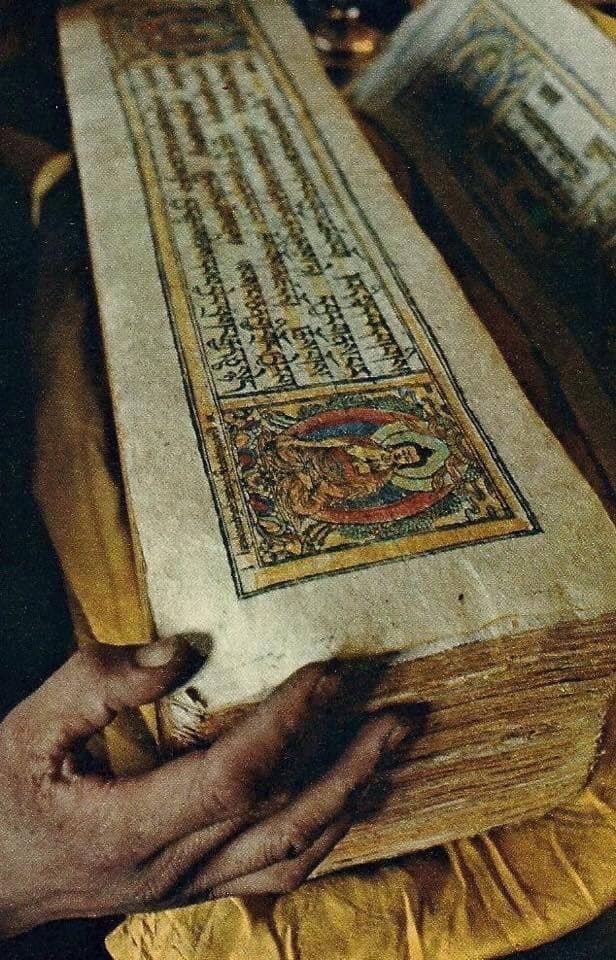
A peculiar discomfort can arise in the heart of a sincere inquirer when confronted with the sheer volume of sacred literature. Shelf upon shelf of ancient commentary, each text demanding allegiance, each tradition claiming the definitive key. In the midst of this overwhelming inheritance, the Prasthanatrayi stands as a deliberate, almost surgical, reduction. It is not a library but a tripod—three texts, each bearing a distinct function, yet all pointing toward the same silence. To grasp the importance of the Prasthanatrayi is not to acquire a new loyalty to three books. It is to discover a mirror that refuses to flatter the one who looks into it.
The term itself—Prasthanatrayi—literally means the three (trayi) starting points or methods of approach (prasthana). In the Advaita Vedanta tradition, these three are the Upanishads, the Brahma Sutras, and the Bhagavad Gita. Together they form a complete curriculum of self-inquiry, not because they accumulate knowledge, but because they systematically dismantle the very framework that makes knowledge seem like a path to liberation. The Upanishads reveal; the Sutras resolve; the Gita integrates. To study them in isolation is to miss their interlocking brilliance. To study them as a unified whole is to undergo a transformation in how one relates to thought itself.
The Triple Canon as a Psychological Map
Modern seekers often approach spiritual texts with the same hunger they bring to career manuals or relationship guides. There is a problem—suffering, confusion, a feeling of incompleteness—and a book is expected to supply the solution. The Prasthanatrayi refuses this transaction. It does not offer a technique to fix a self. Instead, it inquires into the nature of the one who believes she needs fixing. This is a radical reorientation, and the three texts each facilitate a distinct phase of it.
Think of the Prasthanatrayi as a map of psychological collapse. The Upanishads are the raw, unrepeatable testimony of those who saw through the illusion of separateness. They do not argue; they declare. The Brahma Sutras step back from that declaration and ask: does this hold together under rigorous logic? They are the philosophical backbone, the immune system that detects and rejects contradiction. The Bhagavad Gita then takes the entire abstraction and plunges it into the mess of a life: duty, love, violence, despair. It is one thing to understand non-duality in a cave; it is another to see it while standing on a battlefield, your bow slipping from your hand.
The Threefold Wound of the Seeker
Every serious inquirer carries three existential wounds that the Prasthanatrayi addresses. The first is the wound of doubt: even if I have a glimpse, how can I trust it? The second is the wound of isolation: even if I know the truth intellectually, why does my daily experience remain so fragmented? The third is the wound of action: what am I supposed to do with this knowledge? The Upanishads heal the first by providing shruti—that which is heard, the unimpeachable authority of direct revelation. The Sutras heal the second by providing yukti—reason, the coherent logical structure that withstands skeptical scrutiny. The Gita heals the third by providing sadhana—the lived path, the integration of wisdom into the raw material of a human life. No single text could bear this weight alone. The genius of the Prasthanatrayi is its triangulation.
The Upanishads: Listening That Dissolves Distance
The Upanishads are not books in the ordinary sense. They are recorded moments of radical listening. When a student sits at the feet of a teacher who has seen through the veil, what passes between them is not information but a transmission of vision. To open the Upanishads is to overhear a conversation that has already transformed the listener. The words themselves carry a peculiar existential charge: they are not describing a new object of knowledge but turning attention back upon its own source.
This is why the Upanishads use paradox, poetry, and abrupt negation. The mind that tries to grasp them conceptually will feel frustrated, even insulted. A statement like “That thou art” (Tat tvam asi) is not a piece of data. It is a kataphatic explosion designed to shatter the habitual distinction between subject and object. When the text says “The Self is not this, not this” (neti neti), it is not proposing a subtle spiritual entity; it is systematically eliminating every conceivable location where a separate self could hide. The Upanishads function as a stripping mechanism. Each verse removes a layer of identification—body, breath, mind, intellect, bliss—until nothing identifiable remains. And yet, awareness is. That awareness is Brahman.
The Crisis of Authority
For the modern mind, the claim of scriptural authority produces immediate resistance. We have been trained to question, to demand empirical evidence, to distrust anything that asks for faith. The Upanishads do not ask for blind faith. They present themselves as a tool: if you use them as directed, the result will be self-verifying. The authority of the Upanishads, in the Advaita tradition, is not based on historical revelation but on their capacity to remove ignorance. A scalpel has authority over a tumor not because it is holy, but because it cuts precisely. The Upanishads cut precisely at the root of the ego. Their importance lies not in their antiquity but in their relentless efficacy.
“The Self cannot be attained by study, nor by intelligence, nor by much hearing. It is attained by the one whom the Self chooses. To such a one the Self reveals its own nature.” This famous verse from the Katha Upanishad points to a humbling truth: the text alone cannot do the work. It waits until the seeker is ready to be undone.
The Brahma Sutras: The Razor of Reason
If the Upanishads are the heart, the Brahma Sutras are the skeleton. Attributed to Badarayana, these terse aphorisms—often just a few syllables—are nearly incomprehensible without commentary. Their purpose is not to teach new doctrine but to harmonize the apparent contradictions within the Upanishads and to defend the non-dual interpretation against rival schools. They are the philosophical spine that holds the tradition upright.
The Sutras engage in a rigorous process of inquiry known as mimamsa. They examine every conceivable objection: is the material world an independent reality? Is the individual soul separate from Brahman? Can action lead to liberation? Each aphorism is a logical move in a grand argument that culminates in the utter groundlessness of duality. The Brahma Sutras represent the nyaya prasthana—the path of reasoning. They are important precisely because they refuse to let spiritual insight hide behind vagueness. In a culture that often conflates non-duality with a kind of feel-good mysticism, the Sutras stand as a corrective. They demand intellectual integrity.
The Overlooked Role of Tarka
Many who approach Advaita Vedanta are surprised to discover the centrality of tarka—logical argumentation. There is a common misconception that non-dual wisdom is beyond the mind and therefore dismissive of reason. The Brahma Sutras demonstrate the opposite. Reason, when wielded with precision, is not the enemy of liberation; it is the scalpel that cuts away false beliefs. The Sutras show that the mind, when turned against its own assumptions, can exhaust itself into silence. This is a psychologically sophisticated insight. The ego that resists surrender will often yield only when it is defeated on its own terms—through consistent, irrefutable logic. The Brahma Sutras provide that defeat, not as humiliation but as relief.
Aspect | Upanishads | Brahma Sutras |
|---|---|---|
Method | Direct revelation (shruti), paradox, negation | Logical inquiry (yukti), dialectic, harmonization |
Role | Upadesha prasthana: revealing the truth | Nyaya prasthana: establishing coherence |
Primary Challenge | The seeker's emotional attachment to duality | The seeker's intellectual confusion and doubt |
Experiential Analogy | Seeing the sun; the text is the pointing finger | Constructing the telescope; the text is the lens |
The Bhagavad Gita: Action in the Field of Paradox
The Bhagavad Gita occupies a unique space within the Prasthanatrayi. It is smriti—remembered text, not revealed shruti—yet it is revered as the crown jewel of practical wisdom. The Gita does not retreat from the world; it unfolds in the middle of a war. Arjuna, the warrior, collapses under the weight of his moral dilemma: to fight is to destroy his own kin, yet to withdraw is to abandon his duty. Krishna’s response is not a simplistic consolation. It is a complete re-education in the nature of action, agency, and identity.
The Gita adds the dimension of sadhana prasthana—the path of spiritual practice. It acknowledges that most seekers are not ready for the stark negation of the Upanishads or the dry logic of the Sutras. They are caught in the entanglement of desire, fear, and social obligation. The Gita meets them there. It introduces the central teaching of karma yoga: act with full attention and skill, but relinquish the claim of doership and the anxiety for results. This is not moral advice. It is a direct application of non-dual vision to the ordinary movements of life.
The Exhaustion of the Doer
In modern work culture, burnout has become a silent epidemic. The pressure to perform, to curate a successful identity, to outpace others, creates a gnawing sense that one is never enough. The Gita diagnoses this suffering with surgical clarity. The doer—the imagined separate self—is always in a state of lack because it is a byproduct of the very action it claims to initiate. By shifting identification from the doer to the witnessing awareness in which action arises, the Gita offers a way to engage fully without being consumed. This is not escapism. It is the most practical application of non-dual wisdom, tested on the battlefield of daily ambition. When the executive in a high-stakes meeting forgets to claim authorship of her words, the words may become more precise, more attuned. The karma yoga of the Gita is a psychology of action without the fiction of an internal actor.
The Unavoidable Tension Between Scripture and Experience
No honest encounter with the Prasthanatrayi can bypass a central tension: why rely on ancient texts at all, if truth is a living, immediate recognition? This question is not a skeptical dismissal; it is a necessary inquiry that the tradition itself invites. The Prasthanatrayi is important precisely because it holds this tension without collapsing it. It says, in effect: use these words until you no longer need them; rely on this map until you recognize the territory for yourself. The texts are a temporary crutch, but a crutch is invaluable to one who cannot walk.
For the modern seeker, who often begins in isolation—without a living teacher, without a community of practitioners—the Prasthanatrayi serves as a portable guru. It provides a standard against which subjective experiences can be measured. The danger of contemporary spirituality is that it can easily become a mirror of one’s own preferences: a soothing voice that tells you what you want to hear. The Upanishads, Sutras, and Gita together form a corrective. They will not conform to your comfort. They will consistently point beyond the one who seeks comfort.
Scripture as an Invitation, Not a Command
A common mistake is to read the Prasthanatrayi as a set of doctrinal assertions that must be accepted on authority. This turns the texts into an object of belief, which only reinforces the very dualism they seek to dissolve. The Advaita tradition interprets the Prasthanatrayi as an invitation to inquiry. The Upanishads say “listen”; the Sutras say “reason”; the Gita says “experiment.” None says “believe.” The shift from belief to investigation is the threshold between religious adherence and philosophical liberation. The Prasthanatrayi does not ask you to join a sect. It asks you to look at your own experience with unprecedented rigor.
The Prasthanatrayi as a Mirror, Not a Doctrine
Consider the act of reading the Brihadaranyaka Upanishad’s dialogue between Yajnavalkya and Maitreyi. The sage explains that nothing is loved for its own sake; the husband loves the wife not for the wife’s sake but for the Self that shines through her. At first glance, this can feel cold, even narcissistic. But if the reader does not recoil, a subtle shift occurs. The text stops being an external teaching and becomes a description of one’s own hidden motivations. The ambition that drove a career? The same principle—the search for fulfillment that never quite arrived. The loneliness that clung to a relationship? The same structure—the projection of completeness onto an object. The text is no longer about ancient sages. It is about the life you are living right now.
This is how the Prasthanatrayi functions when it is allowed to. It mirrors the psyche back to itself, exposing the mechanics of desire, fear, and attachment. The Brahma Sutras do the same for the intellectual superstructure. They ask: what is the cause of the universe? The mind immediately projects a personal God, a cosmic substance. The Sutras dismantle these projections until only the causeless, partless reality remains. The Gita mirrors the battlefield of your own daily choices, your own moral paralysis, your own search for a way to act without guilt. Together, the three texts become a complete laboratory of self-observation.
Mirror Function | Upanishads | Brahma Sutras | Bhagavad Gita |
|---|---|---|---|
Reflects | The depth of your own being; the silence beneath thought | Your logical assumptions; the architecture of doubt | Your entanglement in action, desire, and identity |
Exposes | Attachment to form, body, mind as self | Unconscious contradictions in worldview | The suffering of the doer; the fear of surrender |
Inquiry Triggered | Who am I, really? | What can I be certain of? | How do I live without being a separate doer? |
Reading Beyond Literacy: The Existential Text
The Prasthanatrayi demands a kind of reading that is nearly extinct in the digital age. We are trained to scan, to extract key points, to summarize. The Upanishads, however, are composed in a Sanskrit that is dense with layered meaning, designed to be chanted, contemplated, and absorbed slowly. The Brahma Sutras are so compressed that each word is a battlefield of interpretation. The Gita’s verses are deceptively simple, but they contain enough psychological nuance to occupy a lifetime of reflection. To study the Prasthanatrayi is to retrain the mind to read not for information but for transformation.
This slow reading is a rebellion against the economy of attention that dominates contemporary life. Social media rewards rapid cognitive processing, instant reaction, and perpetual distraction. The Prasthanatrayi rewards the opposite: sustained, single-pointed absorption. The very act of studying them becomes a sadhana, a practice of reclaiming attention from the centrifugal force of the world. The texts cannot be understood by a fragmented mind. They require a mind that has been gathered, concentrated, and turned inward. Thus, the importance of the Prasthanatrayi extends beyond its content; its form is itself a training in the conditions necessary for self-inquiry.
The Digital Distraction and the Scattered Self
Imagine a young professional who spends hours daily scrolling through curated images of other people’s lives. The self that emerges from this activity is perpetually anxious, comparing, and incomplete. When this same person sits down with the Mandukya Upanishad, which analyses the three states of waking, dream, and deep sleep in just twelve verses, the contrast is violent. The mind, accustomed to noise, cannot settle. The text seems boring, obscure. But if the person persists, a new capacity begins to grow: the ability to hold a thought without needing to be entertained. This capacity is not separate from the content of the Upanishads. It is the very awareness that the text points to, slowly waking up to itself. The Prasthanatrayi is important because it does not just give answers; it secretly cultivates the receiver.
When the Teacher Becomes the Obstacle
An overlooked dimension of the Prasthanatrayi’s importance is its role in the traditional system of guru-shishya parampara. The texts are not meant to be studied in isolation; they are transmitted within a living relationship. Yet the very reverence for the guru can become a trap. The student may project the truth onto the teacher, believing that liberation is something the guru will bestow. The Prasthanatrayi acts as a safeguard against this. The guru’s teachings are constantly checked against the threefold canon. If a teaching contradicts the Upanishads, the Sutras, or the core message of the Gita, it must be questioned. Authority is thus decentralized, resting ultimately in the self-evident validity of the scriptures and, behind them, in the student’s own awakened experience.
This has profound implications for anyone navigating the modern spiritual marketplace. Teachers proliferate. Some are genuine; some are not. Without a foundational grounding in the Prasthanatrayi, a seeker can drift for years following a charismatic figure whose words sound profound but subtly reinforce the ego. The Prasthanatrayi provides an objective standard. It is the anchor that holds the ship steady when winds of personality blow strong. But here again, the anchor can become a weight. The student who clings to the texts as absolute authority, refusing to examine their own direct experience, merely substitutes one idol for another. The tradition recognizes this danger and constantly pushes the seeker from shravana (listening) to manana (reflection) to nididhyasana (deep contemplation), a process that gradually internalizes the text until it is no longer external.
The Three Pillars of a Collapsing Self
If the self is an illusion, what collapses when the Prasthanatrayi is thoroughly absorbed? Not the body, not the functioning personality, but three fundamental supports of the egoic structure: the belief in the real existence of time, the identification with the body-mind as a separate locus, and the assumption that happiness is produced by objects and achievements. The three texts each target one of these pillars.
The Upanishads reveal that the Self is beyond time. The famous inquiry into the three states in the Mandukya demonstrates that waking, dreaming, and deep sleep all come and go, but the awareness that witnesses them is unchanging. The ego, which is an accumulation of time-bound memories, cannot survive this recognition. The Brahma Sutras systematically dismantle the notion of a separate individual soul (jiva) apart from Brahman. Through rigorous causal analysis, they show that the jiva is a conceptual superimposition on the one, undivided consciousness. The Gita then addresses the third pillar: the doer’s belief that its actions and their fruits are the source of fulfillment. By teaching detachment from results and the offering of all action to the divine, the Gita dissolves the link between happiness and external outcomes.
The Existential Fallout
When these three pillars begin to crumble, it is not always peaceful. There can be a period of disorientation, a sense of groundlessness. A person who has built a life on the scaffolding of career achievement may find that the Gita’s vision of action without doership removes the very motivation that drove them. The ambition does not disappear, but its egoic fuel is withdrawn. The person may go through a phase of not knowing what to do, a kind of existential limbo. This is the hidden cost of deep study: the self that was constructed through years of conditioning begins to dissolve, and the interim can feel like death. The Prasthanatrayi is important because it does not just promise liberation; it describes the path through this dissolution, offering a structure when all personal structures fail.
Shankara, in his introduction to the Brahma Sutra Bhashya, notes that the subject (the Self) and the object (the not-Self) are as opposed as light and darkness. Yet we superimpose one upon the other and suffer. The entire Prasthanatrayi is an operation to de-superimpose, to peel the film of error away from the screen of consciousness.
From Information to Transformation: The Unlearning Process
Study of the Prasthanatrayi is not an accumulation but a deconstruction. The texts are not adding new beliefs to the mind’s storehouse; they are systematically clearing out the false certainties that already occupy it. This is why the traditional approach involves repeated reading and listening. The first pass gives intellectual familiarity. The second exposes contradictions in one’s own understanding. By the hundredth pass, the words have become a rhythm that works beneath thought, like a mantra that reorients the deep structures of the psyche. The importance of the Prasthanatrayi cannot be measured by how many verses one has memorized but by how many assumptions have been dissolved.
The educational systems we grow up in train us to treat texts as repositories of data. We approach philosophy with the same mindset: learn the concepts, pass the exam, add another credential to the self-image. The Prasthanatrayi defeats this approach. The Upanishads deliberately use language that resists easy conceptualization. The Brahma Sutras demand a level of logical engagement that reveals the limits of reason itself. The Gita places the seeker in an existential predicament that cannot be solved by more thinking. Together, they create a pedagogical environment where the knowing ego eventually exhausts itself.
Phase of Study | Psychological State | Role of Prasthanatrayi |
|---|---|---|
Shravana (listening) | Dependence on text and teacher; initial inspiration | Provides the correct verbal pointers; establishes framework |
Manana (reflection) | Intellectual struggle; doubt and questioning | Challenges and resolves contradictions; builds conviction |
Nididhyasana (contemplation) | Deep assimilation; the gap between word and experience narrows | Becomes a living presence; the text is now internalized |
Direct Knowledge | Collapse of the seeker; text drops away | Seen as a finger pointing to the moon; no longer needed |
The Social Dimension: How Tradition Mediates Insight
A solitary reader in a quiet room, armed with a translation of the Prasthanatrayi, can certainly receive profound insights. But the full importance of these texts only emerges within the context of a living tradition. The Prasthanatrayi is not a private manual; it is the shared language of a community of inquiry that stretches back millennia. When you read the Upanishads, you are joining a conversation that included Yajnavalkya, Shankara, and countless unknown seekers. This continuity has a subtle psychological effect. It relieves the isolation of the modern spiritual search. You are not inventing a path out of your own confusion; you are walking a trail that has been walked before.
The tradition also provides the correct interpretive keys. Without them, the Brahma Sutras are impenetrable, and the Upanishads can be misunderstood as pantheistic nature worship or solipsism. The commentaries, especially those of Shankara, are not merely scholarly footnotes; they are extensions of the Prasthanatrayi itself. They model a way of thinking that is simultaneously precise and open-ended. However, this social dimension also carries a risk: the tradition can become a fortress of orthodoxy that excludes genuine inquiry. The importance of the Prasthanatrayi lies partly in its capacity to self-correct—to point beyond all words, including its own. A tradition that forgets this becomes a museum, not a living stream.
Loneliness and the Unseen Sangha
For the contemporary seeker who has no access to a physical teacher, the Prasthanatrayi can function as an invisible community. To sit with the Gita is to sit with Krishna and Arjuna. To wrestle with the Mandukya is to join the lineage of Gaudapada. This is not a sentimental fantasy; it is a psychological reality. The texts carry the presence of those who have been transformed by them. The loneliness that pervades modern urban life—the feeling of being a disconnected fragment—is subtly healed through this contact. The Prasthanatrayi becomes a bridge from the isolated ego to the vast, impersonal awareness that the texts themselves describe.
The Danger of Canonical Closure
There is a shadow side to any canon, and the Prasthanatrayi is no exception. When a set of texts is declared definitive, there is a temptation to close the door to any further revelation. The Advaita tradition has sometimes been criticized for its perceived rigidity: if it’s not in the Upanishads, Sutras, or Gita, it’s not Vedanta. This attitude can stifle the living, spontaneous recognition that the texts themselves are meant to catalyze. The importance of the Prasthanatrayi, paradoxically, includes recognizing when to set it aside. A text that is meant to remove ignorance can become a new veil if it is fetishized.
The mature relationship to the Prasthanatrayi is one of profound gratitude and ultimate detachment. Like a raft used to cross a river, it is honored for its service and then left on the shore. One does not carry the raft on one’s head into the forest. The Upanishads themselves say: those who know Brahman are silent, beyond all words. The Sutras ultimately dissolve into the silence they defend. The Gita ends with Arjuna picking up his bow, not discussing philosophy. The threefold canon completes itself by pointing to a life lived in the direct light of awareness, where no scripture is needed.
Closing Reflection
The Prasthanatrayi is not a collection of holy books to be worshipped. It is a precise instrument designed to dismantle the illusion of a separate self. Its importance cannot be conveyed through a list of its contents or a summary of its doctrines. It is felt only when the words stop being about someone else’s insight and start describing one’s own direct experience. The Upanishads become the voice of your own deepest silence. The Brahma Sutras become the structure of your own clear reasoning. The Gita becomes the manual for your own battlefield. When that shift happens, the texts are no longer outside. They are recognized as having always been the map of the very ground you stand on. And then, quietly, the map is folded and put away. The terrain remains—vast, luminous, and utterly free.
Frequently Asked Questions
What exactly is the Prasthanatrayi?
The Prasthanatrayi refers to the three foundational texts of Vedanta philosophy, especially in the Advaita tradition: the Upanishads (shruti, revelation), the Brahma Sutras (nyaya prasthana, logical systematization), and the Bhagavad Gita (smriti, practical integration). Together they provide a complete framework for self-inquiry and liberation.
Why are these three texts considered sufficient?
They are sufficient not because they contain all possible knowledge, but because they address the fundamental ignorance of the separate self from three essential angles: direct revelation, rigorous logic, and applied practice. Any further study that does not point to self-inquiry is considered secondary in the tradition.
Do I need a guru to study the Prasthanatrayi?
Traditionally, a qualified guru is considered essential, because the texts can easily be misinterpreted. The guru provides the living context and the unspoken transmission that words alone cannot convey. However, in the absence of a living teacher, careful study with reliable commentaries and a humble, reflective attitude can still bear fruit.
How does the Prasthanatrayi relate to other Advaita texts?
Many other texts—like the works of Shankara, the Ashtavakra Gita, the Vivekachudamani—are highly valued, but they are considered expansions or commentaries on the Prasthanatrayi. The triple canon is the root; everything else is an explanatory branch.
Can I study only one of the three texts?
You can, and any of them can spark a deep awakening. However, the tradition emphasizes the unity of the three because a one-sided approach may lead to imbalance: the Upanishads alone can overwhelm with non-dual statements without logical grounding; the Sutras alone can become dry scholasticism; the Gita alone can be reduced to a moral manual without the radical vision of non-duality.
Is the Prasthanatrayi only for renunciates or advanced seekers?
No. The Gita, in particular, is explicitly taught on a battlefield to a householder warrior. The Prasthanatrayi is for anyone who genuinely seeks self-knowledge. The depth of understanding will naturally depend on the seeker's maturity, but there is no prerequisite of formal renunciation. The real renunciation is internal: the letting go of false identification.