


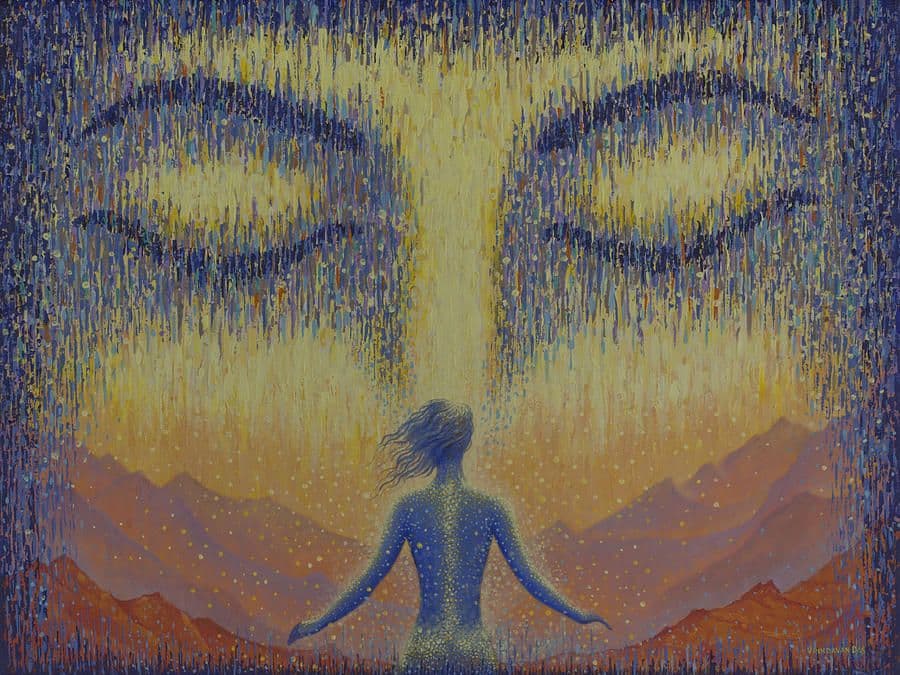
There is a silence that has never been disturbed. It is not the silence of soundlessness, but the silence out of which all sounds arise and into which they dissolve. You can sense it when a thought finishes and before the next one appears. In that gap, no state is active — you are not awake, not dreaming, not asleep — yet you are profoundly present. This unchanging, unstateable presence is called Turiya in the Mandukya Upanishad, one of the shortest but most dense spiritual texts humanity has produced. To ask “What is Turiya?” is to ask what remains when every experience, every condition, every flicker of mind falls away. It is not a mystical abstraction. It is the most intimate fact of being — so close that it is routinely overlooked. This article does not aim to explain Turiya as a doctrine but to use it as a lens to investigate the architecture of consciousness itself. Through a careful inquiry into waking, dreaming, and deep sleep, and the unexpected continuity that threads them, we will explore why Turiya refuses to become just another concept, and how it silently reclaims all our assumptions about identity, suffering, and the nature of real knowing.
Search intent around Turiya often begins with curiosity: Is it a fourth state? A super-consciousness to be achieved? A mystical experience reserved for yogis? Yet the Mandukya Upanishad insists that Turiya is not a state among states. It is the changeless background, the self-luminous witness, the atman itself — already fully present, never truly absent. This distinction is essential, because treating Turiya as a state turns it into a goal for the ego, while seeing it as the timeless ground of all states dissolves the seeker into what was always already here. The article will satisfy both the beginner’s need for clarity and the advanced contemplative’s hunger for genuine depth, traversing the spectrum from simple definitions to the most subtle edges of non-dual recognition.
1. Before Turiya: The Three States That Frame Our World
To grasp the radical nature of the fourth, one must first sit inside the structure of the three ordinary states that constitute our entire known existence. The Mandukya Upanishad maps consciousness onto a three-storeyed house: Vaishvanara (waking), Taijasa (dreaming), and Prajna (deep sleep). Each is not merely a biological phase but a complete mode of experiencing reality, each with its own subject, its own object, and its own peculiar sense of self. The waking state gives us a world of external, shared objects and a body-bound identity. The dream state reveals a private, internal world woven from memory and desire, where the mind creates its own landscapes. Deep sleep is a dimensionless darkness, a state of no objects and no distinct “I,” yet upon waking we report “I slept peacefully, I knew nothing.” This recollection hints that something persists even through the absence of all content.
Ordinary life swings between these three without questioning the underlying continuum. We take the waking world as the gold standard of reality, dismiss dreams as unreal fables, and treat deep sleep as a blackout. But if we pause, we notice that the one who knows “I was dreaming” is the same one who knows “I am awake.” There is a single thread of sentience that witnesses the appearance and disappearance of states. In the Advaita Vedanta tradition, this witnessing principle is precisely what Turiya points toward. The common assumption that consciousness is a product of the waking brain is challenged by the simple fact of sleep: you existed in deep sleep as pure awareness, devoid of objects, yet that awareness was not dead. It was presence without phenomena. Turiya is the name for that ever-present, unbroken awareness.
State | Subject | Object | Quality | Turiya's Relation |
|---|---|---|---|---|
Waking (Vaishvanara) | Ego-body identity | External world | Cognition and action | Witness of the state and its experiences |
Dreaming (Taijasa) | Subtle body/mind | Internal mental images | Vivid, private, symbolic | Illuminator of the dream without entering it |
Deep Sleep (Prajna) | Undifferentiated mass of consciousness | None (absence of objects) | Bliss, ignorance, potentiality | The very ground of the bliss and the witness of the absence |
Turiya | None — pure witnessing | All states, yet none | Peace, non-duality, unconditioned | Turiya itself; the common denominator |
This table already forces a conceptual shift: Turiya is not placed “above” the three as a fourth floor, but as the space in which all floors stand. The illusion is that we move from state to state, when in fact states move within us. The waking person who believes themselves to be a separate individual fails to see that the same light of awareness that illuminates the waking world is no different from the light that witnessed the dream and the emptiness of sleep. Turiya does not need to be cultivated; it needs to be recognized as what one already is, even in the midst of state-driven turmoil.
2. The Mandukya Upanishad: A Text That Refuses Metaphor
The Mandukya Upanishad, consisting of only twelve verses, is often considered the most distilled expression of Advaita Vedanta. It does not argue; it simply declares, with breathtaking precision, the nature of reality as OM and the four quarters of consciousness. The seventh verse delivers the definition of Turiya:
“Not inwardly cognitive, not outwardly cognitive, not both together cognitive, not a cognition-mass, not cognitive, not non-cognitive — unseen, incapable of being spoken of, ungraspable, without any distinctive marks, unthinkable, unnameable, the essence of the knowledge of the one self, that into which the world is resolved, the peaceful, the benign, the non-dual — such is the fourth. That is the Atman. That is to be known.”
This string of negations is not mystification but surgical precision. Turiya cannot be described because description requires duality — a subject describing an object. Any positive attribute (“it is blissful,” “it is vast”) would place it among objects and thus miss the mark. The Upanishad instead uses the method of neti, neti (not this, not this) to strip away everything that can be objectified, leaving only the sheer fact of being aware. The beginner often finds this frustrating: “If it’s nothing, why should I care?” But the nothing that remains is not empty absence; it is the fullness of subjectivity that can never be objectified. It is the light by which all things are seen, itself never seen.
The association of Turiya with OM is also profoundly instructive. OM is parsed into three sounds — A, U, M — corresponding to waking, dreaming, and deep sleep. The silence that follows the chant, and out of which the next chant arises, is the pointer to Turiya. That silence is not mere absence of sound; it is the receptive spaciousness in which sound becomes possible. In the same way, Turiya is not the absence of experience, but the open capacity for experience. The Mandukya Upanishad’s genius is to embed the absolute in the very structure of a syllable that has echoed through millennia. It refuses to let the transcendent be anything other than immanent.
3. Not a State: The Grand Misconception
Perhaps the most common misunderstanding about Turiya is that it is a “fourth state” — a super-state of consciousness reached through advanced meditation or samadhi. Spiritual seekers often strain to attain a special experience of unity, vivid light, or infinite love, and then label that experience Turiya. The Advaita tradition, however, is uncompromising: Turiya is not an experience. Experiences come and go; they have a beginning and an end; they appear to a subject. Turiya is what remains identical throughout all experiences, including the experience of “I am enlightened.” If it could be attained, it could be lost. If it were a state, it would be conditioned by causes, and therefore transient.
This insight shatters the spiritual ego’s ambition. Much of the modern consciousness marketplace sells techniques to “access higher states.” The unexamined assumption is that there is a deficient self that needs a special experience to become complete. Turiya, as taught by the Mandukya Upanishad and Shankara, undercuts this entire project. You cannot access what you are. You can only cease to overlook it. The problem is not the absence of Turiya but the presence of superimposition — the mind’s habit of identifying with the fleeting states and their contents. A helpful comparison table illuminates this difference:
Aspect | Misconception (Turiya as a State) | Advaita Vedanta (Turiya as Ground) |
|---|---|---|
Nature | A special, elevated condition | Unconditioned, ever-present awareness |
Attainment | Requires effort, technique, grace | Requires only recognition, removal of ignorance |
Duration | Temporary, may fade | Eternal, without temporal boundaries |
Subject-Object | Still contains a subtle experiencer | Non-dual, no separation between knower and known |
Relationship to Daily Life | May be lost in waking activities | Present in all states, never obscured essentially |
The psychological consequence of this correction is enormous. If Turiya is already the case, the frantic search for it only reinforces the ego that pretends to search. The real inquiry is not “How do I get Turiya?” but “What is this ‘I’ that claims to be separate from it?” The question itself turns inward, and the seeker begins to investigate the very nature of the one who feels unenlightened. This shift from attainment to investigation is the hallmark of authentic Advaita inquiry.
4. The Witness That Never Winks: Turiya in Daily Life
If Turiya is not a state reserved for deep meditation, where is it in ordinary existence? It is the simple, undeniable awareness that you are present right now, reading these words. Before the mind labels the experience “reading” or “interesting” or “boring,” there is the raw fact of conscious presence. This presence does not come from the words; it illuminates the words and the mind’s reactions. It was present this morning when you woke up — indeed, it was the continuity that recognized “I was asleep” and bridged the gap. It is present in moments of anxiety, not as an anxious entity but as the silent space in which anxiety appears and subsides. Even in extreme crisis, when the mind feels shattered, there is an unmoved background that registers the shattering.
Consider a mundane example: losing your train of thought. In conversation, you suddenly blank. There is a moment of pure, alert silence before the mind scrambles to recover. That alert silence is not dead; it is intensely alive and knowing. It is Turiya, momentarily recognized without the veil of mental content. Most people immediately rush to fill the gap with words because the ego feels threatened by its own absence. But if one stays with that gap, it reveals a peace that is not dependent on thoughts. Similarly, the instant between waking and sleeping — the hypnagogic threshold — often yields a taste of objectless consciousness. The body is asleep, but awareness remains, witnessing the dissolution of the waking world. These are not exotic attainments; they are leaks of the absolute into daily experience.
The workplace, too, becomes a field for this recognition. When a project fails and the mind reels with self-criticism, the suffering is intense. But if one can ask, “Who is aware of this suffering?” a subtle distance appears. The suffering is an object, a pattern of thought and sensation. The awareness that registers it is not itself suffering. This is not dissociation; it is the beginning of wisdom. The suffering is allowed to be fully felt, yet it is no longer personalized. The one who suffers is seen to be another appearance within the vast openness of Turiya. This does not trivialize pain; it reframes the relationship to it, revealing a dimension of oneself that has never been hurt and cannot be threatened.
5. The Anatomy of Negation: Why Turiya Cannot Be Grasped
A significant portion of confusion about Turiya arises from the mind’s demand for positive description. “If it’s so important, tell me what it is!” The Mandukya Upanishad’s response is a relentless series of negations — not to hide a secret but to expose the impossibility of objectifying the subject. The eyes can see everything except themselves directly. A knife can cut anything but cannot cut itself. Consciousness can know all objects but cannot know itself as an object. Any image or concept of Turiya is immediately a distortion, a finite representation of the infinite. Thus, negation becomes the purest form of indication.
This has profound implications for how we pursue knowledge. We are conditioned to believe that to know something, we must be able to define it, measure it, and mentally possess it. Spiritual materialism exploits this drive by offering subtle objects — visions, energies, states — as proof of progress. Advaita Vedanta dismantles the entire apparatus by insisting that the ultimate reality is not a thing to be known but the very knower. The moment you try to grasp it, you have already placed a conceptual distance between yourself and it. The realization of Turiya is not an acquisition but an un-learning: the abandonment of the habit of mistaking the known for the knower. In that un-learning, nothing new is added, but the false identifications fall away, revealing what has always been self-evident.
“That which is not thinkable by the mind, but that by which the mind thinks — know that alone to be Brahman, and not what is worshipped here.” — Kena Upanishad. This points directly to Turiya as the inaccessible subject that makes all access possible.
The psychological resistance to negation is itself instructive. The ego feels starved when denied objects to cling to. The process of hearing “not this, not this” can evoke a kind of existential vertigo. This vertigo is precisely the loosening of the ego’s grip. The mind, having exhausted all possible concepts, falls silent. In that silence, Turiya is not achieved; it is simply what remains when the effort to become something ceases. The advanced practitioner learns to rest in this not-knowing without grasping for a new foundation. The beginner, given the same teaching, may feel lost — yet the very sense of being lost is also witnessed by Turiya.
6. Turiya and the Problem of Identity: Who Am I Really?
The question “Who am I?” is the engine of all self-inquiry. In waking, the answer is a narrative: I am this body, this name, this history, these relationships. In dreaming, the answer shifts: I am the dream character, with its own bizarre context. In deep sleep, the question does not even arise because the ego is absent, yet something still knows the absence. So who is this something? Turiya is the answer that unravels all partial answers. It is not a who but an impersonal “am-ness” that precedes and contains all personal identities. The realization of Turiya does not mean becoming a disembodied void; it means recognizing that the personal self is a temporary expression, a wave on the ocean of awareness, and that the ocean is what one truly is.
This insight crashes into modern identity politics, self-improvement culture, and the endless curation of a digital self. The social media profile is a carefully edited waking-state identity, an object presented to an imagined audience. That identity demands constant maintenance and is perpetually fragile. To even glimpse Turiya is to see that this profile is a character in a dream — real at its level, but not the final reality. The anxiety of “not enough” that powers the entire self-improvement industry is exposed as the ego’s attempt to fix a ghost. The one who seeks improvement is itself an appearance. The peace of Turiya is not found by making the ego perfect but by recognizing its illusory status. This is not to advocate passivity but to invite action that flows from a deeper, unconditioned source rather than from the wounds of a fictional self.
Consider the experience of failure. If identity is tied to the waking-state persona, professional collapse feels like annihilation. If, however, one has even a tacit recognition of the witnessing presence that survives all changes, failure becomes a dramatic scene observed with compassion. The sting is still felt, but it does not define the fundamental sense of being. This is the existential relief that Turiya offers — not an escape from life’s difficulties, but an unshakeable ground that cannot be shaken. The “I” that was never born cannot die. The “I” that was never successful cannot fail.
7. The Overlooked Continuity: Deep Sleep as a Metaphysical Clue
Deep sleep is the forgotten key. Most spiritual analysis focuses on waking and dreaming because they contain content. Deep sleep, being contentless, is dismissed as a period of unconsciousness. Yet the fact that we wake up and report “I slept well, I knew nothing” is philosophically explosive. The report indicates a direct, immediate knowledge of the absence of objects. If consciousness had truly ceased, there would be no memory of peace or of the passage of time. Some continuous principle must have been present to witness the blankness. That principle is Turiya.
This has massive implications for the fear of death. Death is commonly imagined as the total extinction of consciousness. But deep sleep provides a nightly miniature death from which we return. What dies is the ego, the bundle of memories and identity, which in deep sleep temporarily dissolves, yet awareness remains. The terror of death is actually the ego’s terror of its own non-existence. Turiya, being unborn and undying, reveals that there is nothing to fear. Not as a comforting belief, but as a direct, lived recognition: you survive the daily erasure of the waking self in deep sleep. So what is truly you cannot be erased by any event, including the death of the body.
Advaita Vedanta uses this analysis to dismantle the identification with the body-mind. If you were only the body, who knows the body in sleep? If you were only the mind, who knows the mind’s absence in dreamless sleep? The “I” that knows both presence and absence is more fundamental than both. The existential tension between the feeling of being a separate mortal and the intuition of an undying core is resolved by this direct, pre-philosophical datum of sleep. This is not an argument to be accepted but an investigation to be undertaken: tonight, as you fall asleep, can you catch the seam where the waking world dissolves and you remain as the silent witness?
8. The Pitfall of Spiritual Bypass: When Turiya Becomes a Hiding Place
Any profound teaching can be misused, and Turiya is no exception. The recognition that all experiences are appearances in the witness can, if immaturely held, lead to a cold detachment that dismisses the relative reality of suffering. “It’s all just a dream — why care about injustice or personal pain?” This is spiritual bypass, a defense mechanism that uses non-dual language to avoid facing unresolved pain or ethical responsibility. Genuine Advaita does not permit this. Shankara himself was a rigorous debater and a builder of institutions, fully engaged with the world of duality even while knowing it to be ultimately unreal.
The healthy integration of Turiya involves honoring the relative while resting in the absolute. The body still feels hunger; the heart still grieves; relationships still require attention and care. The difference is that these experiences are no longer taken to define the self. A jivanmukta — one liberated while living — does not become a stone. Compassion arises naturally because the boundary between self and other has been recognized as conventional, not fundamental. The suffering of another is seen as one’s own suffering, just as the suffering of the left hand is the body’s suffering. Thus, the non-dual vision fuels engagement, not withdrawal. A comparison of bypass versus genuine integration clarifies:
Phenomenon | Spiritual Bypass (Misuse) | Genuine Integration |
|---|---|---|
Personal Pain | “It’s an illusion, ignore it.” | Pain is felt fully but not personalized. The witness holds space for healing. |
Others' Suffering | “They are just dream characters.” | Empathic action flows from non-separation; service is natural. |
Emotions | Suppressed or denied as unreal. | Allowed to arise and dissolve in awareness, without identification. |
World Engagement | Detachment that looks like apathy. | Dynamic engagement with less egoic burden; freedom in action. |
The key discernment is between knowing the dream as dream while fully participating in it, and using the dream idea to flee from it. Turiya is not an escape hatch but the ground that makes authentic living possible. When the false burden of ego-identification is lifted, one can act with total intensity and simultaneous lightness. The pursuit of success, the experience of failure, the ordinariness of daily chores — all are infused with the silent knowing that they are a play of consciousness, held by what never changes.
9. Turiya and the Brain: The Neurophenomenological Mirror
The modern materialist paradigm asks: What is the brain state corresponding to Turiya? This question, while natural, already presumes that consciousness is a product of neural activity. Advaita inverts this: the brain and its states appear within consciousness. Still, investigating the neural correlates of non-dual awareness can provide an interesting relative map. Research on advanced meditators, particularly in the Advaita and Buddhist non-dual traditions, shows that periods of pure awareness without content are accompanied by changes in the brain’s default mode network (DMN) and a reduction of the mental chatter associated with the ego. Yet even these measurable states are not Turiya itself; they are the physiological expressions of a shift in identification.
The danger of neuroscientific reductionism is that it turns Turiya into a brain function that can be “switched on” through biofeedback or stimulation. This again frames it as a state to be achieved. The Advaita point is more subtle: the very scientist measuring the brain waves is the living presence of Turiya, but the scientific gaze, by objectifying, misses the subject. A truly integrated view might see neuroscience as a useful descriptor of the relative effects of recognition, never as an explanation that exhausts the mystery. There is no contradiction in saying that the brain’s DMN quiets down during self-inquiry, while simultaneously acknowledging that the awareness registering this quietness is not produced by the DMN. Both can coexist without one annexing the other.
This reflection invites an open-mindedness that does not require choosing between science and spirituality. A meditator who recognizes Turiya may have no interest in brain scans; a scientist who studies non-dual states may never taste the recognition. Both are operating within the same indivisible reality, just with different lenses. The challenge is to avoid the arrogance that one lens invalidates the other, recognizing instead that the ultimate subject cannot be placed under any microscope because it is the very space in which all microscopes appear.
10. The Method of Inquiry: Listening, Reflecting, Contemplating
If Turiya cannot be attained, how is it recognized? Advaita Vedanta outlines a three-stage process: shravana (listening to the teaching), manana (reflecting deeply on it), and nididhyasana (sustained contemplation until the truth becomes lived reality). This is not a technique to generate a new state, but a method to remove the misidentification that veils the ever-present reality. Shravana involves encountering the mahavakyas like “That Thou Art” from a competent teacher, not merely as words but as pointers that directly reveal the self. Manana is the rational, introspective process of clearing doubts and seeing the logic of non-duality. Nididhyasana is the assimilation in stillness, where the mind rests in its source without effort.
This method honors the complexity of the human mind. It does not ask for blind belief but for rigorous inquiry. The modern seeker, accustomed to instant downloads, may find this too slow. Yet real transformation of the root identity cannot be rushed. Intellectual understanding alone leaves the ego intact; emotional catharsis alone leaves the mind unconvinced. The three-stage process works on all layers, gradually wearing down the habit of believing the “I” to be the body-mind. Eventually, a moment comes — often in the midst of ordinary life — when the teaching flowers and the witness stands revealed as always having been there. This is not dramatic but profoundly ordinary. As the sages say, it is the simplest thing, so simple that the mind overlooks it in search of complexity.
11. The Gap Between Thoughts: A Laboratory for Turiya
One of the most accessible yet overlooked gateways is the gap between consecutive thoughts. Thoughts arise and fade like waves. Between them, there is a silent, alert pause. Most people do not notice this pause because attention is glued to the content of thoughts. But with minimal training, one can become aware of the awareness in which thoughts appear. That awareness is not a thought; it is the constant background. To rest in that gap, even for a fraction of a second, is to taste Turiya. Over time, that taste stabilizes, and one begins to identify not with the thoughts but with the spaciousness. The thoughts still arise, but they are no longer mistaken for the self.
This practice transforms the relationship to anxiety. Anxiety often feels like a relentless, suffocating mental stream. The sufferer is completely identified with the anxious thoughts and believes “I am anxious.” But if one can locate the gap, the anxiety is seen as a cluster of thoughts and sensations floating in a vast, non-anxious awareness. The anxiety does not necessarily vanish, but its ability to define the self is broken. This is the practical, psychological miracle of Turiya — not the removal of life’s challenges, but the removal of the added suffering caused by identification. The one who is anxious is revealed to be a character, while the background remains in unaffected peace.
Workplace stress, creative blocks, relationship turmoil — all can become laboratories. The moment you ask, “Who is experiencing this?” there is an automatic shift from the story to the awareness of the story. This shift is not dissociation but integration at a higher level. It is the difference between drowning in a river and standing on the bank, watching the river flow. You are still in relation to the river, but no longer swept away. Turiya is the bank that has always been there, unnoticed because we were taught only to swim and never to stand.
12. Turiya and the Modern Crisis of Meaning
The contemporary search for meaning is often a symptom of the ego’s desperation. Meaning is sought in career, relationships, achievements, and even spirituality. When these fail to provide lasting satisfaction, despair sets in. Turiya reframes the entire quest: meaning is not something to be found in objects or experiences; it is the very nature of the subject. The emptiness that people feel is not a lack that can be filled, but a call to recognize that the one who feels empty is itself the fullness. This inversion is the core of Advaita’s response to nihilism. Nihilism says: there is no inherent meaning. Advaita does not disagree at the level of objects, but adds: the one who seeks meaning is itself the source of all meaning, which is love, consciousness, and peace.
In a culture saturated with social media, the phenomenon of “doomscrolling” — the compulsive consumption of bad news — can be understood as a desperate attempt to feel something, to confirm one’s existence through emotional activation. Underneath the scrolling is a deep discomfort with simple, objectless being. Turiya invites the opposite movement: to stop, to be still, and to discover that existence itself, without any addition, is profoundly enough. This is not a cheap positivity. It is the resolution of the search into the searcher. When the mind falls silent, not by suppression but by recognition, what remains is not a lack of meaning but the living actuality of consciousness, which needs no external validation.
Thus, the difference between a life lived from Turiya and a life lived from the three states is not a difference in outer circumstances, but a difference in the felt texture of being. The same world — with its injustices, beauty, and transience — is experienced as a seamless expression of one’s own self, rather than an alien field to be conquered or endured. This is the ultimate existential satisfaction: not a permanent happiness, but a permanent peace that underlies all changing emotions.
Closing Reflection
Turiya is the answer that was never missing. It is the silent partner in every conversation, the witness of every dream, the peace of every sleep. The Mandukya Upanishad offers not a system to be believed but a mirror to be looked into. What looks back is not a thing but the simple, undeniable fact of being aware. All the spiritual striving, the intellectual grappling, the emotional turmoil — all occur within this unshakable presence. To ask “What is Turiya?” is to ask “What is it that is asking?” and to find that the questioner and the answer are one. The greatest relief is not in the obtaining but in the recognizing. Perhaps the most profound response to the question is not a new idea but a gentle, inward-turn, a softening of the search, and a quiet settling into that which has always, silently, been home.
Frequently Asked Questions
Is Turiya the same as samadhi?
Not exactly. Samadhi is a state of meditative absorption, often temporary and induced by practice. Turiya is not a state but the ever-present ground of all states, including samadhi. In the highest sense, nirvikalpa samadhi may be a glimpse of Turiya, but the fullness of recognition is that Turiya pervades even the ordinary waking state and does not depend on any special concentration.
Can Turiya be experienced during daily activities?
Yes, Turiya is never absent. It is the awareness that illuminates daily activities. The sense that it is “lost” during activity is only the overshadowing of the mind's preoccupation with objects. With recognition, one can function in the world while the inner knowing of the witness remains steady. This is the state of the jivanmukta.
How is Turiya different from the unconscious or deep sleep?
Deep sleep is characterized by the absence of objects and also the absence of explicit self-awareness; it is a mass of undifferentiated ignorance. Turiya is pure consciousness, not ignorance. The bliss and peace of deep sleep are reflections of Turiya, but in deep sleep the mind is dormant and does not recognize itself. Turiya is the light by which the absence of objects in deep sleep is known upon waking.
Do other traditions have concepts similar to Turiya?
Yes. In Tibetan Buddhism, the concept of rigpa or the nature of mind points to a similar non-dual awareness. Sufi mysticism's notion of the “secret of secrets” and certain Christian contemplative descriptions of the ground of the soul bear resemblance. However, the precise philosophical articulation in the Mandukya Upanishad is unique to Advaita Vedanta.
Is it possible to lose the recognition of Turiya once established?
True recognition is irreversible because it is not the acquisition of something new but the permanent removal of a false belief. However, the mind’s habitual tendencies may continue to arise, creating the appearance of forgetting. But the one who knows the truth is never truly obscured; even the feeling of “I have lost it” is witnessed. The recognition stabilizes over time.