


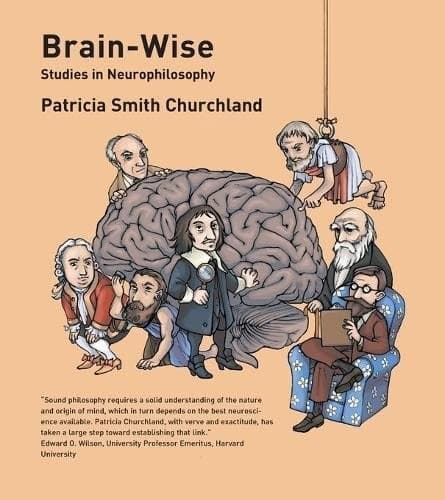
Brain-Wise: Studies in Neurophilosophy

Churchland's central claim is that the mind is a complex of brain functions, and that philosophy of mind must be conducted within the framework of the brain sciences rather than from the armchair. As the sequel to her landmark Neurophilosophy (1986), Brain-Wise applies this neurophilosophical method to consciousness, the self, free will, knowledge, and moral and religious experience. Churchland argues that progress in neuroscience is profoundly changing our conception of ourselves, and that philosophers who ignore brain research are working with an obsolete picture of what the mind is.
Key Insights
✦What is the central claim of Brain-Wise, and what does it reject?
Churchland's central claim is that the mind is a complex of brain functions, and that philosophical questions about consciousness, the self, free will, and knowledge must be pursued within the framework of the brain sciences rather than through a priori analysis alone. The book rejects the view, still influential in philosophy, that neuroscience is irrelevant to understanding the mind or that conceptual analysis can proceed independently of empirical research. Churchland argues that progress in the neurosciences is profoundly changing our conception of ourselves, and that there is no stemming the revolutionary impact that brain research will have on our understanding of how the mind works . The book is the sequel to her Neurophilosophy, which launched the subfield.
✦How does Brain-Wise relate to Churchland's earlier Neurophilosophy?
Brain-Wise is the explicit sequel to Neurophilosophy (1986), the book that launched the subfield of neurophilosophy . Where the earlier book laid out the programme and its methodological commitments, Brain-Wise takes stock of developments in molecular biology, experimental psychology, and neuroscience over the intervening sixteen years and applies the neurophilosophical framework to specific philosophical problems: consciousness, the self, free choice, knowledge, and religious and moral experience . Churchland acknowledges in the later book that neuroscience remains an immature science, but she argues that enough has been learned to make the neurophilosophical approach fruitful for traditional philosophical questions .
✦What criticisms have been leveled at Brain-Wise's treatment of functionalism?
A detailed critical review by Ryder argues that Churchland's rejection of functionalism is based on a non sequitur. Her argument, as Ryder reconstructs it, is roughly that functionalists think understanding the brain won't help understand the mind, but this is clearly false, so functionalism is false. Ryder points out that functionalism as a metaphysical thesis says nothing about what specific causal roles characterize mental states, and those roles could be realized at the neurophysiological level. Understanding the brain would then help understand the mind without threatening functionalism . Ryder also notes that Churchland does not even mention the possibility of a functionalist theory of consciousness, despite such theories being dominant in contemporary philosophy .
✦How does Churchland's eliminative materialism figure in Brain-Wise?
Churchland's eliminative materialism is the ontological background to Brain-Wise rather than its explicit focus. Her view, developed with Paul Churchland, is that folk psychology—the commonsense framework of beliefs, desires, and other propositional attitudes—is a theory that may eventually be displaced rather than smoothly reduced by a completed neuroscience . In Brain-Wise, this commitment informs her treatment of the self and knowledge: rather than assuming that folk-psychological categories carve mental reality at its joints, she asks what neuroscience reveals about the capacities that folk psychology gestures toward. Churchland has since said she no longer uses the term 'eliminative materialism' because it is widely misunderstood, while maintaining that the question of how much folk theory will change remains open .
✦What role does neuroscience play in Churchland's account of the self and free will?
Churchland argues that the self should be reconceived in terms of self-representational capacities rather than as a unified substance or a simple inner entity. In the chapter on the self, she moves from the premise that we conceive of the self in many different metaphorical ways to the conclusion that the self is a 'squadron of capacities flying in loose formation,' whose nature neuroscience will reveal . Ryder criticizes this move, arguing that from the fact that our conceptions of a thing are non-systematic or confused, it does not follow that there is no coherent, unified thing being conceived . On free will, Churchland treats the question as one that neuroscience can inform, asking what the brain sciences reveal about decision-making and self-control rather than approaching freedom as a purely metaphysical problem.
✦What is a common misconception about Brain-Wise's relationship to philosophy?
A frequent misconception is that Churchland is arguing for the replacement of philosophy by neuroscience. That is not her position. She argues that neuroscience needs philosophy because ongoing research must have a synoptic vision that only philosophy can provide, and that this philosophy must be 'in the swim with the rest of science' rather than an a priori discipline pontificating from outside . Brain-Wise is itself a work of philosophy, not a neuroscience textbook: it uses empirical findings to interrogate traditional philosophical problems, but the questions and the argumentative structure are philosophical. Churchland's target is not philosophy as such but the anti-scientific bias she sees in much mainstream philosophy of mind, particularly the assumption that conceptual analysis can proceed in isolation from empirical research on the brain.
Wealthy Psyche is an intellectual archive. We do not host, distribute, or sell book copies — physical or digital. We provide structured knowledge to help you think better, faster.