


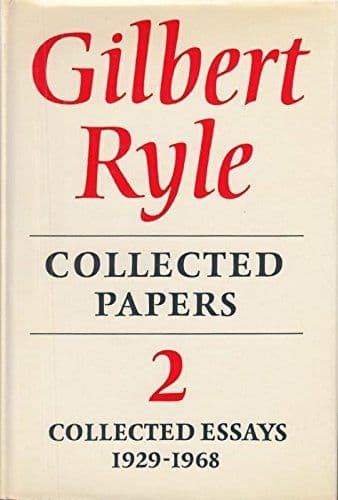
Collected Papers (Vol. 1–2)
These two volumes assemble Ryle's shorter writings up to his 1968 retirement, dividing them into critical essays on other philosophers (Vol. 1) and original essays on logic, language, and mind (Vol. 2). The collection's spine is Ryle's method of conceptual cartography: philosophy's task is to map the logical geography of concepts, exposing absurdities that arise when expressions are misconstrued as denoting entities. Volume 2 gathers the essays that apply this method to thinking, sensation, pleasure, and meaning, extending and refining the programme of The Concept of Mind.
Key Insights
✦What unifies these two volumes methodologically, given their disparate topics?
The unifying thread is what Ryle called conceptual cartography: the philosopher's task is to exhibit the logical interconnections among concepts and to diagnose absurdities that arise when expressions are misconstrued as naming entities. Volume 1 applies this method to the history of philosophy, reading Plato, Locke, Hume, and Heidegger as interlocutors whose positions can be clarified or dissolved through attention to conceptual geography. Volume 2 applies it directly to problems in logic, language, and mind—propositions, categories, thinking, sensation, pleasure. A contemporary review in The Monist noted that the volumes reveal Ryle's philosophy developing but not radically changing: the early negative diagnosis of paradoxes as idiom-misunderstandings matures into a positive programme of mapping concepts, while the detection of absurdity remains a key methodological device.
✦How do the essays in Volume 2 relate to The Concept of Mind?
Several essays in Volume 2 extend, qualify, or revise positions from Ryle's 1949 book. The most frequently cited is 'Knowing How and Knowing That,' which develops the distinction between practical skill and propositional knowledge that The Concept of Mind had gestured toward but not fully worked out. Other essays—'Thinking,' 'A Puzzling Element in the Notion of Thinking,' and 'Thinking Thoughts and Having Concepts'—address a topic Ryle himself acknowledged was inadequately treated in the earlier book: occurrent thought, as opposed to dispositional intelligence. The volume thus functions as a laboratory in which Ryle tests and refines the conceptual apparatus of his major work, sometimes in response to critics and sometimes in pursuit of puzzles left unresolved.
✦What is the significance of Ryle's review of Heidegger's Being and Time, reprinted in Volume 1?
Ryle's 1928 review of Sein und Zeit is one of the earliest substantive engagements with Heidegger by an analytic philosopher, and it cuts against the later narrative that ordinary language philosophy was uniformly dismissive of phenomenology. Ryle judged that phenomenology 'will end in self-ruinous subjectivism or in a windy mysticism,' yet he also acknowledged Heidegger as a thinker of great originality and importance. The review is a document of cross-tradition reading at a moment when the analytic-continental divide was not yet entrenched. Its presence in Volume 1 alongside essays on Plato, Locke, and Wittgenstein shows Ryle's historical range and complicates any portrait of him as a narrowly parochial Oxford ordinary language philosopher.
✦Are these volumes a reliable guide to Ryle's final views, or do they contain superseded positions?
Neither wholly. A contemporary reviewer observed that some of the most influential early essays, such as 'Systematically Misleading Expressions,' were published in the early 1930s, had already been much discussed, and 'no longer exactly represent Ryle's views'. Ryle's thinking about philosophy's nature evolved from assigning it a purely negative role—showing that paradoxes rest on misunderstandings of idiom—toward a more positive conception of conceptual cartography. Yet the reviewer also judged that Ryle's views 'developed but not radically changed'. The collection is therefore best read as a record of a philosopher's sustained methodological commitment worked out across four decades, with early essays serving as historical documents and later ones as refinements rather than reversals.
✦How does Ryle's treatment of thinking in these essays differ from the behaviourist reading often imposed on him?
The essays on thinking are the strongest evidence against the crude behaviourist label. Ryle was not denying that people think; he was denying that 'thinking' names a hidden inner process that runs parallel to intelligent behaviour. In essays such as 'Thinking' and 'A Puzzling Element in the Notion of Thinking,' he works to give an account of occurrent thought that is sufficiently 'thick'—that does justice to the phenomenon—without positing 'bogus mental processes and objects'. The challenge Ryle sets himself is to describe what someone is doing when they are thinking without turning thought into either a ghostly episode or a mere disposition to behave. Whether he succeeds is debatable, but the essays show the project was more nuanced than the behaviourist caricature allows.
✦What is the editorial and publication history of these volumes?
The Collected Papers were first published in 1971 by Hutchinson in London, in two volumes: Volume 1 as Critical Essays and Volume 2 as Collected Essays 1929–1968. A simultaneous American edition was issued by Barnes & Noble in New York. The volumes were reprinted in facsimile by Thoemmes in Bristol in 1990. Routledge brought out new editions in 2009 with substantial introductions by Julia Tanney, making the essays widely available again after a period of scarcity. The 2009 Routledge editions are the standard scholarly versions currently in print, though the pagination differs from the original Hutchinson volumes.
Wealthy Psyche is an intellectual archive. We do not host, distribute, or sell book copies — physical or digital. We provide structured knowledge to help you think better, faster.