


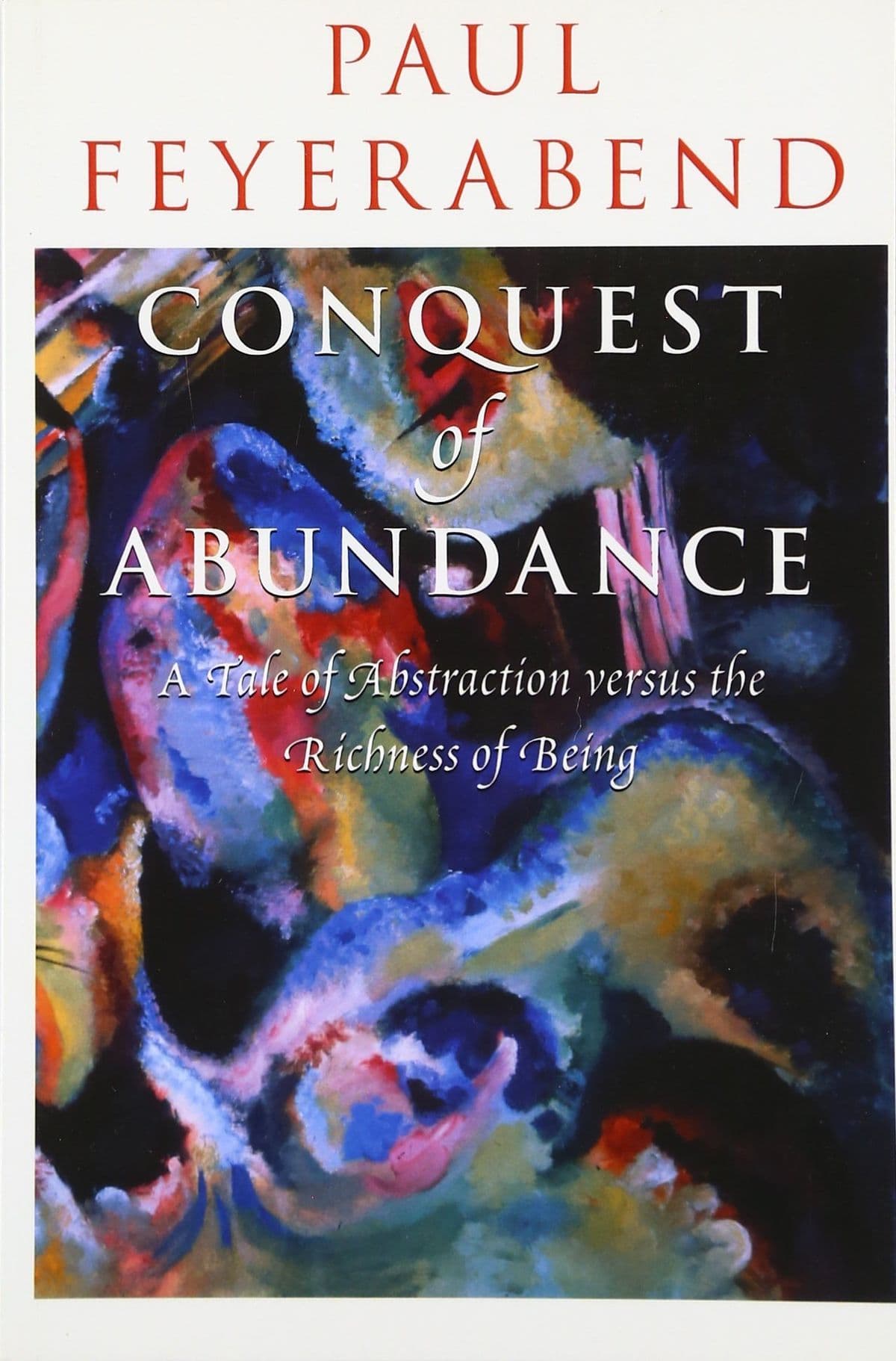
Conquest of Abundance: A Tale of Abstraction versus the Richness of Being
Feyerabend's posthumous book argues that human attempts to make meaning out of reality—through science, philosophy, religion, and technology—inevitably reduce the sensory and intellectual abundance of the world. The central mechanism is abstraction: our perceptual and conceptual systems capture only a fraction of reality's richness, and this reduction, while necessary for survival, becomes a 'conquest' when abstraction is mistaken for the whole truth. The book is less a lament than a demonstration that the conquest is always incomplete, and that the abundance it suppresses persists beneath every abstract system.
Key Insights
✦What is the central argument of Conquest of Abundance, and what does Feyerabend mean by 'abundance'?
The central argument is that all human attempts to make meaning out of reality—through perceptual systems, religion, politics, technology, science, and philosophy—reduce the abundance of being . Abundance is the sensory and intellectual richness of the world, from flea bites to galaxies, which human senses and intelligence can take in only a fraction of. Feyerabend writes that this reduction is 'a blessing, not a drawback,' since a superconscious organism 'would not be superwise, it would be paralyzed' . The book's title names the process by which abstraction conquers this richness, but Feyerabend's point is not that the conquest should be reversed—it cannot be—but that it should be recognized as a reduction rather than a full capture of reality.
✦How did the book's posthumous publication shape its form, and what does Bert Terpstra's editorial work reveal?
Conquest of Abundance was the book Feyerabend was working on when he died in 1994. It was prepared from drafts of the manuscript left at his death, working notes, and lectures and articles he wrote while the larger work was in progress . The text is therefore incomplete and fragmentary, and one scholarly assessment notes that it is 'too underdeveloped on crucial points' for a definitive interpretation . Terpstra's editorial work assembled a coherent book from disparate materials, but readers should approach it as a reconstruction, not a finished monograph. The University of Chicago Press edition appeared in 1999, with a paperback in 2001 .
✦How does Conquest of Abundance relate to Feyerabend's earlier work, particularly Farewell to Reason?
The themes of Conquest develop ideas already present in Farewell to Reason (1987), which discussed the importance of cultural diversity and the imposition of uniform Western practices on indigenous cultures . However, the 'conquest' thesis is not merely a rebranded postcolonial critique. The general narrative was in Feyerabend's mind since the early 1970s, predating his interest in cultural diversity, when he began a multi-volume history of Western philosophy of nature from the Stone Age to the present . The book is thus the culmination of a long-standing concern with how abstraction homogenizes experience, rather than a late addition to his political thought.
✦What is the significance of the claim that 'abundance occurs in history, not in the world'?
This cryptic remark, from one of the essays in the volume, suggests that abundance is not a property of a static, mind-independent world but something that manifests in the history of human cultures—in the plurality of ways of experiencing and engaging with reality . The 'conquest' is therefore the homogenization of these diverse forms of life, not the loss of a metaphysical quantity. This reading connects Feyerabend's later work to his pluralism: what is at stake is not a single 'true' reality that abstraction distorts, but the rich variety of human experiments with meaning. The abundance is historical and cultural, and its loss is existential and cultural rather than merely epistemological.
✦How have critics assessed the book's historical claims about the 'conquest'?
Critics have disputed the historical narrative. Stephen R.L. Clark, in a sympathetic but critical assessment, called Feyerabend's 'essays in creative history' 'inaccurate in detail as they may be, and ambiguous in their implications,' yet still 'a deeply serious vehicle for exploring the dilemmas and ambiguities of living' . The text's incompleteness makes it difficult to establish dramatic claims about long-range historical tendencies toward uniformity. Some scholars suggest the 'conquest' thesis should be read genealogically—as a narrative intended to provoke critical attitudes toward inherited convictions—rather than as a literal history of European thought .
✦Is the book a lament for a lost world, or does it offer a more affirmative vision?
It is not a lament. One review notes that 'lamentation is not at all the tone of the book.' Feyerabend shows the conquest at work from Xenophanes onward, but the conclusion is that the process 'has never yet succeeded in replacing our real world by its pale abstractions.' The conquest is 'a sham conquest, an illusory victory for the forces of abstracting intellect' . The book's final testament is thus not despair but a kind of wonder: the abundance persists despite every attempt to reduce it, and the recognition of this persistence is itself a form of liberation. Richard Rorty called Feyerabend 'brilliant, brave, adventurous, original and quirky,' and the book's style—charming, lucid, mischievous—embodies the abundance it describes .
Wealthy Psyche is an intellectual archive. We do not host, distribute, or sell book copies — physical or digital. We provide structured knowledge to help you think better, faster.