


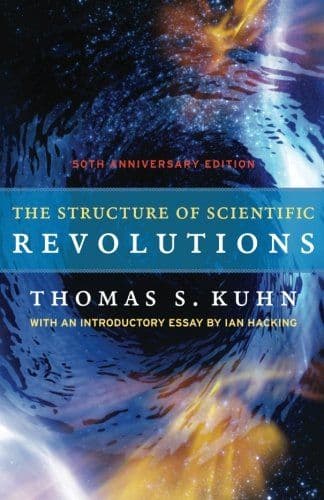
The Structure of Scientific Revolutions
Kuhn's central argument is that science does not progress by the steady accumulation of facts but through periodic revolutions in which one paradigm—a set of shared assumptions, problems, and methods—is replaced by another. The distinctive mechanism is the cycle of normal science, anomaly, crisis, and revolution: normal science solves puzzles within a paradigm, anomalies accumulate when the paradigm fails to account for them, crisis ensues, and a new paradigm is adopted. Because paradigms are incommensurable, the choice between them is not fully determined by logic or evidence, making scientific change a social and psychological process as much as a rational one.
Key Insights
✦What is a paradigm, and why is the concept central to Kuhn's argument?
A paradigm is a set of shared assumptions, problems, methods, and standards that define a scientific community's work. It includes both explicit theories and the tacit knowledge transmitted through examples and training. The concept is central because it explains how normal science operates: scientists do not constantly question fundamental assumptions but work within a paradigm, solving puzzles and extending its reach. Kuhn later distinguished between a broad 'disciplinary matrix' and narrower 'exemplars,' acknowledging that his original use of 'paradigm' was ambiguous. The concept transformed the history and philosophy of science by shifting attention from individual theories to the communal framework within which theories are formulated and evaluated.
✦What is the cycle of normal science, anomaly, crisis, and revolution, and how does it explain scientific change?
Normal science is puzzle-solving within a paradigm: scientists work on problems the paradigm defines as solvable, accumulating knowledge and refining methods. Anomalies are phenomena the paradigm cannot explain; when they accumulate, they generate a sense of crisis. A revolution occurs when a new paradigm is proposed that can resolve the anomalies and attract a significant following. Kuhn argues that this cycle is the actual pattern of scientific development, not the steady accumulation of facts. The cycle explains change without appeal to a single rational method: revolutions are not simply the triumph of better evidence but involve persuasion, conversion, and generational turnover. The model has been enormously influential, shaping not only the philosophy of science but also the social sciences and humanities.
✦What is incommensurability, and why does it make theory choice partly social?
Incommensurability is the idea that competing paradigms are not fully translatable into one another: they use terms differently, pose different problems, and have different standards of evidence. Because of this, the choice between paradigms is not fully determined by logic or evidence. Kuhn argues that scientists who adopt a new paradigm often do so for reasons that cannot be fully justified by the standards of the old paradigm—they experience a kind of conversion. This does not mean theory choice is irrational, but it does mean it involves social and psychological factors that a purely logical account of science cannot capture. The concept has been widely debated and criticised, but it remains central to Kuhn's challenge to the idea of a single rational method in science.
✦How was the book received, and what was the significance of the 1970 second edition?
The book was published in 1962 and became one of the most influential works of the twentieth century, shaping fields far beyond the philosophy of science. Its reception was divided: some saw it as a liberation from the rigidities of logical positivism, while others saw it as a threat to the rationality of science. The 1970 second edition added a postscript in which Kuhn responded to critics, clarifying his use of 'paradigm,' addressing the charge of relativism, and discussing the nature of scientific communities. The postscript is essential for understanding Kuhn's mature position, as it corrects some of the ambiguities of the first edition. The book has been translated into numerous languages and remains a standard text in courses on the philosophy and history of science.
✦What is the most common misunderstanding of Kuhn's argument?
The most common misunderstanding is that Kuhn is a relativist who believes that scientific change is irrational or that all paradigms are equally valid. In fact, Kuhn insists that science is a rational enterprise, but he denies that rationality is exhausted by formal logic and evidence. He argues that theory choice involves judgment, persuasion, and the standards of the scientific community, and that these are not arbitrary. A related misunderstanding is that incommensurability means paradigms cannot be compared at all. Kuhn argues that they can be compared, but not by a neutral algorithm; comparison requires translation, learning, and the willingness to see the world differently. The book is a defence of the rationality of science, not an attack on it.
✦How does Kuhn's account of science differ from Popper's and Lakatos's, and why did that matter for the debate in Criticism and the Growth of Knowledge?
Kuhn differs from Popper in rejecting falsificationism: scientists do not abandon theories as soon as they encounter anomalies; they defend the paradigm and try to solve the anomaly. Kuhn differs from Lakatos in rejecting the attempt to provide a rational reconstruction of scientific growth: Lakatos's methodology of research programmes is too rationalistic for Kuhn, who emphasises the social and psychological dimensions of paradigm change. The debate in Criticism and the Growth of Knowledge (1970) staged these differences directly: Kuhn responded to Popper's criticisms, and Lakatos responded to both. The volume is a record of the confrontation that shaped the philosophy of science for decades, and it remains essential reading for understanding the positions of all three thinkers.
Wealthy Psyche is an intellectual archive. We do not host, distribute, or sell book copies — physical or digital. We provide structured knowledge to help you think better, faster.