


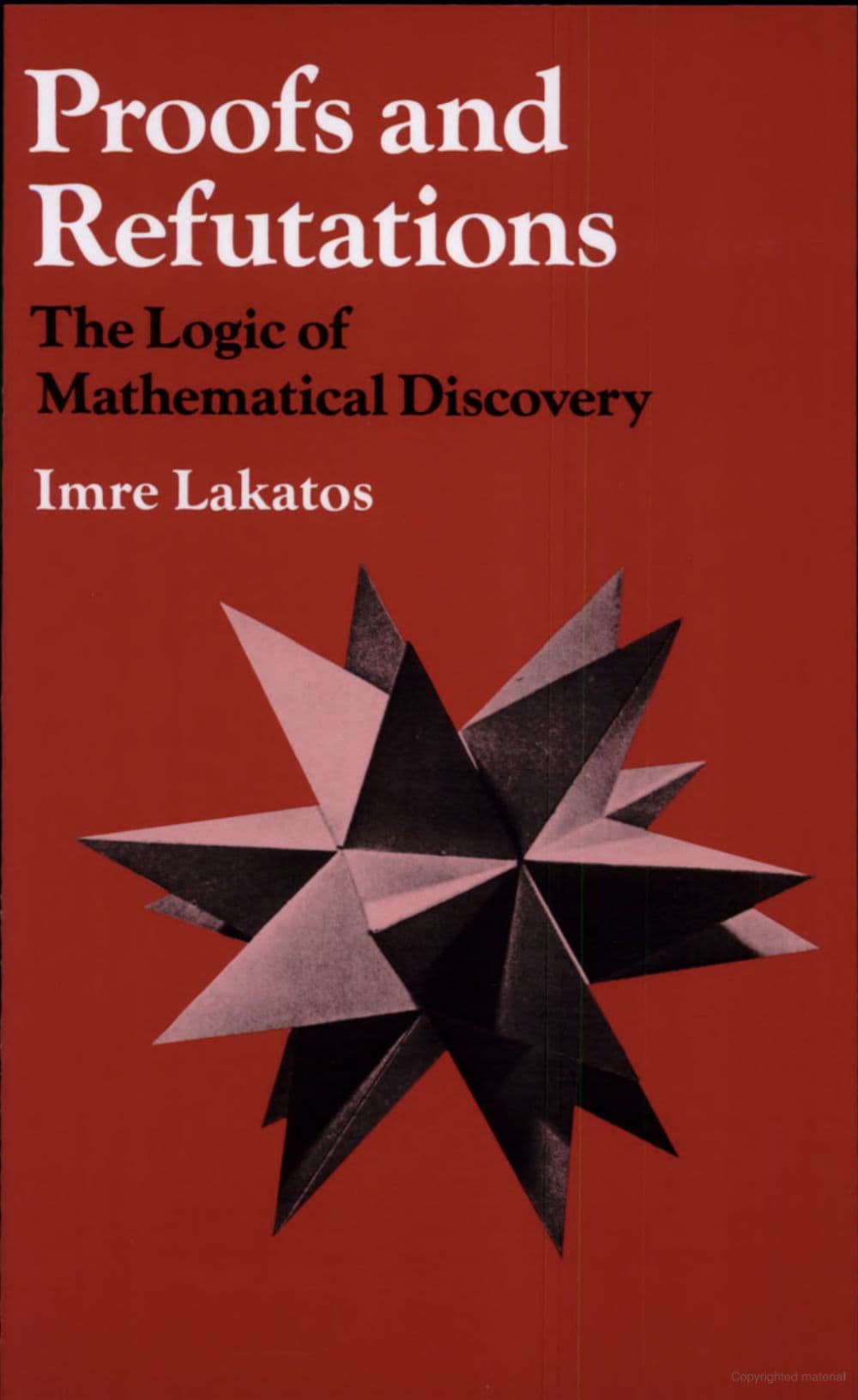
Proofs and Refutations: The Logic of Mathematical Discovery
Lakatos's central argument is that mathematics grows not by the accumulation of infallible proofs but through a dialectic of conjecture, proof, refutation, and concept-improvement. The book's distinctive mechanism is its dialogue form: a classroom of students argues over Euler's polyhedron formula, proposing counterexamples and revising definitions, thereby enacting the process by which mathematical knowledge actually develops. Its claim is that mathematical discovery is quasi-empirical—driven by criticism and the 'method of proofs and refutations'—and that formalism conceals this living process behind a frozen deductive skeleton.
Key Insights
✦What is the central argument of Proofs and Refutations, and why does Lakatos use a dialogue form?
The central argument is that mathematics develops through a dialectical process of conjecture, proof, refutation, and concept-improvement, not by the accumulation of infallible proofs. Lakatos uses a dialogue form because he wants to show this process as it actually happens—as a critical conversation among mathematicians. The dialogue centres on Euler's polyhedron formula (V − E + F = 2) and the successive counterexamples that force the students to revise their definitions of 'polyhedron.' The form is not a literary conceit; it enacts the method. As the editors note, Lakatos's aim is to present the history of a mathematical idea as a rational reconstruction of its growth, and the dialogue allows him to dramatise the 'method of proofs and refutations' that formalism conceals behind a frozen deductive skeleton.
✦What is the 'method of proofs and refutations,' and how does it work?
The method is a heuristic procedure for mathematical discovery. It begins with a primitive conjecture, followed by a proof (a rough thought-experiment or argument). The proof is then subjected to criticism: counterexamples are sought, and when found, the conjecture is modified, the proof is repaired, or the concepts involved are redefined. Lakatos describes the process as one of 'monster-barring,' 'exception-barring,' and 'lemma-incorporation'—strategies by which mathematicians defend or revise their proofs in the face of counterexamples. The method is quasi-empirical: it does not derive theorems from indubitable axioms but develops them through criticism and conjecture. The dialogue in Proofs and Refutations is a sustained illustration of this method, showing how mathematical knowledge grows through the interplay of proof and refutation.
✦How was the book assembled and published, and what does its editorial history reveal?
Proofs and Refutations was published posthumously in 1976, edited by John Worrall and Elie Zahar. Lakatos had been working on the material for years; parts of it had appeared as articles in the British Journal for the Philosophy of Science in 1963–64, and he was preparing a book-length version when he died in 1974. The editors assembled the book from these articles and unpublished manuscripts, adding appendices and a bibliography. The introduction by Worrall and Zahar situates the work in Lakatos's broader philosophy and explains its relationship to his methodology of scientific research programmes. The book is thus a reconstruction, but the editors note that Lakatos had left the material in a form that was substantially complete.
✦How does the book relate to Lakatos's philosophy of science, particularly the methodology of research programmes?
Proofs and Refutations is the mathematical counterpart to Lakatos's methodology of scientific research programmes. Where the latter describes how scientific theories are evaluated within progressive or degenerating research programmes, Proofs and Refutations shows how mathematical knowledge grows through a similar dialectic of conjecture, proof, and refutation. The book's introduction argues that the method of proofs and refutations is a special case of the more general methodology of research programmes, applied to mathematics. Lakatos rejects both formalism (the view that mathematics is a static body of formal truths) and what he calls 'Euclideanism' (the search for an infallible foundation). His alternative is a fallibilist, historical account of mathematical growth that treats mathematics as a human, critical activity. The book is thus a key text in the development of Lakatos's philosophy of science.
✦How has the book been received by mathematicians and philosophers, and what criticisms have been made?
Reception has been mixed but broadly positive. The book is widely regarded as a classic in the philosophy of mathematics, and it has been influential in shaping the fallibilist and historicist turn in the field. But it has also attracted criticism. Some philosophers have argued that Lakatos's dialogue is historically inaccurate and that his account of mathematical discovery is not representative of mathematical practice. Others have questioned whether the method of proofs and refutations can be generalised beyond the case of Euler's formula. Mathematicians have been divided: some have seen the book as a welcome corrective to formalism, while others have regarded it as a philosopher's misunderstanding of the subject. The book's influence, however, has been enduring, and it is now a standard reference in the philosophy of mathematics.
✦What is the most common misunderstanding of the book's argument?
The most common misunderstanding is that Lakatos is denying the rigour or objectivity of mathematics. In fact, he is arguing that mathematical rigour is historical and critical, not foundational and infallible. He does not claim that mathematics is arbitrary or that proofs do not matter; he claims that proofs are part of a dynamic process of conjecture and criticism, not a static body of certainties. A related misunderstanding is that the book is merely a historical study of Euler's formula. It is a philosophical essay on the logic of mathematical discovery, using the history of the formula as its illustrative material. Reading the book as a contribution to the history of mathematics, rather than as a work of philosophy, misses its central aim.
Wealthy Psyche is an intellectual archive. We do not host, distribute, or sell book copies — physical or digital. We provide structured knowledge to help you think better, faster.