


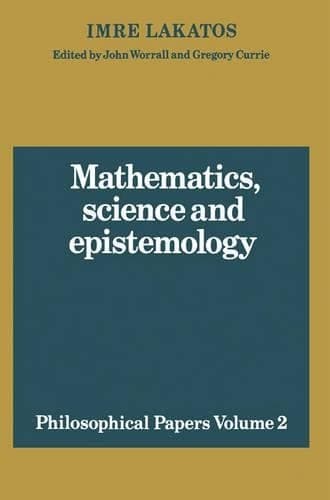
Mathematics, Science and Epistemology: Philosophical Papers, Volume 2
This posthumous collection argues that mathematics, like science, grows through a dialectic of proofs and refutations rather than the steady accumulation of infallible truths. The volume's distinctive contribution is to extend Lakatos's methodology of scientific research programmes into the philosophy of mathematics, showing that mathematical knowledge is quasi-empirical: conjectures are improved through counterexamples, concept-stretching, and critical dialogue. The critical papers apply this fallibilist lens to Popper, Toulmin, and inductive logic, while the education essays insist that science carries no inherent social responsibility—only scientists do.
Key Insights
✦What is the central thesis of Mathematics, Science and Epistemology, and how does it unify the volume's disparate essays?
The unifying thesis is fallibilism: there is no infallible foundation for knowledge, whether in mathematics or in science. Lakatos argues that mathematical knowledge grows through a dialectic of proofs and refutations, in which conjectures are proposed, counterexamples are found, concepts are stretched, and theorems are revised. This is the 'quasi-empirical' character of mathematics—not that it is based on sense experience, but that it develops through criticism and conjecture in a way analogous to empirical science. The critical papers apply this lens to Popper, Toulmin, and inductive logic, while the education essays extend it to the social responsibility of science. The volume's editors note that there is 'an essential unity of theme and purpose' running through the papers .
✦What is 'quasi-empiricism' in mathematics, and why did Lakatos adopt the term?
Quasi-empiricism is Lakatos's term for the view that mathematics is not a body of a priori, infallible truths but a developing body of knowledge subject to criticism, revision, and improvement. The term does not mean that mathematics is based on sensory experience; it means that mathematical knowledge grows in a way structurally similar to empirical science—through conjecture, counterexample, and the progressive refinement of concepts. One scholarly note reports that Lakatos encountered the concept of 'quasi-empiricism' in Russell's writings after his emigration to England . The concept is central to his challenge to the 'Euclidean programme' of mathematics, which sought an authoritative and irrefutable foundation. Lakatos's alternative is a fallibilist account that treats mathematics as a human, historical activity rather than a static system of certainties.
✦How does the volume's treatment of Popper differ from simple endorsement, and what does Lakatos revise?
Lakatos was a critic of Popper as well as an inheritor. He accepted Popper's fallibilism and the rejection of inductivism, but he argued that Popper's falsificationism was too crude: science does not proceed by the instant rejection of theories that fail a test. Instead, Lakatos developed the methodology of scientific research programmes, which allows for theories to be defended against anomalies within a progressive or degenerating research programme. The essay 'On Popperian Historiography' challenges Popper to dissociate himself from views expressed by Agassi, and 'Anomalies versus Crucial Experiments' is a rejoinder to Grünbaum's criticisms of Lakatos's devaluation of falsification . The volume thus shows Lakatos working out the implications of his revision of Popper, not simply restating a Popperian position.
✦What are the most significant previously unpublished papers in this collection, and what do they contribute?
The volume contains several important first publications. 'Cauchy and the Continuum' develops the significance of non-standard analysis for the history and philosophy of mathematics, building on Abraham Robinson's work. 'What Does a Mathematical Proof Prove?' discusses the relation between proof and formalization—a central question for Lakatos's fallibilism. 'The Method of Analysis-Synthesis' examines the heuristic rule propounded by Euclid and Pappus. 'The Problem of Appraising Scientific Theories: Three Approaches' compares dogmatic relativism, rationalist criteria, and elitism. 'The Social Responsibility of Science' argues controversially that science itself has no social responsibility—only scientists do . These essays show Lakatos extending his method into new domains and engaging with contemporary debates.
✦How was the volume edited and published, and what is its relationship to Lakatos's other posthumous collections?
The volume was edited by John Worrall and Gregory Currie and published by Cambridge University Press in 1978, four years after Lakatos's death. It is the second of two volumes of Philosophical Papers: Volume I is The Methodology of Scientific Research Programmes, and Volume II is Mathematics, Science and Epistemology . The editors assembled published and unpublished papers, cross-referencing them so that the collection serves as a coherent assessment of Lakatos's contribution. Proofs and Refutations (1976) was published separately as a book and is not included, though it is the foundational text for the philosophy of mathematics papers collected here. A 1980 paperback edition made the volume more widely accessible .
✦What is the most common misconception about Lakatos's philosophy of mathematics?
The most common misconception is that Lakatos denied the objectivity or rationality of mathematics. In fact, he insisted that mathematics is rational, but that its rationality is dialectical rather than foundational. He rejected the view that mathematics is a static body of infallible truths, but he did not conclude that mathematical knowledge is arbitrary or merely conventional. The method of proofs and refutations is a rational procedure: conjectures are criticised, counterexamples are examined, concepts are refined, and theorems are improved. Lakatos's target was the 'Euclidean' picture of mathematics as an authoritative, infallible system, not the idea that mathematics has standards of rigour and criticism. His fallibilism is a thesis about how mathematical knowledge grows, not a denial that it constitutes knowledge.
Wealthy Psyche is an intellectual archive. We do not host, distribute, or sell book copies — physical or digital. We provide structured knowledge to help you think better, faster.