


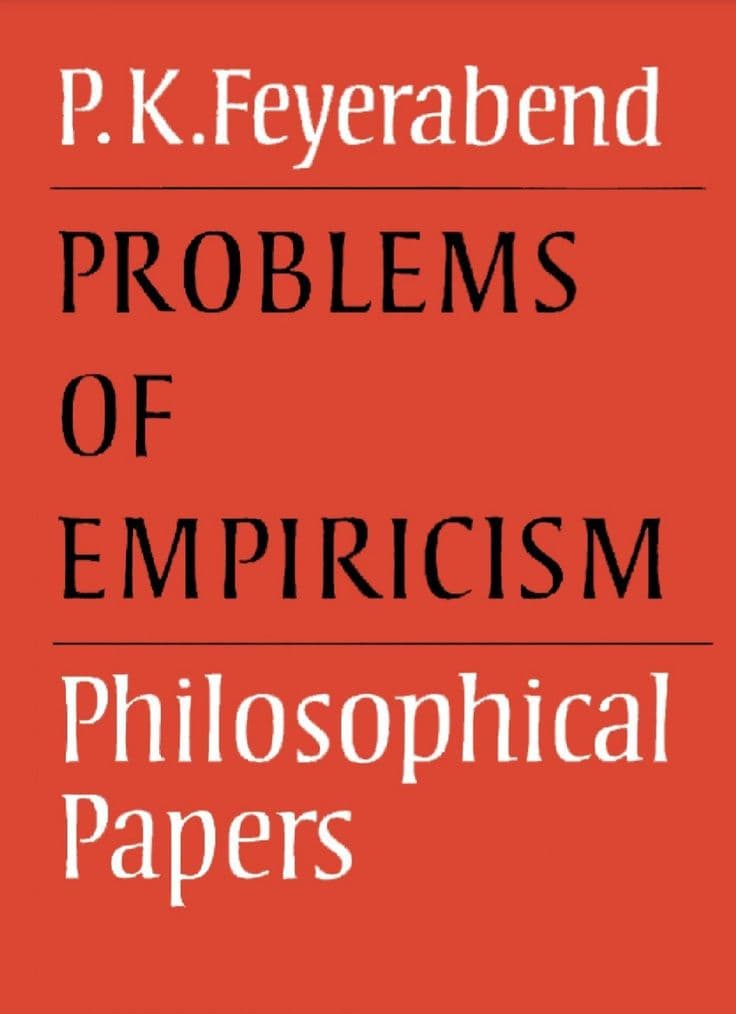
Problems of Empiricism: Philosophical Papers, Volume 2

This collection of Feyerabend's essays argues that classical empiricism and the abstract rationalism built upon it are historically and philosophically untenable, and that the philosophy of science must abandon its search for universal methodological rules. The volume's distinctive mechanism is a historical critique of 'abstract rationalism': by examining episodes such as Mach's influence on Einstein and the Popperian school's response, Feyerabend shows that scientific practice has always been more opportunistic and pluralistic than any methodology admits. The essays collectively argue for a comprehensive pluralism in which no single standard governs all inquiry.
Key Insights
✦What is the central argument of Problems of Empiricism, and how does it relate to Feyerabend's broader project?
The central argument is that classical empiricism, and the abstract rationalism that Feyerabend sees as its successor, are historically and philosophically untenable. The essays examine the origins and consequences of abstract rationalism for the philosophy of science, arguing that scientific practice has always been more opportunistic and pluralistic than any methodology admits . Cambridge University Press's description states that Feyerabend 'argues with great force and imagination for a comprehensive and opportunistic pluralism,' drawing on extensive knowledge of scientific history and practice . The volume is part of the groundwork for Against Method (1975), and it shows Feyerabend developing the historical and critical arguments that would culminate in his slogan 'anything goes.'
✦What essays are collected in this volume, and which are most significant?
The volume contains eleven essays, including 'Historical background: some observations on the decay of the philosophy of science,' 'Classical empiricism,' 'The structure of science,' 'Two models of epistemic change: Mill and Hegel,' 'Philosophy of science versus scientific practice: observations on Mach, his followers, and his opponents,' 'Mach, Einstein, and the Popperians,' 'Wittgenstein's Philosophical Investigations,' 'Consolations for the specialist,' 'Popper's Objective Knowledge,' 'The methodology of scientific research programmes,' and a review of Laudan's Progress and its Problems . The essay on Mach and Einstein is particularly significant for its historical demonstration of how scientific progress depended on methodological opportunism, while 'Consolations for the specialist' is a direct intervention in the Popper-Kuhn debate.
✦How does this volume relate to the Popper-Kuhn-Lakatos debates of the 1960s and 1970s?
The volume is a sustained intervention in those debates. 'Consolations for the specialist' attacks Popper from a Kuhnian perspective, while 'The methodology of scientific research programmes' critiques Lakatos's attempt to provide a rational reconstruction of scientific growth . Feyerabend had been a member of Popper's school, and his break from it is documented in the volume's essays. The Stanford Encyclopedia of Philosophy notes that 1967 marked Feyerabend's 'awakening' from his 'dogmatic slumber,' when he realized he no longer considered himself a Popperian and began to generalize from the limited validity of falsificationism to the view that all methodological rules have only limited validity . The volume thus records a key moment in the transition from Popperianism to epistemological anarchism.
✦What is the publication history of this volume, and how does it relate to Volume 1 of the Philosophical Papers?
Problems of Empiricism was published by Cambridge University Press in 1981 as Volume 2 of Feyerabend's Philosophical Papers . Volume 1, Realism, Rationalism and Scientific Method, presents papers on the interpretation of scientific theories and applications to problems in philosophy and physics. Volume 2, the present work, examines the origin and history of abstract rationalism and its consequences for the philosophy of science . The volumes were reprinted in paperback in 1985 and again in 1995 . The essays were originally published between the early 1960s and the late 1970s, and the volume includes new introductions providing an overview and historical perspective on each part .
✦How was the volume received, and what did reviewers identify as its significance?
Reception was strongly positive among those sympathetic to Feyerabend's challenge to orthodox philosophy of science. A review in Philosophical Investigations called the issues raised 'deep, to the heart of a number of central debates in contemporary philosophy concerning anti-realism, Wittgenstein, rationality and so on,' and declared that 'these exhilarating volumes must be essential reading' for anyone engaged with those issues . The Times Literary Supplement offered a more ambivalent assessment: 'The importance of Feyerabend is that he shows this easy way out cannot be taken for granted... After Feyerabend, simply gesturing in the direction of some supposed common intellectual commitment is no longer going to see how we can continue believing in the one true theoretical way' . The volume was recognised as a major contribution to the pluralist challenge in the philosophy of science.
✦What is the most common misunderstanding of Feyerabend's position in these essays?
The most common misunderstanding is that Feyerabend is advocating irrationalism or the abandonment of all standards. In fact, his argument is historical and critical: he shows that the standards proposed by philosophers of science have never governed actual scientific practice, and that scientific progress has often depended on violating them. The call for pluralism is not a rejection of rigour but a rejection of the claim that any single set of rules is universally valid. As the Cambridge description notes, Feyerabend draws on 'extensive knowledge of scientific history and practice' and is 'alert always to the wider philosophical, practical and political implications of conflicting views' . Reading the essays as a defence of mere chaos misses the detailed historical work that supports the argument.
Wealthy Psyche is an intellectual archive. We do not host, distribute, or sell book copies — physical or digital. We provide structured knowledge to help you think better, faster.