


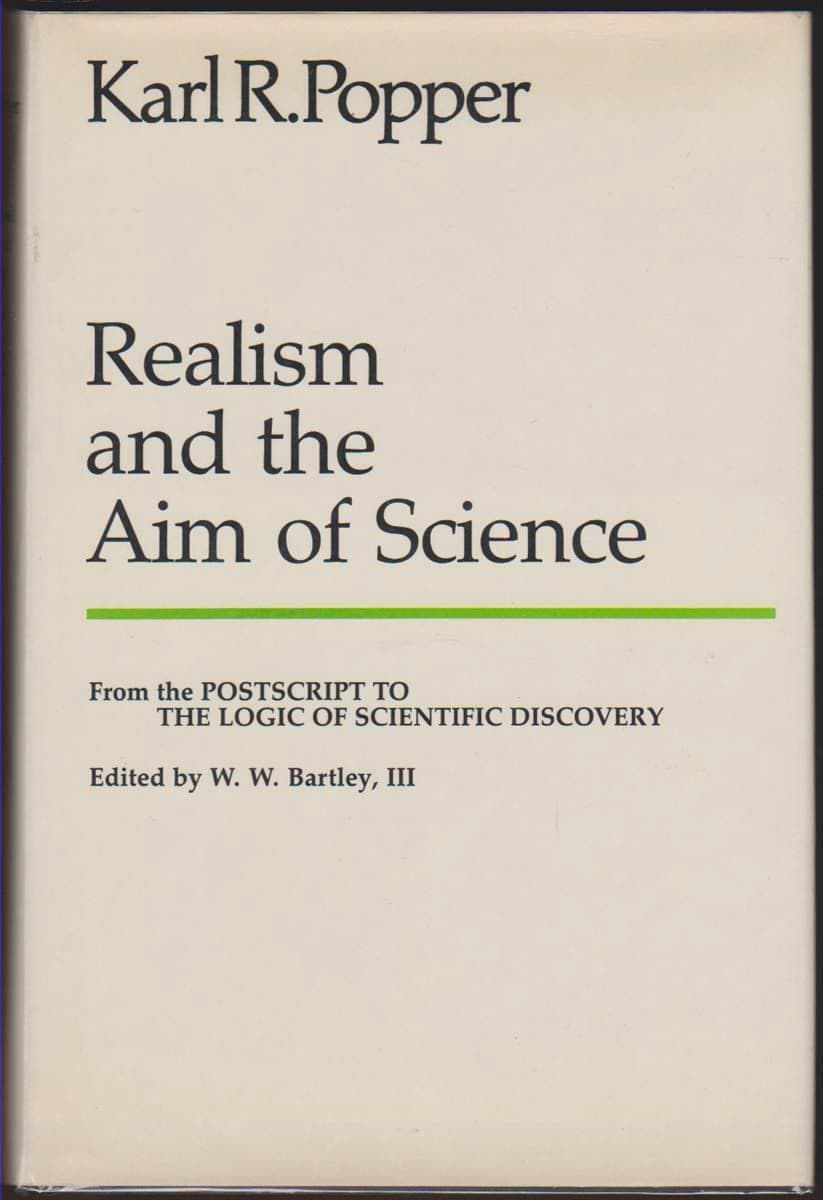
Realism and the Aim of Science
Realism and the Aim of Science argues that science aims at true theories about a mind-independent world, and that this aim is both intelligible and rational even though truth is not a criterion we can apply to our theories. The book's distinctive mechanism is the 'three worlds' ontology: physical objects, subjective experiences, and objective contents of thought (World 3), which includes scientific theories as autonomous objects. Popper defends metaphysical realism as a regulative ideal, arguing that the search for truth—approximated through verisimilitude—is what makes scientific inquiry rational.
Key Insights
✦What is the central argument of Realism and the Aim of Science, and what does it reject?
The central argument is that science aims at true theories about a mind-independent world, and that this aim is intelligible and rational even though we can never know for certain that we have attained the truth. Popper defends metaphysical realism—the view that there is a real world independent of our minds—as a regulative ideal that makes sense of scientific inquiry. He rejects instrumentalism, the view that theories are merely useful instruments for prediction, and positivism, which treats metaphysical questions as meaningless. The book argues that the search for truth, understood as an asymptotic approximation through verisimilitude, is what makes science a rational enterprise. Truth is not a criterion we can apply to our theories, but it is the aim that guides our critical testing.
✦What are the 'three worlds' in Popper's ontology, and why does World 3 matter for the philosophy of science?
Popper distinguishes three worlds: World 1 is the world of physical objects and states; World 2 is the world of subjective experiences and mental states; World 3 is the world of objective contents of thought—scientific theories, mathematical objects, works of art, and institutions. World 3 is autonomous: once theories are formulated, they have implications and problems that their creators did not foresee. They can be criticised and developed independently of any particular mind. This matters for the philosophy of science because it explains how scientific knowledge can be objective without being merely physical. Theories are not reducible to the mental states of scientists; they are public objects that can be tested, criticised, and improved. The World 3 ontology is Popper's answer to the question of how knowledge can be both human and objective.
✦What is verisimilitude, and how does it function in Popper's later philosophy?
Verisimilitude is the idea that a theory can be closer to the truth than its rivals, even though we cannot know for certain that any theory is true. Popper introduced the concept in the 1960s as a way of making sense of scientific progress: if science aims at truth, and if we can never know that we have attained it, how can we say that science progresses? His answer is that progress consists in increasing verisimilitude—a theory that makes more true predictions and fewer false ones than its predecessor is closer to the truth. The concept has been widely discussed and criticised: some philosophers argue that it is impossible to define a comparative measure of verisimilitude, while others have attempted to revise and defend it. In Realism and the Aim of Science, Popper develops the concept in response to his critics, particularly David Miller and Pavel Tichý.
✦How was the book assembled and published, and what is its relationship to Popper's other posthumous works?
Realism and the Aim of Science was published in 1983, edited by W.W. Bartley III. It is the first volume of Popper's Postscript to the Logic of Scientific Discovery, a projected three-volume work that Popper had been preparing for decades but never completed in his lifetime. The Postscript was originally intended as a sequel to the Logik der Forschung, but it grew into a separate work. The second volume is The Open Universe: An Argument for Indeterminism, and the third is Quantum Theory and the Schism in Physics. The volumes were edited from Popper's manuscripts and published posthumously, though Popper was involved in their preparation. Readers should be aware that the Postscript represents Popper's later views, not a continuation of the 1934 argument.
✦What is Popper's argument for metaphysical realism, and how does he distinguish it from a scientific hypothesis?
Popper argues that metaphysical realism cannot be proved or refuted; it is not a scientific hypothesis but a metaphysical position. But he insists that it is a reasonable position to adopt, because it is presupposed by scientific inquiry. If there were no mind-independent world, the search for true theories would be unintelligible. Popper's argument is not a proof of realism but a defence of its rationality: it is the only position that makes sense of the scientific enterprise. He distinguishes metaphysical realism from scientific hypotheses by its untestability, but he denies that untestability makes it meaningless. On the contrary, metaphysical ideas can be fruitful: they can inspire scientific theories and guide inquiry, even if they cannot be tested directly. Realism is thus a regulative ideal, not a scientific claim.
✦What are the most common criticisms of Popper's realism and verisimilitude?
The most common criticisms are that verisimilitude is unworkable as a measure of progress and that Popper's realism is an article of faith rather than a rationally defensible position. David Miller and Pavel Tichý showed that Popper's original definition of verisimilitude had counterintuitive consequences, leading Popper to revise it. Critics argue that without a workable measure of verisimilitude, the claim that science progresses toward truth is empty. Defenders respond that the concept is a regulative ideal, not an operational measure, and that it is useful for understanding the aims of science even if it cannot be applied algorithmically. The debate over verisimilitude remains one of the most technical and contested areas of Popper's philosophy, and the book is essential for understanding his mature position.
Wealthy Psyche is an intellectual archive. We do not host, distribute, or sell book copies — physical or digital. We provide structured knowledge to help you think better, faster.